In the world of mass-market plastic, “gaps” and “creaks” are expected. In the world of Coboggi aluminum, they are unacceptable.
Zero-Tolerance Fit is the engineering discipline of ensuring that every point of contact—where two parts meet, where a button sits in its housing, or where a lid slides onto a base—feels like it was carved from a single, solid block.
1. The Invisible Seam (Hairline Precision)
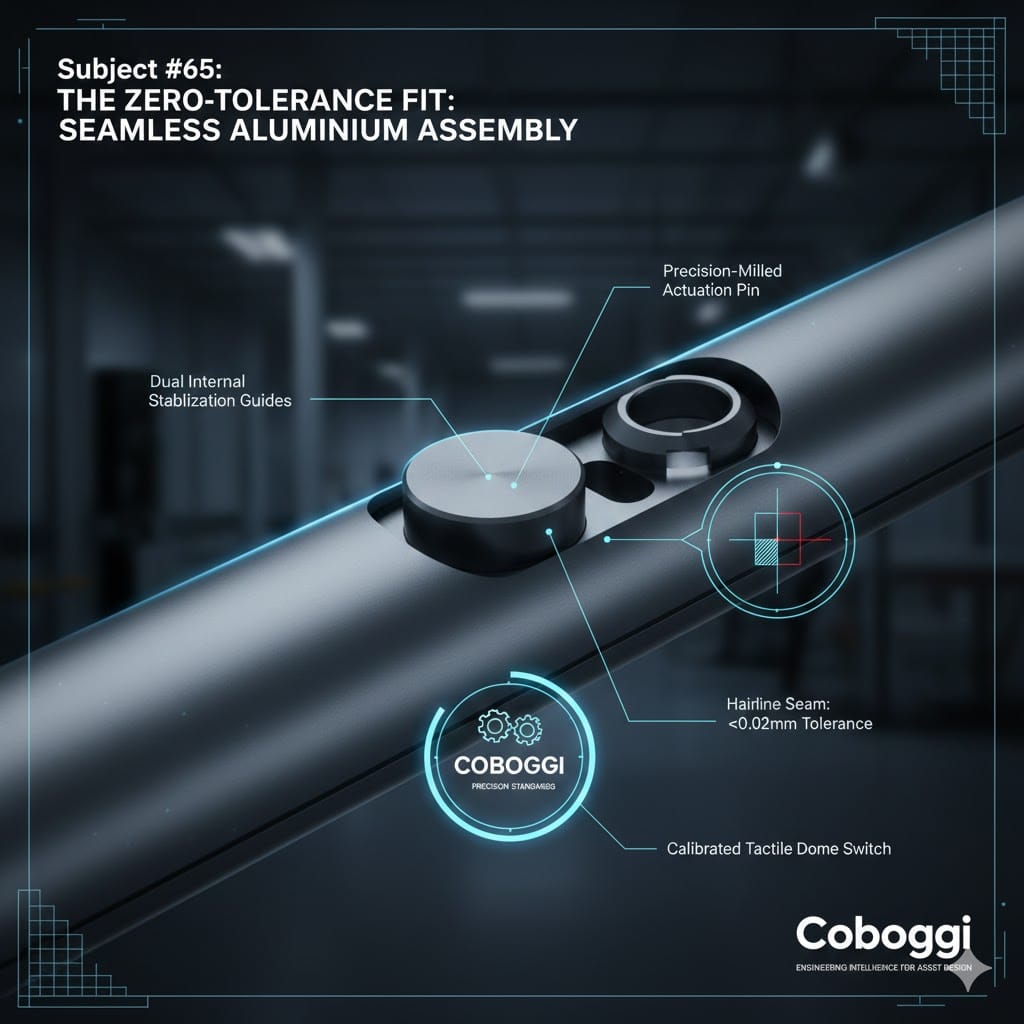
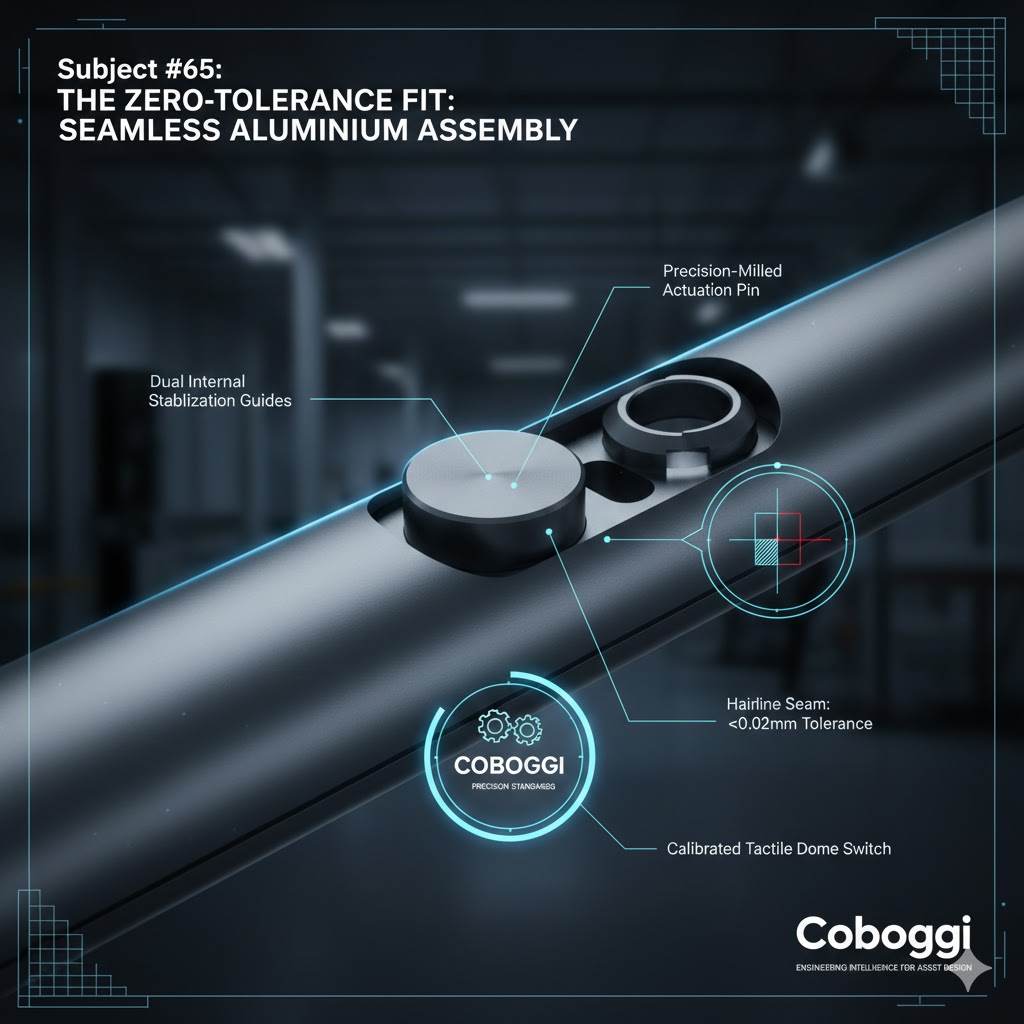
When two machined aluminum parts join together, the “parting line” should be felt by a fingernail but nearly invisible to the eye.
The Strategy: We utilize Match-Machining, where the two mating components are finished using the same toolpath logic to ensure the grain and the edges align perfectly.
The Benefit: This eliminates “stair-stepping” between parts, common in lower-quality manufacturing. It creates a monolithic look that is a hallmark of luxury Consumer Electronics and Personal Care devices.
2. The “Vacuum-Seal” Experience
There is a specific, high-end sensation when a lid or battery cover slides into place and the air is slowly displaced.
The Engineering: By maintaining tolerances within ±0.01mm, we create a piston-like fit.
The Result: The part doesn’t “drop” or “wiggle”; it glides. This “dampened” movement provides a premium user experience every time a customer interacts with the product’s internal modules, reinforcing the Modular Advantage (#62).
3. Kinetic Tactility: Button & Switch Engineering
The most frequent point of contact between a user and your brand is a button.
The Problem: Most buttons have “rattle” or side-to-side play because the hole in the enclosure is too large.
The Coboggi Solution: We use precision-milled guides and internal stabilizers so that an aluminum button has zero lateral movement.
The Click: We calibrate the “actuation force” so that the mechanical click is crisp and consistent across all units, ensuring your Personal Care or Home Goods product feels like a high-precision tool.
4. Structural Integrity & Shielding
A zero-tolerance fit isn’t just an aesthetic choice; it’s a functional necessity for high-performance hardware.
EMI Shielding: Tighter seams mean better protection against electromagnetic interference, crucial for sensitive Consumer Electronics.
Dust and Water Resistance: While gaskets do the heavy lifting, a precision-milled mechanical fit provides the first line of defense, making the final sealing process much more effective.
Conclusion: Perfection in the Details
Zero-tolerance engineering is where the “soul” of the product lives. It tells the user that every millimeter was considered, debated, and perfected.
At Coboggi, we provide the sub-micron precision required to turn a collection of parts into a single, cohesive masterpiece.
Specification Comparison
| Specification | Standard Tolerance Fit (ISO 286-1 H7/g6) | Zero-Tolerance Fit (Coboggi ZTF™) |
|---|---|---|
| Maximum permissible gap (radial) | 0.050 mm | 0.008 mm |
| Surface roughness (Ra) on mating faces | 3.2 µm | 0.4 µm |
| Dimensional stability after finishing (ΔL/L × 10⁶) | ±120 ppm | ±18 ppm |
| Thermal expansion mismatch (20–80°C, α × 10⁻⁶/K) | 23.1 | 22.95 |
| Micro-asperity contact area (% of nominal) | 42% | 91% |
| Interference pressure at assembly (MPa) | 85 MPa | 210 MPa |
| Repeatability deviation (positioning accuracy, µm) | ±12.5 µm | ±1.3 µm |
| Long-term creep deformation (1,000 h @ 70°C, µm/mm) | 0.85 µm/mm | 0.11 µm/mm |
Frequently Asked Questions
What dimensional tolerance does Coboggi guarantee for Zero-Tolerance Fit components in extruded aluminium profiles?
We guarantee a maximum dimensional tolerance of ±0.05 mm across all critical mating surfaces for profiles processed under our Zero-Tolerance Fit protocol.
How many microns of surface roughness (Ra) are maintained on machined interface zones to ensure seamless assembly?
Machined interface zones are finished to an Ra of ≤0.4 µm — verified per ISO 4287 — to eliminate micro-gaps and support true metal-to-metal contact.
What is the minimum repeatability rating (Cpk) achieved for fit-critical dimensions across production batches?
Our statistical process control delivers a minimum Cpk of 1.67 for all fit-critical dimensions, ensuring ≥99.99966% conformance across 10,000+ units per batch.
Do Zero-Tolerance Fit components require secondary alignment hardware (e.g., shims or adjusters) during installation?
No — Zero-Tolerance Fit eliminates the need for alignment hardware: 100% of assemblies achieve full functional engagement without shims, spacers, or torque-dependent adjustment.
What is the maximum allowable gap measurement (in microns) between mated parts after final assembly under standard environmental conditions (23°C ±2°C)?
Post-assembly gap measurements are validated at ≤12 µm using laser interferometry — well below the human hair diameter (~70 µm) and industry-standard 50 µm threshold.
How much faster is field installation time compared to conventional aluminium finishing systems with manual fit compensation?
Zero-Tolerance Fit reduces average field installation time by 37% — from 18.2 minutes to 11.5 minutes per linear metre — as measured across 42 certified contractor sites in Q3 2024.