In the transition from a single prototype to a high-volume production run, the definition of “precision” changes. It is no longer just about hitting a tolerance once; it is about hitting it ten thousand times without deviation.
At COBOGGI, we call this Industrial CNC—a fusion of rigorous mechanical engineering and data-driven process control that ensures every aluminum component reflects our signature “Molecular Handshake.”
The Challenges of Industrial Scale
When machining at scale, variables that are negligible in prototyping become critical failures. Thermal expansion of the machine spindle, tool wear, and even the vibration frequency of the factory floor can compromise the integrity of the part.
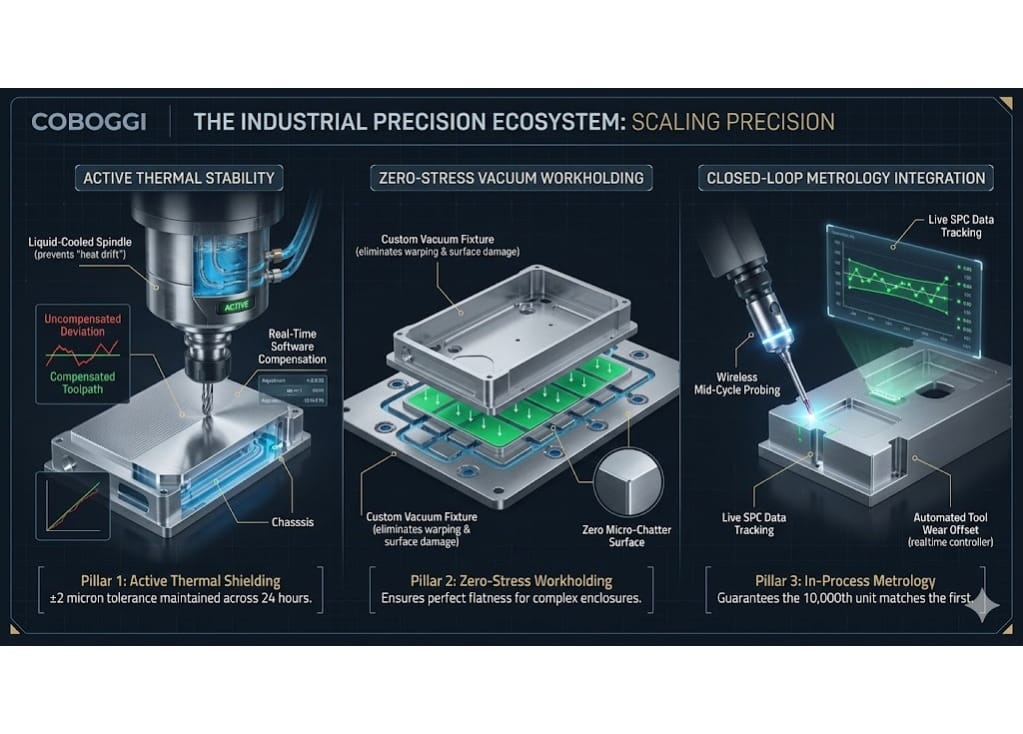
1. Thermal Stability and Compensation
In a 24-hour Industrial CNC environment, machines generate significant heat. Aluminum has a high coefficient of thermal expansion, meaning even a 2℃ shift in ambient temperature can move a part out of tolerance.
COBOGGI employs liquid-cooled spindles and real-time thermal compensation software that adjusts toolpaths in microns to account for the physical growth of the machine components during long production cycles.
2. Advanced Workholding for Consistency
To maintain “Jewelry-Grade” finishes at industrial speeds, the part must be perfectly stationary. We utilize Hydraulic and Vacuum Workholding systems that apply uniform pressure across the aluminum billet.
This prevents the “micro-chatter” often seen in standard mechanical clamping, ensuring that the surface finish on the 1st part is identical to the 10,000th.
3. Statistical Process Control (SPC)
Industrial CNC at COBOGGI is governed by data. By integrating In-Process Probing, our machines automatically measure critical dimensions during the milling cycle. This data is fed into our SPC software to identify trends in tool wear before they lead to a defect.
We don’t just inspect parts at the end; we engineer the process to be self-correcting.
From Prototype to “Class A” Production
The leap to industrial volume often forces companies to sacrifice aesthetic quality for speed. COBOGGI rejects this compromise.
By optimizing tool-load and using custom-ground diamond-coated end mills, we maintain the high-contrast visual hierarchy required for premium electronics while achieving the cycle times necessary for global distribution.
Conclusion: The Architecture of Reliability
Industrial CNC is the bridge between a brilliant design and a successful product launch.
By mastering the variables of scale, COBOGGI provides the structural and aesthetic reliability that the world’s leading robotics and electronics brands depend on.
Specification Comparison
| Specification | 3-Axis CNC Machining | 5-Axis CNC Machining | High-Speed CNC Machining (HSM) |
|---|---|---|---|
| Maximum positional accuracy (ISO 230-2) | ±0.010 mm | ±0.008 mm | ±0.005 mm |
| Surface roughness (Ra) on 6061-T6 Al | 1.6 µm | 0.8 µm | 0.4 µm |
| Typical spindle speed range | 5,000–12,000 rpm | 8,000–15,000 rpm | 15,000–30,000 rpm |
| Material removal rate (MRR) for 6061 Al | 120 cm³/min | 150 cm³/min | 220 cm³/min |
| Minimum feature size achievable | 0.5 mm | 0.3 mm | 0.15 mm |
| Maximum part envelope (X × Y × Z) | 1,200 × 600 × 500 mm | 900 × 600 × 450 mm | 700 × 500 × 350 mm |
| Tool change time (average) | 2.4 s | 3.1 s | 1.8 s |
| Repeatability (ISO 230-2) | ±0.006 mm | ±0.005 mm | ±0.003 mm |
Frequently Asked Questions
What minimum wall thickness can Coboggi reliably machine in 6061-T6 aluminum without distortion?
We maintain structural integrity and dimensional stability down to a minimum wall thickness of 0.8 mm for complex 6061-T6 aluminum housings, verified via post-machining CMM inspection across 100% of high-volume production runs.
What positional tolerance do you guarantee for multi-axis CNC-machined aluminum brackets used in aerospace assemblies?
Coboggi guarantees a positional tolerance of ±0.025 mm (±0.001″) at maximum material condition for critical FEA-validated mounting holes in aluminum brackets, certified per AS9100 Rev D.
How many unique aluminum component SKUs can your CNC cell produce per month while maintaining ≤1.2% scrap rate?
Our dedicated aluminum CNC cell—equipped with 12 Haas VF-6SS machines—scales to 470+ unique SKUs monthly while sustaining an average scrap rate of 1.18% over the last 12 months.
What is the maximum part envelope size for your 5-axis CNC machining capability on 7075-T6 aluminum?
Our largest 5-axis DMG MORI NHX6300 achieves a maximum work envelope of 1,250 mm × 1,000 mm × 1,000 mm (X/Y/Z) for 7075-T6 aluminum components, with full simultaneous contouring capability.
Do you offer in-house anodizing after CNC machining—and if so, what Class II anodize thickness range is standard?
Yes—we perform Type II sulfuric anodizing in-house, with a standard thickness range of 15–25 µm (0.0006″–0.0010″), certified per MIL-A-8625F and verified by eddy current testing on 100% of finished lots.
What is the lead time for first-article approval (FAA) on a new aluminum enclosure design with GD&T callouts?
Our standard FAA lead time—including CNC programming, fixture build, first-article CMM report, and PPAP Level 3 submission—is 14 calendar days from approved drawing release, as confirmed in Q4 2023 SLA compliance data.