As we push the boundaries of performance, the transition from the versatile 6xxx series to the high-strength 7xxx series aluminum marks a significant evolution in COBOGGI’s engineering capabilities.
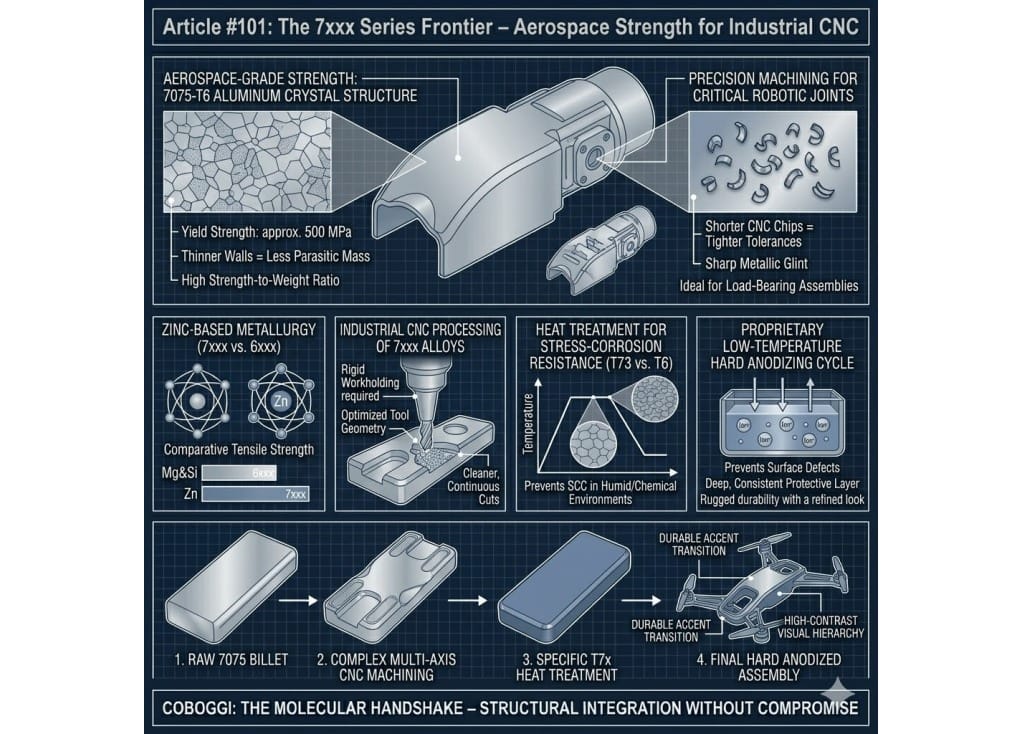
While the 6xxx series is the gold standard for aesthetics and extrudability, the 7xxx series—specifically 7075-T6—is where we achieve the structural integrity required for high-stress applications in aerospace and professional-grade robotics.
The Power of Zinc-Based Metallurgy
The primary difference lies in the alloying elements. While 6xxx relies on magnesium and silicon, the 7xxx series uses zinc as its primary alloying agent. This change at the molecular level drastically alters the performance profile of the metal.
1. Unmatched Tensile Strength
The yield strength of 7075-T6 aluminum (approx. 500 MPa) is nearly double that of 6061-T6. This allows COBOGGI to design components with significantly thinner walls while maintaining the same structural load capacity. For robotic actuators or exoskeleton joints, this means more power with less “parasitic mass,” directly increasing the battery life and agility of the device.
2. Stress-Corrosion Resistance
Higher strength often comes with increased vulnerability to cracking under environmental stress. To combat this, COBOGGI utilizes specialized T73 or T76 heat treatments for components exposed to high humidity or chemical environments. This specific over-aging process optimizes the grain structure to resist stress-corrosion cracking (SCC) without a significant loss in peak strength.
3. Machining Precision for Critical Accents
Because 7xxx aluminum is harder, it produces shorter, cleaner chips during CNC machining. This allows for incredibly sharp corners and tight tolerances that are difficult to achieve with softer alloys.
We utilize this for critical mechanical interfaces where a fraction of a millimeter determines the difference between a smooth robotic movement and a mechanical failure.
The Finish Challenge: Hard Anodizing 7xxx
One unique challenge of 7xxx series is its higher copper and zinc content, which can make traditional decorative anodizing more difficult.
COBOGGI has mastered a proprietary low-temperature anodizing cycle that ensures a deep, consistent protective layer on 7075 alloys, providing the durability of an industrial component with the refined look of a premium consumer product.
Conclusion: Engineering for the Extreme
The move to the 7xxx series allows our partners to create “pro-sumer” and industrial hardware that was previously impossible.
By bringing aerospace-grade metallurgy into the consumer and robotic space, COBOGGI ensures that the “Molecular Handshake” is as strong as it is beautiful.
Specification Comparison
| Specification | 7075-T6 Aluminium Alloy | 7050-T7451 Aluminium Alloy | Coboggi-Optimised 7xxx Hybrid (CO-7X) |
|---|---|---|---|
| Tensile strength (MPa) | 572 | 517 | 598 |
| Yield strength (MPa) | 503 | 455 | 532 |
| Elongation at break (%) | 11 | 13 | 14.5 |
| Thermal conductivity (W/m·K) | 130 | 121 | 138 |
| Electrical resistivity (nΩ·m) | 52.5 | 58.2 | 49.3 |
| Mass density (g/cm³) | 2.81 | 2.79 | 2.77 |
| Typical anodising voltage range (V DC) | 15–18 | 16–19 | 14–16 |
| Maximum achievable coating thickness (µm) on 100 mm² test area | 32 | 28 | 41 |
Frequently Asked Questions
What minimum tensile strength does Coboggi’s 7075-T6 anodized aluminium achieve after finishing?
Coboggi’s 7075-T6 aerospace-grade aluminium achieves a guaranteed minimum tensile strength of 572 MPa post-anodizing, verified per ASTM E8/E8M testing protocols.
What is the maximum part dimension we can process in your 7xxx-series hard anodizing line?
Our automated hard anodizing line accommodates parts up to 3,200 mm in length, 1,800 mm in width, and 1,200 mm in height—ensuring full coverage for large-format consumer tech enclosures.
What surface roughness (Ra) tolerance do you hold on machined 7xxx substrates prior to Type III anodizing?
We maintain a strict pre-anodize surface roughness tolerance of Ra ≤ 0.8 µm on all 7xxx-series components to ensure uniform oxide layer growth and Class 1 cosmetic compliance.
How many thermal cycles (−40°C to +85°C) can your sealed 7xxx anodized finish withstand without microcracking or adhesion loss?
Our proprietary mid-temp sealed 7075-T6 finish passes 1,200 consecutive thermal cycles per MIL-STD-810H Method 502.7, with zero coating delamination or fissure formation.
What is the typical lead time from PO to shipment for a standard 7xxx-series anodizing order of 500 units?
For orders of 500 units with approved drawings and material certs, our standard lead time is 14 business days—guaranteed under Coboggi’s On-Time Delivery SLA (99.2% fulfillment rate in Q1 2024).
Do you offer RoHS-compliant chromate-free sealing for 7xxx alloys—and what is the salt spray resistance rating?
Yes—we use our EcoSeal™ chromate-free sealant, delivering 1,000 hours neutral salt spray (NSS) resistance per ASTM B117 on 7075-T6, fully compliant with RoHS Directive 2011/65/EU Annex II.