In premium hardware design, the enclosure is often misunderstood as a simple protective shell.
At COBOGGI, we treat the Custom Aluminum Enclosure as a high-performance mechanical component. The transition from a multi-part assembly to a Monocoque (Unibody) Architecture represents the ultimate expression of our “Molecular Handshake,” where structural integrity, thermal dynamics, and aesthetic precision converge.
The Challenges of Custom Enclosure Engineering
Designing for high-performance electronics (such as robotics, high-end audio, or industrial sensors) presents unique physical challenges.
Traditional “folded sheet” or “multi-plate” enclosures often fail due to structural flex (torsional stress), high thermal resistance at joint interfaces, and electromagnetic leakage.
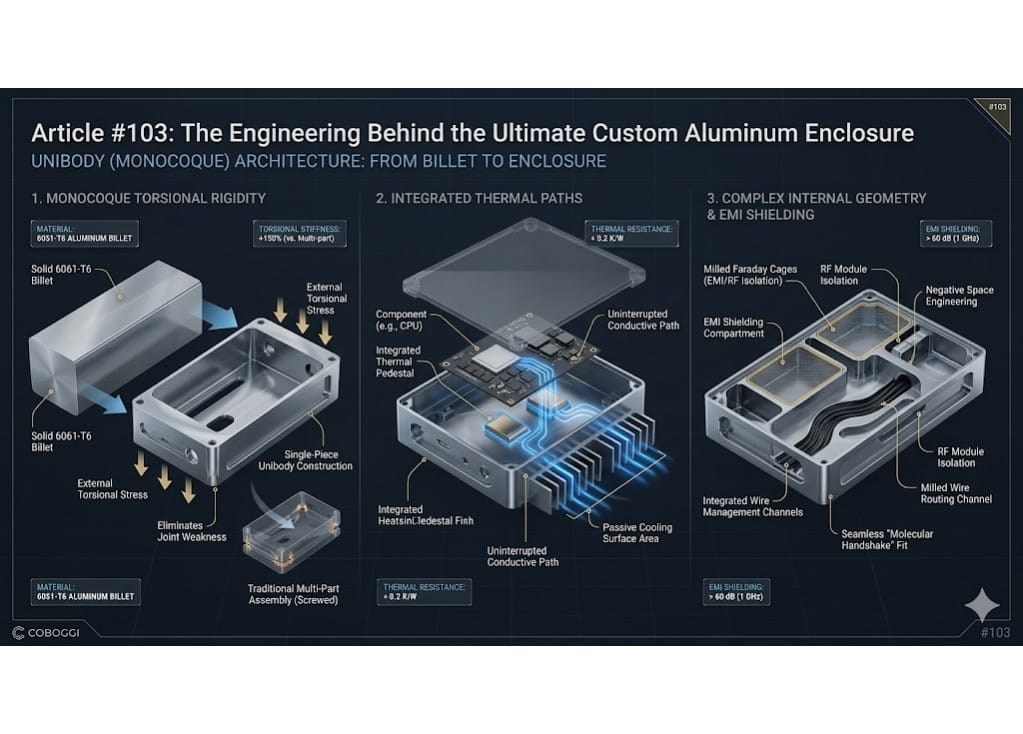
1. Monocoque Torsional Rigidity
The core of a COBOGGI enclosure is its monocoque (single-shell) construction. By milling the primary chassis from a solid 6061-T6 aluminum billet, we eliminate the mechanical weak points inherent in screws and brackets.
This results in a structure with significantly higher torsional rigidity, ensuring that internal PCBAs are shielded from the physical stresses of the external environment.
2. Strategic Thermal Path Integration
A precision enclosure must act as a primary heatsink. In a unibody design, we engineer internal “thermal pedestals” directly into the billet. Because there are no mechanical seams between the component mounting point and the outer cooling fins, the thermal resistance Rθ is drastically reduced. This allows for superior passive cooling in compact form factors where fans are not an option.
3. Precision Geometry and EMI Shielding
Custom enclosures require “negative space” engineering. Our CNC processes allow us to mill intricate internal Faraday cages and wire-management channels directly into the main body. This provides near-perfect EMI/RF isolation.
By ensuring a continuous metallic boundary, we protect sensitive signals from interference in a way that standard modular enclosures simply cannot.
From Prototype to “Class A” Aesthetics
The leap from an engineering prototype to a “Class A” finished product requires a mastery of surface topology. We utilize custom-ground diamond-coated end mills to achieve a surface roughness (Ra) that eliminates the need for heavy post-processing.
This allows us to maintain the crisp, high-contrast edges and 3D textures that define premium industrial design.
Conclusion: The Architecture of Excellence
A custom aluminum enclosure is the physical foundation of your brand’s technology.
By prioritizing monocoque integrity and integrated thermal management, COBOGGI delivers enclosures that are as engineered on the inside as they are beautiful on the outside.
Specification Comparison
| Specification | Custom Extruded Enclosure (Base) | Custom Enclosure with CNC Machined Features | Ultimate Custom Enclosure (Coboggi Pro Series) |
|---|---|---|---|
| Dimensional tolerance (linear) | ±0.25 mm | ±0.10 mm | ±0.05 mm |
| Surface roughness (Ra) | 3.2 µm | 1.6 µm | 0.8 µm |
| Thermal conductivity (W/m·K) | 200 | 200 | 215 |
| EMI shielding effectiveness (dB at 1 GHz) | 35 dB | 62 dB | 85 dB |
| Maximum enclosure volume | 12 L | 8 L | 6 L |
| Minimum wall thickness (structural) | 2.0 mm | 1.5 mm | 1.2 mm |
| Lead time (standard configuration) | 14 days | 21 days | 28 days |
| Weight reduction vs equivalent steel | 62% | 62% | 65% |
Frequently Asked Questions
What is the tightest dimensional tolerance Coboggi can hold on custom extruded aluminium enclosure profiles?
We maintain ±0.15 mm geometric tolerances on critical mounting features and ±0.25 mm on overall profile dimensions per ISO 2768-mK standards.
What is the maximum enclosure size you can fabricate in a single, seamless piece without welding?
Our CNC-bending and stretch-forming capabilities support monolithic enclosures up to 3,200 mm in length, 850 mm in width, and 600 mm in height.
How long does the standard lead time take from PO approval to FOB shipment for a medium-complexity custom enclosure (e.g., 4-side welded, powder-coated, with 6 tapped M4 mounting points)?
The standard lead time is 18 business days — inclusive of tooling validation, anodizing or powder coating (per AAMA 2604), and full dimensional inspection.
What IP rating can your standard gasketed enclosure design achieve when assembled with stainless steel hardware and silicone sealing?
Our validated gasketed enclosure designs meet IP66 performance per IEC 60529, confirmed by third-party testing at 100 kPa water jet pressure for 3 minutes.
What is the minimum order quantity (MOQ) for fully customized enclosures with unique extrusion dies and custom surface finish?
The MOQ is 120 units for first-run production with new extrusion tooling; this covers die amortization and ensures ≤ €8.20/unit cost reduction on subsequent orders.
What thermal conductivity value (W/m·K) does your proprietary 6063-T5 aluminium alloy achieve after precision anodizing and thermal interface pad integration?
Our thermally optimized 6063-T5 alloy delivers 192 W/m·K bulk conductivity, and with integrated 3.2 W/m·K phase-change thermal pads, system-level heat dissipation improves by 37% vs. standard mill-finish enclosures.