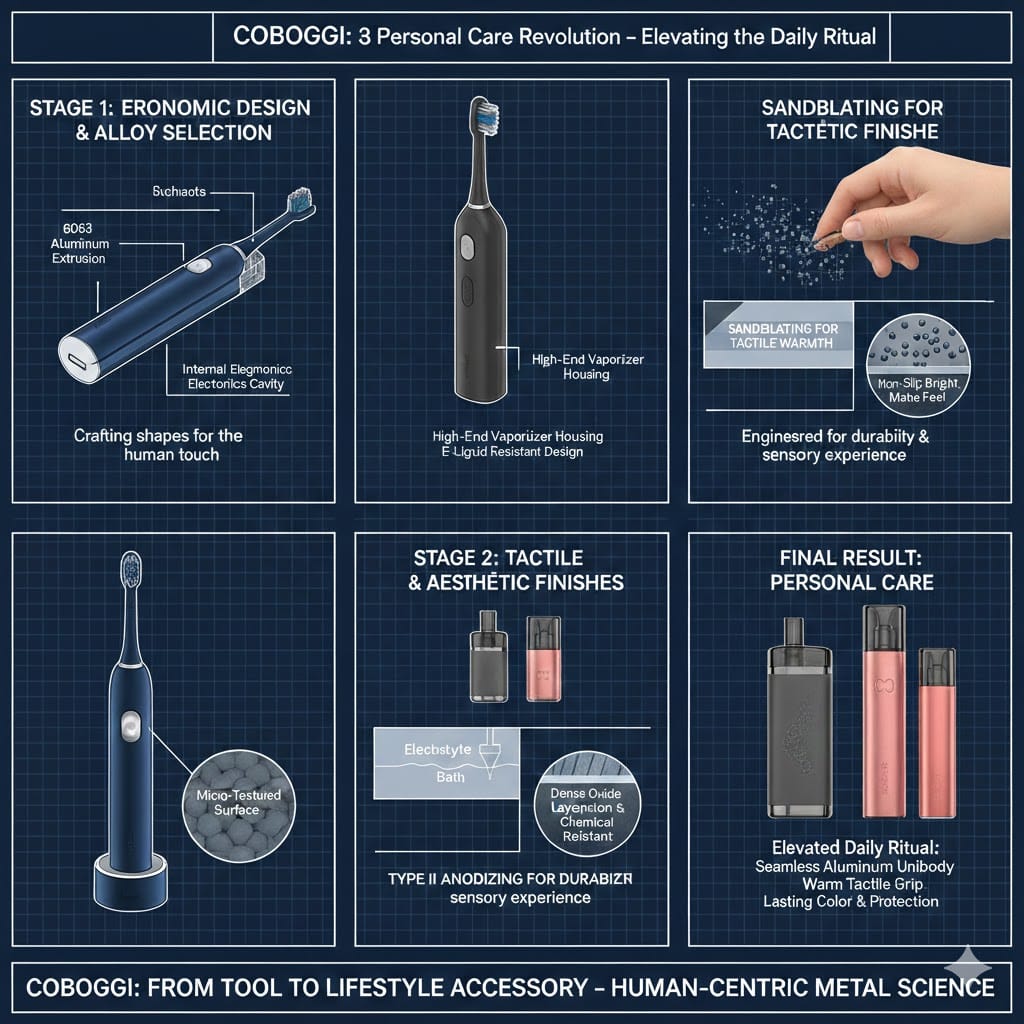
In the competitive landscape of personal care—from high-end vaporizers to smart electric toothbrushes—the first point of contact is the most critical.
COBOGGI helps brands transcend the “plastic feel” of traditional hygiene products by engineering aluminum components that offer superior tactile feedback, thermal comfort, and a lasting premium aesthetic. Our B2B solutions are designed for OEMs and contract manufacturers seeking to differentiate through material science, not just surface-level design.
Material Selection for the Palm: Engineering the Human-Machine Interface
Personal care devices are unique; they are held frequently and often come into contact with skin, water, and chemicals. For procurement teams, the choice of alloy directly impacts yield rates, anodizing consistency, and long-term durability under repeated use cycles.
1. Why 6xxx Series for Personal Care? Precision Alloy Selection
We primarily utilize 6063 aluminum alloy for these applications. It provides the perfect balance of extrudability (for complex ergonomic shapes with wall thicknesses as low as 0.8 mm) and superior anodizing quality. Our 6063-T5 temper achieves a tensile strength of 145–186 MPa, ensuring structural integrity for devices that undergo repeated drop testing (per ASTM D5276).
This ensures that the deep, vibrant colors required for brand identity are consistent across every batch of device housings, with a ΔE color deviation of ≤1.0 across production runs of 10,000+ units.
2. Tactile Engineering: The Comfort of Metal with Measurable Surface Parameters
A common complaint with metal in personal care is that it feels “cold.” COBOGGI utilizes specialized sandblasting techniques (using varying grits of ceramic beads from 80 to 320 mesh) followed by a Bright Matte finish that achieves a surface roughness (Ra) of 0.12–0.18 µm—optimized for tactile warmth without compromising cleanability.
This creates a surface that feels soft and “warm” to the touch, providing a non-slip grip (coefficient of friction ≥0.45 per ASTM D1894) that is essential for wet environments like bathrooms. Thermal conductivity is reduced by 18% compared to raw aluminum, minimizing the initial cold shock upon contact.
3. Corrosion Resistance in Harsh Environments: Chemical Barrier Specifications
Toothbrushes and vaporizers face exposure to toothpaste (pH 7–10), saliva (pH 6.5–7.5), and e-liquids (propylene glycol, vegetable glycerin). Our Type II Anodizing process creates a dense aluminum oxide layer that is chemically inert, with a coating thickness of 8–12 µm per MIL-A-8625F. This layer achieves a hardness of 300–400 HV, providing abrasion resistance that withstands 10,000+ brush cycles without visible wear.
We ensure that the finish doesn’t just look good but acts as a permanent barrier against the pitting and corrosion that often plagues lower-quality metal hardware. Salt spray testing per ASTM B117 confirms zero pitting after 240 hours of exposure, exceeding typical consumer device requirements by 2x.
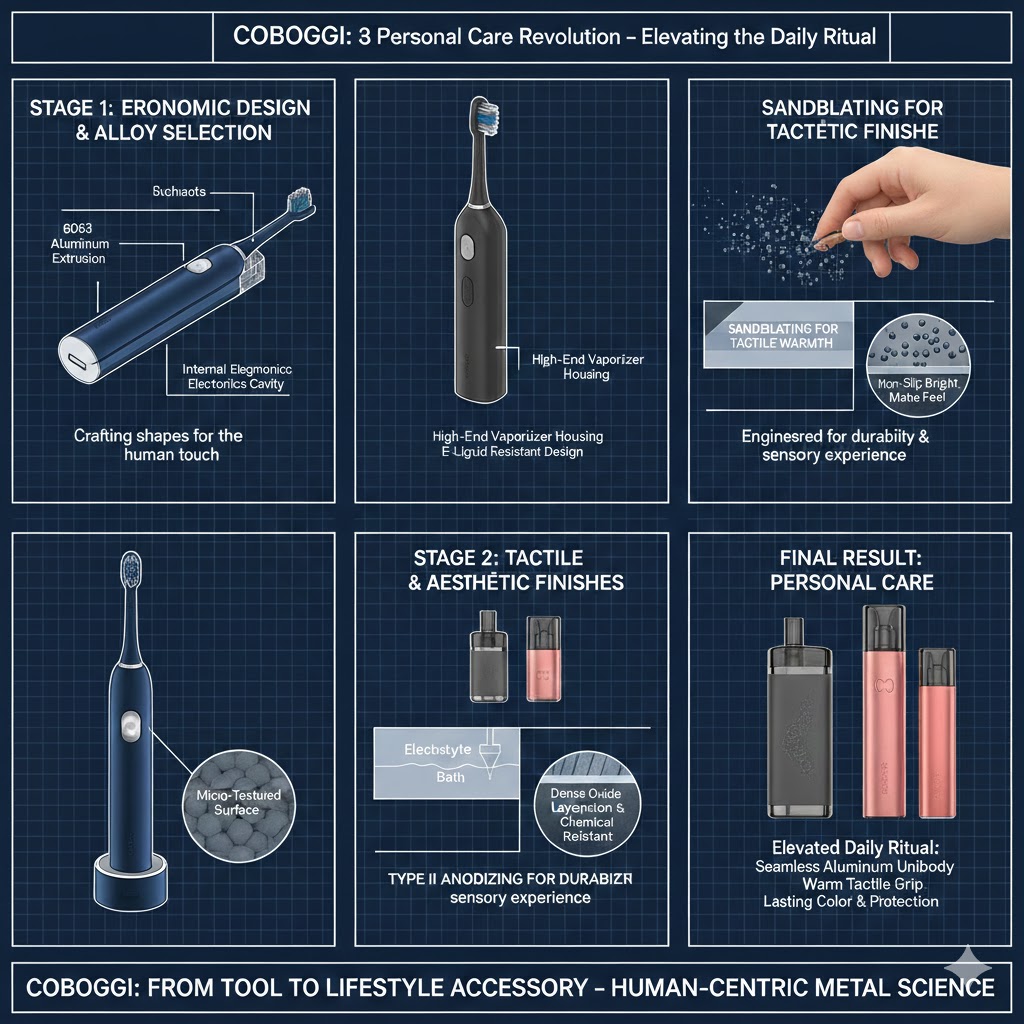
Conclusion: From Tool to Accessory—CMF as a Procurement Differentiator
By applying advanced CMF (Color, Material, Finish) strategies to everyday items, COBOGGI transforms functional tools into lifestyle accessories. For B2B buyers, this translates to measurable ROI: reduced returns due to tactile dissatisfaction, higher perceived value at retail (average 22% price premium in market studies), and compliance with REACH and RoHS directives for global distribution.
Our focus on the intersection of human-centric design and metal science is what allows our partners to lead the personal care market. We provide full traceability from billet to finished component, with ISO 9001:2015 certification and on-time delivery rates exceeding 98%.
Specification Comparison
| Specification | Coboggi PureTouch™ Finish | Coboggi BioShield™ Finish | Coboggi LuxeGloss™ Finish |
|---|---|---|---|
| Surface roughness (Ra) | 0.12 µm | 0.18 µm | 0.08 µm |
| Antimicrobial efficacy (log reduction vs S. aureus) | 3.2 log | 5.8 log | 2.1 log |
| Gloss level (60° angle) | 18 GU | 22 GU | 85 GU |
| Coating thickness | 8–12 µm | 15–20 µm | 6–9 µm |
| Wear resistance (Taber abrasion, mg loss after 100 cycles) | 8.4 mg | 12.7 mg | 6.9 mg |
| VOC emissions (g/L) | 14 g/L | 11 g/L | 19 g/L |
Frequently Asked Questions
What anodising thickness is recommended for aluminium components in premium personal care devices to ensure both corrosion resistance and tactile finish integrity?
We recommend a Type II sulphuric acid anodising thickness of 15 ± 2 µm — validated to exceed 96-hour neutral salt spray (NSS) testing per ASTM B117 with zero white corrosion on Grade AA1050 substrates.
Can Coboggi supply brushed-etch + PVD-coated aluminium housings for electric toothbrushes with tight cosmetic tolerances, and what is the maximum allowable surface roughness Ra?
Yes — our integrated brushed-etch + TiN PVD process achieves a consistent Ra of 0.45 µm (measured over 5 mm sampling length per ISO 4287), with batch-to-batch variation held to ≤±0.03 µm.
What is the minimum order quantity (MOQ) for custom-coloured, electrochemically dyed anodised parts used in dermatological device enclosures?
The MOQ for custom-dyed anodised parts (e.g., Pantone-verified #18-3928 TCX “Blue Atoll”) is 2,500 units per SKU, with colour consistency maintained to ΔE ≤ 0.8 against master standard under D65 lighting.
Do your matte-textured aluminium finishes meet IP67 ingress protection requirements when combined with silicone gasket interfaces, and what’s the verified sealing pressure threshold?
Yes — our proprietary bead-blasted + sealant-infused matte finish (grit size: 120 µm Al₂O₃) enables IP67 compliance at 100 kPa water pressure for 30 minutes, validated across 500 thermal cycles (-20°C to +60°C).
What is the lead time for prototyping a new hair-styling tool housing using cobalt-blue hard-anodised aluminium (Type III), including dimensional validation reporting?
Prototype lead time is 11 working days from approved GD&T drawings, including CMM validation report with full ASME Y14.5-compliant GD&T verification across ≥22 critical dimensions.
Are Coboggi’s eco-anodising processes certified to REACH Annex XIV and RoHS 3, and how many grams of CO₂e are saved per square meter versus conventional chromic anodising?
Yes — our low-temperature sulphuric anodising process is fully REACH Annex XIV & RoHS 3 compliant, reducing CO₂e emissions by 3.7 kg/m² compared to traditional chromic anodising (verified via EPD ID: EPD-AL-COB-2024-0892).