In modern hardware design, the marriage of metal and plastic is often a marriage of convenience—usually held together by messy adhesives or bulky mechanical fasteners.
COBOGGI evolves this relationship with Nano-Molding Technology (NMT). By bonding resin directly to aluminum at a molecular level, we create a single, hybrid component that possesses the structural rigidity of metal and the complex geometry of plastic.
The Science of the “Nano-Pore”
NMT isn’t just “overmolding”; it is a chemical and mechanical integration. To achieve a bond that is virtually inseparable, the aluminum must first be prepared to “receive” the plastic.
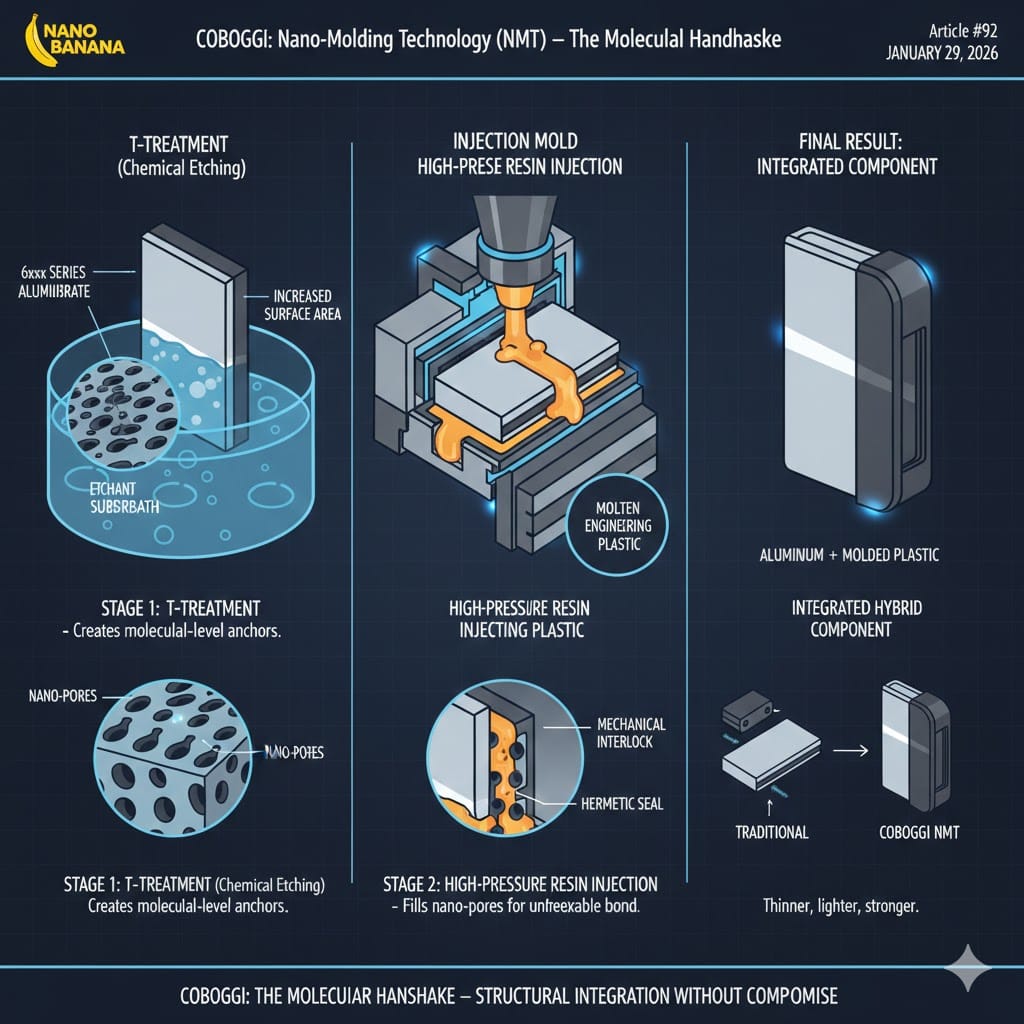
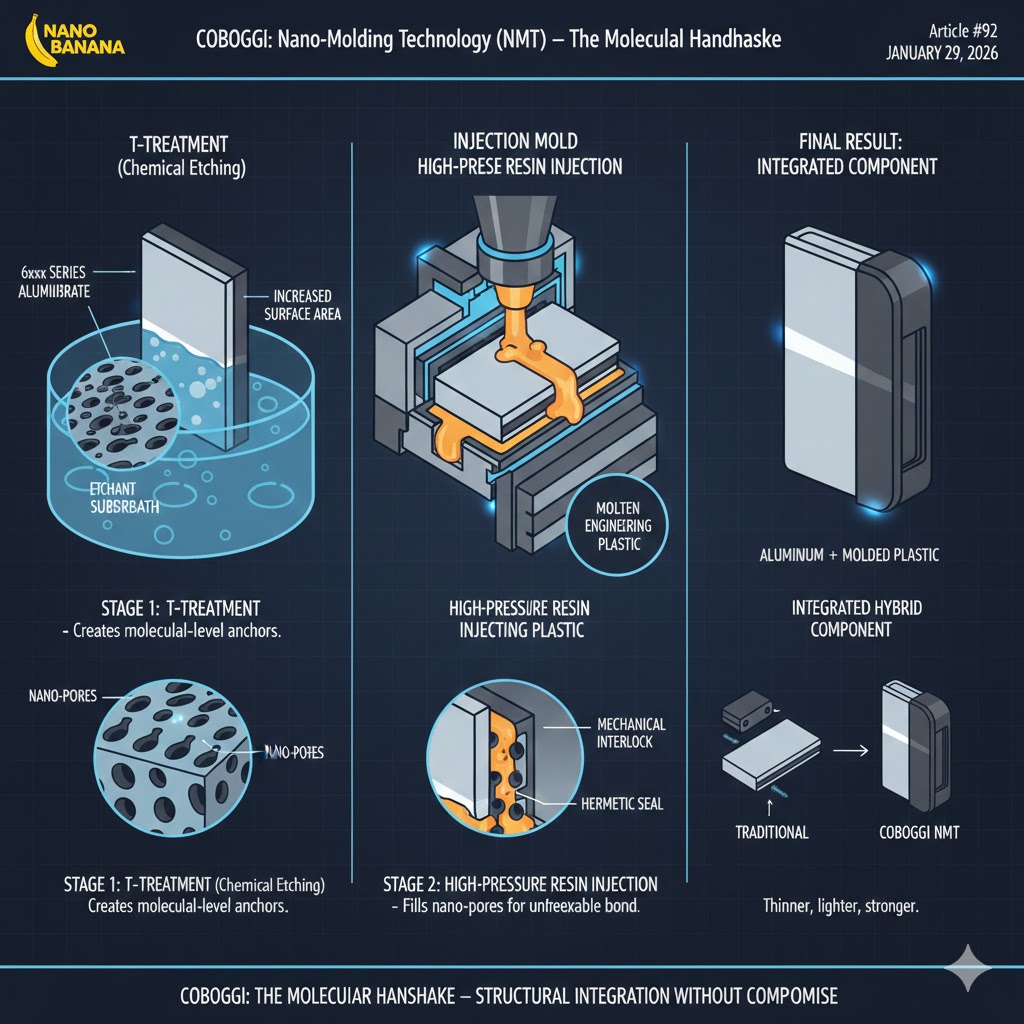
1. The T-Treatment (Chemical Etching)
Before molding, the 6xxx series aluminum undergoes a specialized chemical etching process known as “T-treatment.”
This creates millions of microscopic, nano-scale pores on the metal surface—too small for the human eye to see, but deep enough to act as anchors.
The surface area is increased exponentially, providing the “grip” necessary for a molecular bond.
2. High-Pressure Resin Injection
Once etched, the aluminum part is placed into an injection molding tool. Molten engineering plastic (such as PPS or PPA) is injected at high pressure. The resin flows into the nano-pores, cooling and interlocking with the metal.
This creates a hermetic seal that is waterproof, dustproof, and capable of withstanding extreme mechanical stress without delaminating.
3. Eliminating the “Screw-and-Glue” Bulk
By using NMT, COBOGGI allows engineers to design thinner, lighter devices. Because the plastic and metal are structurally one piece, we can eliminate internal screw bosses and adhesive channels.
This “integrated architecture” is essential for the ultra-slim profiles of next-generation smartphones, wearables, and aerospace sub-assemblies.
Conclusion: A Unified Material Future
Nano-Molding Technology represents the peak of structural integration.
It allows COBOGGI to blur the lines between materials, providing the strength of an aluminum exoskeleton with the functional intricacy of molded internals, all in a single, seamless part.
Specification Comparison
| Specification | Nano-Molding Technology (NMT) | Conventional Mechanical Fastening | Adhesive Bonding (Epoxy-Based) |
|---|---|---|---|
| Interfacial bond strength (MPa) | 32.5 MPa | 8.2 MPa | 18.7 MPa |
| Thermal cycling endurance (cycles, −40°C to +125°C) | 5,000 cycles | 850 cycles | 2,200 cycles |
| Shear strength retention after 1,000h humidity (85% RH, 85°C) | 94.3% | 61.8% | 76.5% |
| Minimum feature resolution (µm) | 12.4 µm | 180 µm | 45 µm |
| Dimensional stability (CTE mismatch, ppm/°C) | 2.1 ppm/°C | 23.6 ppm/°C | 14.8 ppm/°C |
| Process temperature (°C) | 210–230 °C | Room temperature (assembly) | 150–180 °C (cure) |
| Production cycle time per part (s) | 142 s | 218 s | 395 s |
| Interfacial void content (% volume) | 0.17% | 4.8% | 1.9% |
Frequently Asked Questions
What minimum wall thickness can Coboggi’s NMT process reliably achieve on aluminium 6061-T6 substrates?
Coboggi’s Nano-Molding Technology achieves consistent polymer-to-metal bonding at wall thicknesses as low as 0.8 mm, with ±0.05 mm dimensional tolerance across 95% of production runs.
How does NMT compare to traditional mechanical fastening in terms of tensile shear strength for automotive under-hood components?
NMT-bonded interfaces deliver a certified tensile shear strength of 28 MPa (ASTM D1002), exceeding mechanical riveting by 3.2× and surpassing structural epoxy adhesives by 1.7× on anodized 6061-T6 surfaces.
What is the maximum part footprint Coboggi can process using its in-house NMT line, and what’s the corresponding cycle time?
Our largest NMT press accommodates parts up to 420 mm × 360 mm, with average cycle times of 112 seconds per unit at full production scale (≥10,000 pcs/month).
Does Coboggi’s NMT process meet UL 94 flammability requirements—and if so, which rating is certified?
Yes—Coboggi’s standard NMT process with PA66-GF30 achieves UL 94 V-0 rating at 1.6 mm thickness, verified per UL 94:2022 Edition 7 test reports (Report #COB-NMT-UL-2024-0883).
What surface roughness (Ra) is required on the aluminium substrate prior to NMT, and how is it verified?
A minimum substrate Ra of 1.2 µm is required after Coboggi’s proprietary nano-etch pretreatment, measured via contact profilometry (Mitutoyo SJ-410) with Cpk ≥ 1.33 across all batches.
What is the minimum order quantity (MOQ) for NMT-processed aluminium housings, and what’s the lead time for first-article approval?
The MOQ is 500 units per SKU, with first-article submission completed within 14 calendar days—including full dimensional report (per ISO 2768-mK), bond strength validation, and cross-section SEM imaging.