As processors grow more powerful and compact, traditional heat sinks are reaching their physical limits. The future of thermal management lies in liquid cooling, but traditional plumbing is too bulky for sleek hardware.
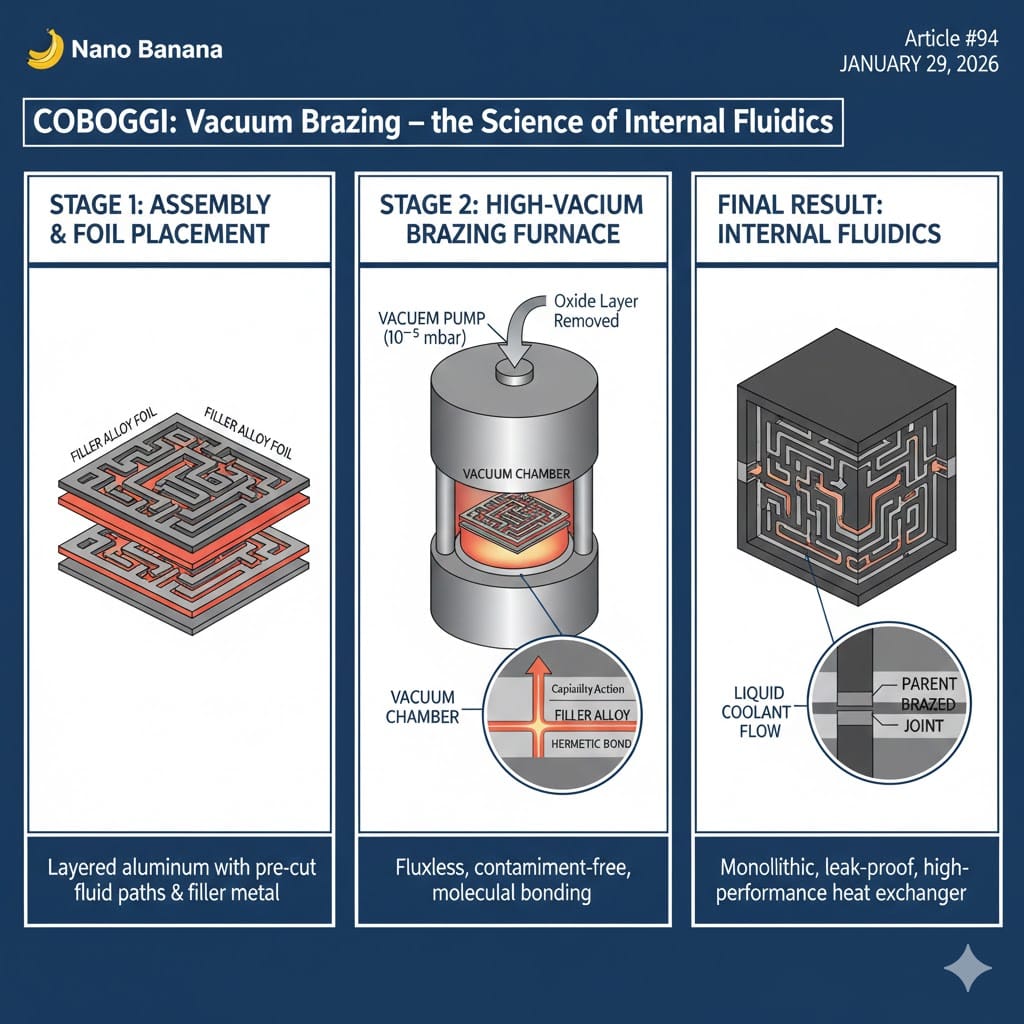
COBOGGI solves this through Vacuum Brazing, a high-end joining process that allows us to “sandwich” complex internal fluid channels directly into an aluminum chassis.
The Anatomy of a Hermetic Bond
Vacuum brazing is a thermal joining process that takes place in a controlled atmosphere. It allows COBOGGI to join multiple layers of 6xxx or 3xxx series aluminum into a single, monolithic block with intricate internal labyrinths.
1. The Filler Foil and Capillary Action
Instead of melting the base aluminum, we place a thin layer of a specialized aluminum-silicon filler alloy (with a lower melting point) between the components.
As the temperature rises in the furnace, the filler melts and is drawn into the microscopic gaps between the parts by capillary action. This creates a bond that is as strong as the parent metal itself.
2. The Power of the Vacuum
Oxidation is the enemy of aluminum welding. By performing the brazing in a high-vacuum chamber (pressures as low as 10{-5}mbar), COBOGGI eliminates the need for corrosive flux.
The vacuum environment strips away the natural oxide layer of the aluminum, allowing the filler metal to “wet” the surfaces perfectly. This results in joints that are vacuum-tight and 100% leak-proof—essential for liquid-cooled electronics.
3. Complexity Without Compromise
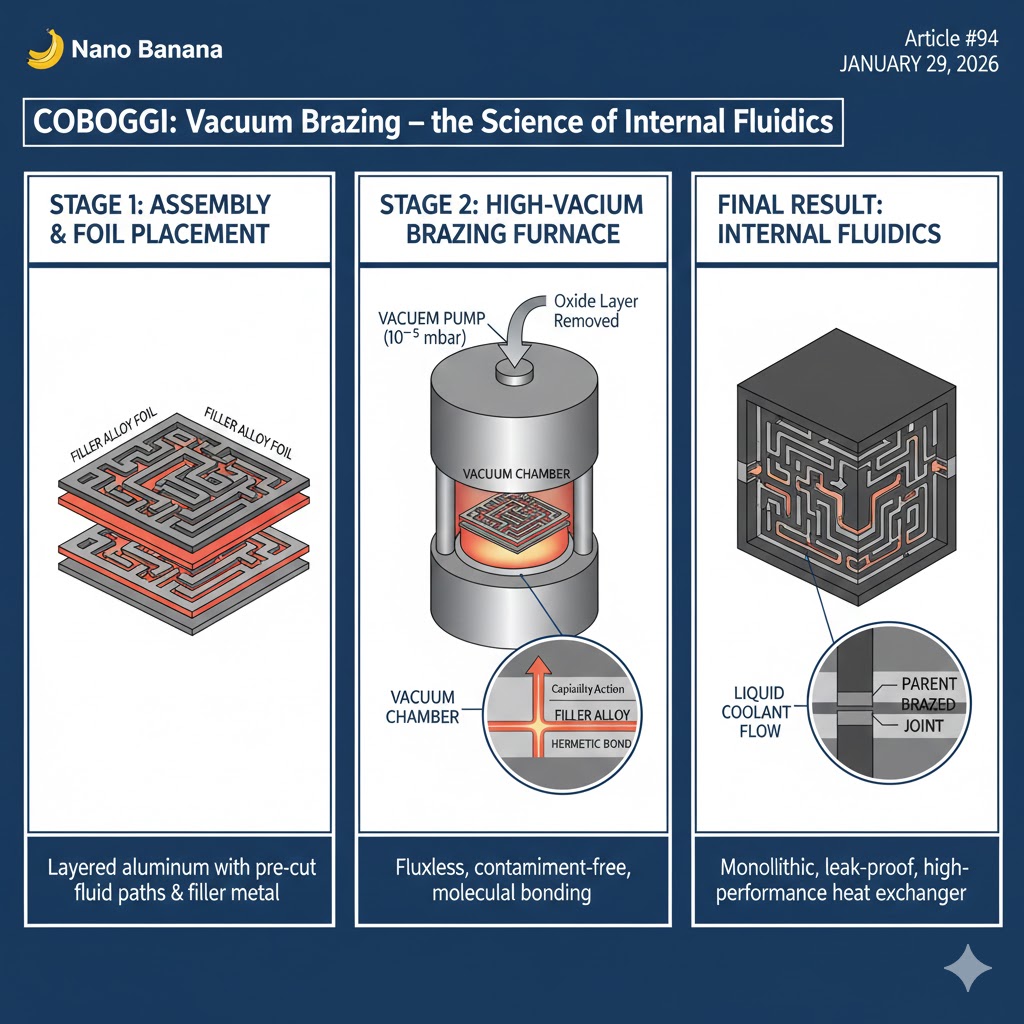
Because the process happens across the entire surface of the part simultaneously, we can create incredibly complex internal cooling paths.
We can braze a “maze” of fins and channels that maximize the surface area for heat transfer. The final part looks like a solid piece of aluminum from the outside, but inside, it is a high-performance heat exchanger.
Conclusion: Invisible Infrastructure
Vacuum brazing allows COBOGGI to hide the “engine” of the cooling system within the walls of the device.
It provides the thermal overhead required for next-generation AI and high-performance computing while maintaining the minimalist, unibody aesthetic our clients demand.
Specification Comparison
| Specification | Vacuum Brazing (Standard) | Vacuum Brazing (High-Precision Internal Fluidics) |
|---|---|---|
| Brazing temperature range | 580–620 °C | 595–615 °C |
| Chamber pressure (operational) | 1 × 10⁻³ mbar | 5 × 10⁻⁵ mbar |
| Maximum part dimension tolerance (as-brazed) | ±0.05 mm | ±0.015 mm |
| Internal channel surface roughness (Ra) | 3.2 µm | 0.8 µm |
| Minimum internal channel diameter | 1.2 mm | 0.4 mm |
| Joint fill uniformity (cross-section variance) | ±12% | ±3.5% |
| Residual oxygen content in joint interface | 85 ppm | 12 ppm |
| Thermal cycle repeatability (peak temp deviation) | ±4.2 °C | ±0.9 °C |
Frequently Asked Questions
What minimum internal channel diameter can Coboggi reliably braze using vacuum brazing for aluminium heat exchangers?
Coboggi achieves consistent capillary flow and joint integrity in internal fluidic passages down to a minimum diameter of 0.8 mm, with ±0.05 mm geometric tolerance maintained across production batches.
What is the maximum part envelope size your vacuum brazing furnace accommodates for aerospace-grade aluminium assemblies?
Our Class 1000 cleanroom-integrated vacuum brazing furnace accepts parts up to 1,200 mm × 800 mm × 600 mm (L×W×H), with uniform temperature uniformity of ±2.5°C across the full hot zone.
What is the typical lead time from PO to shipment for a medium-volume order (50–200 units) of vacuum-brazed aluminium cold plates?
Standard lead time is 14 business days, including NDT (dye penetrant and helium leak testing at ≤1×10⁻⁹ mbar·L/s sensitivity) and full dimensional CMM validation per ASME Y14.5-2018.
What is the minimum guaranteed joint shear strength for 6061-T6 to 6061-T6 vacuum-brazed joints using Coboggi’s proprietary Al-Si-Cu filler alloy?
All production joints meet or exceed a minimum average shear strength of 92 MPa, verified per ASTM B577-22 on destructively sampled coupons from each furnace run.
Do you offer PPAP documentation and material certifications for automotive EV battery cooling plates?
Yes — we provide full Level 3 PPAP packages, including IMDS compliance reports, EN 10204 3.1 mill certificates, and traceable lot-controlled filler metal (Al-11.0Si-1.0Cu, certified to ISO 9001:2015 and IATF 16949:2016).
What is the maximum thermal cycling endurance validated for Coboggi vacuum-brazed aluminium manifolds operating between −40°C and +120°C?
Our qualification testing demonstrates zero joint failure after 5,000 cycles (per SAE J2394), with leakage rates sustained below 5×10⁻¹⁰ mbar·L/s post-cycling.