In the rapidly advancing field of robotics, the challenge is always the same: strength-to-weight ratio. For robotic exoskeletons—whether designed for medical rehabilitation or industrial power-assistance—the frame must be light enough for a human to wear but rigid enough to support massive mechanical loads.
Specification Comparison
| Specification | 6061-T6 Aluminium | 6082-T6 Aluminium | 6005A-T6 Aluminium |
|---|---|---|---|
| Tensile strength (MPa) | 310 | 310 | 300 |
| Yield strength (MPa) | 276 | 270 | 260 |
| Elongation at break (% in 50 mm) | 12 | 10 | 10 |
| Electrical conductivity (% IACS) | 43 | 42 | 41 |
| Thermal conductivity (W/m·K) | 167 | 165 | 160 |
| Modulus of elasticity (GPa) | 68.9 | 70.0 | 70.3 |
| Anodising response (oxide layer thickness, µm, at 20 V DC) | 18.5 | 17.8 | 19.2 |
| Typical extrusion speed (mm/min) for 50 mm profile | 120 | 115 | 125 |
COBOGGI leverages the unique properties of the 6xxx series aluminum to provide the structural backbone for these “wearable machines.”
Engineering the “Artificial Bone”
An exoskeleton is essentially an external skeleton. To mimic the efficiency of human bone, the material must resist bending and fatigue while remaining incredibly light.
1. Why 6061-T6 for Robotics?
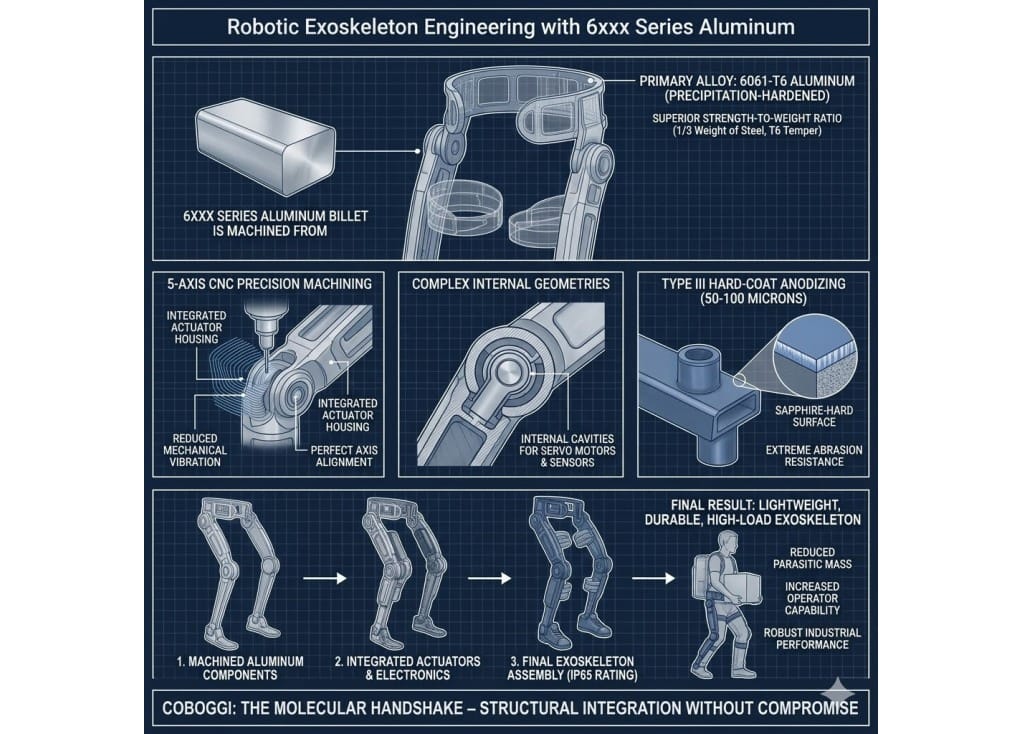
While we use 6063 for aesthetic personal care products, 6061-T6 aluminum is our go-to for robotics. It is a precipitation-hardened alloy containing magnesium and silicon. In its T6 temper, it offers a yield strength comparable to some steels but at approximately one-third of the weight. This allows COBOGGI to manufacture limbs and joints that reduce the “parasitic mass” the user has to carry.
2. Complex CNC Geometries for Actuator Integration
Robotic joints require high-precision internal cavities to house servo motors, planetary gears, and sensors. Using 5-axis CNC machining, COBOGGI carves these complex features directly into the aluminum billets. This integrated approach ensures that the “bone” (the frame) and the “muscle” (the actuator) are perfectly aligned, reducing vibration and mechanical wear.
3. Hard-Coat Anodizing (Type III)
Unlike the decorative anodizing used in consumer electronics, robotic components require Type III Hard-Coat Anodizing. This process creates a much thicker, sapphire-hard oxide layer (up to 50–100 microns). This provides extreme abrasion resistance at the pivot points and protects the exoskeleton from the harsh, dusty environments of industrial warehouses or outdoor terrain.
Conclusion: Empowering Human Motion
The future of robotics isn’t just about software; it’s about the materials that move. By combining the structural reliability of the 6xxx series with advanced machining and protective treatments, COBOGGI provides the physical platform that allows robotic exoskeletons to enhance human capability safely and efficiently.
Frequently Asked Questions
What load capacity do Coboggi’s 6xxx-series aluminium exoskeleton frames support in industrial lifting applications?
Our standard 6061-T6 robotic exoskeleton frame supports up to 18.5 kg per actuator while maintaining ±0.15 mm dimensional tolerance across critical hinge interfaces.
How does the anodized surface finish on the 6xxx-series structural components improve corrosion resistance in humid production environments?
The Type II sulfuric acid anodizing (per MIL-A-8625) delivers a minimum 25 µm coating thickness, achieving a 336-hour salt-spray resistance rating (ASTM B117).
What is the typical lead time for custom-configured exoskeletons using 6063-T5 extrusions?
Standard configurations ship in 14 business days; custom-engineered variants with integrated sensor mounts and CNC-machined 6063-T5 extrusions require a 22-day lead time from PO confirmation.
Can Coboggi’s 6xxx-series exoskeleton arms integrate with third-party collaborative robot controllers, and what communication protocol is certified?
Yes — all units are certified for EtherCAT communication at 100 Mbps, with real-time jitter under 2.3 µs (IEC 61784-2 CP 3/1 compliance).
What is the maximum operating temperature range for 6061-T6 structural joints under continuous dynamic load?
The joints maintain structural integrity up to 150°C, with thermal expansion coefficient of 23.6 × 10⁻⁶ /°C ensuring ≤0.08 mm positional drift over 1.2 m span at peak temp.
How much weight reduction does the 6xxx-series design achieve versus equivalent steel-frame exoskeletons, and what is the resulting payload-to-weight ratio?
Our 6xxx-series architecture reduces mass by 58% (e.g., 7.2 kg vs. 17.3 kg for comparable Class-3 assist units), delivering a payload-to-weight ratio of 2.5:1 at full assist capacity.