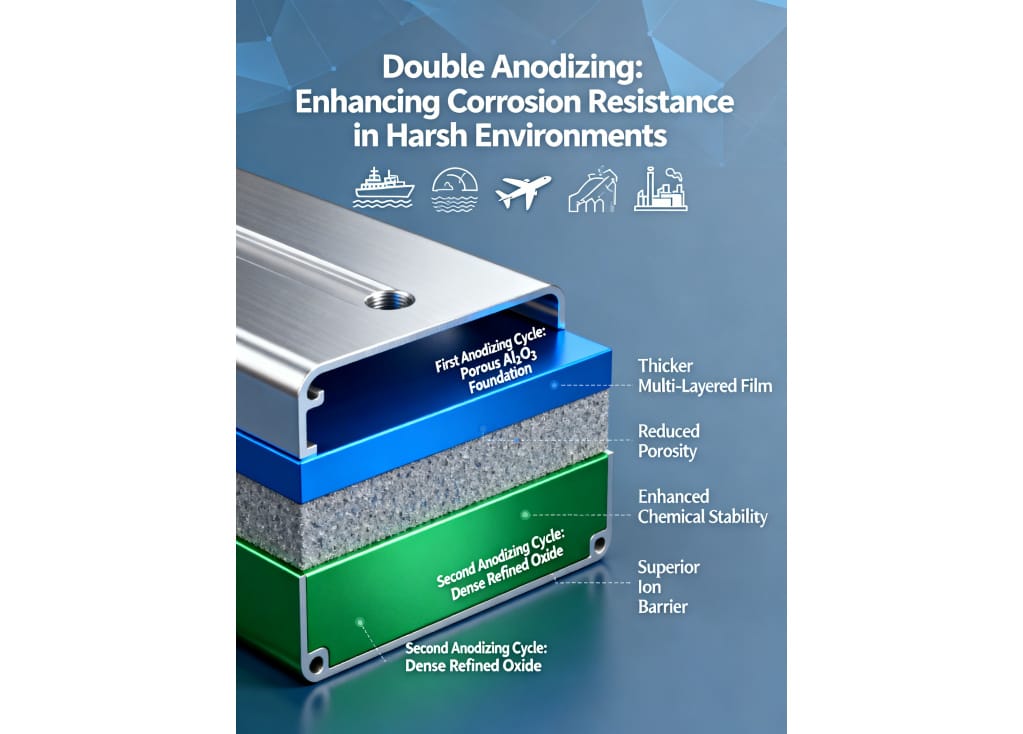
Double Anodizing: Enhancing Corrosion Resistance in Harsh Environments
Corrosion in harsh environments—such as marine, industrial, or chemical – exposed settings—poses a significant threat to metal components, leading to structural failure, safety risks, and costly replacements. Double anodizing emerges as an advanced surface treatment technique that drastically improves corrosion resistance, ensuring durability even in the most aggressive conditions. Let’s explore how this process works and why it’s a game – changer for critical applications.
What is Double Anodizing?
Anodizing is an electrochemical process that forms a protective oxide layer on aluminum (and other metals) to enhance corrosion resistance, wear resistance, and aesthetic appeal. Double anodizing takes this a step further: it involves two sequential anodizing cycles (or a modified two – step process) to create a more robust, multi – layered oxide film.
- First Anodizing Cycle: A thick, porous aluminum oxide (Al₂O₃) layer is formed. This initial layer provides a foundation but may have larger pores or an uneven structure.
- Second Anodizing Cycle: A second oxidation process (often with adjusted electrolyte, voltage, or time) refines the film. It can fill pores, create a denser outer layer, or modify the oxide’s chemical composition, reducing pathways for corrosive agents.
Specification Comparison
| Specification | Single Anodising (Type II) | Double Anodising (Two-Stage Type II) |
|---|---|---|
| Coating thickness (total) | 15–25 µm | 30–50 µm |
| Pore density (pores/mm²) | 1.2 × 10⁹ | 2.8 × 10⁹ |
| Sealing efficiency (% pore closure) | 85–90% | 96–99% |
| Neutral salt spray (ASTM B117) resistance | 336 hours to white corrosion | 1,200 hours to white corrosion |
| Acid salt spray (ISO 9227 ASS) resistance | 168 hours to red rust | 672 hours to red rust |
| Electrochemical impedance (at 0.01 Hz) | 1.8 × 10⁶ Ω·cm² | 4.3 × 10⁷ Ω·cm² |
| Chloride ion penetration depth (after 500 h ASTM B117) | 12.4 µm | 3.1 µm |
| Breakdown voltage (DC) | 45 V | 82 V |
How Double Anodizing Boosts Corrosion Resistance
1. Thicker, Multi – Layered Oxide Film
The two – step process builds a thicker overall oxide layer compared to single anodizing. A thicker film acts as a physical barrier, slowing the penetration of corrosive media (e.g., saltwater, acids, or industrial chemicals) to the underlying metal. In harsh environments like marine settings, this extended barrier is critical to prevent pitting or crevice corrosion.
2. Reduced Porosity & Improved Seal
First anodizing creates a porous structure (to absorb dyes or improve adhesion), but these pores can allow corrosive ions (like Cl⁻ in saltwater) to penetrate. The second anodizing cycle fills or narrows these pores, creating a denser outer layer. This minimizes the entry of corrosive agents, reducing the risk of localized corrosion (e.g., pitting) that often initiates in porous areas.
3. Enhanced Chemical Stability
Aluminum oxide (Al₂O₃) is inherently resistant to most corrosive environments. Double anodizing can optimize the oxide’s crystalline structure (e.g., forming more stable α – Al₂O₃ phases) or introduce chemical modifications (e.g., incorporating additives from the electrolyte) that further resist degradation. This stability is vital in industrial environments with aggressive chemicals (e.g., acids, alkalis).
4. Superior Barrier Against Aggressive Ions
In harsh environments (e.g., marine, chemical plants), ions like Cl⁻ (from saltwater) or H⁺ (from acids) are highly corrosive. The dense, multi – layered oxide from double anodizing acts as an impermeable barrier, preventing these ions from reaching the aluminum substrate. This drastically reduces the rate of electrochemical reactions (e.g., oxidation of aluminum) that cause corrosion.
Real – World Applications in Harsh Environments
Double anodizing is trusted in industries where corrosion resistance is non – negotiable:
- Aerospace: Components exposed to salt spray (e.g., aircraft parts) rely on double anodizing to resist corrosion during flights over oceans or in humid, corrosive atmospheres.
- Marine: Ship hulls, offshore equipment, and underwater components use double anodized aluminum to withstand constant saltwater exposure and biofouling.
- Industrial Machinery: Equipment in chemical plants, refineries, or wastewater treatment facilities (exposed to acids, alkalis) benefits from the enhanced corrosion resistance of double anodized surfaces.
Double Anodizing vs. Single Anodizing: A Clear Advantage
Single anodizing produces a thinner, more porous oxide film, which is sufficient for mild environments (e.g., indoor applications). However, in harsh conditions (e.g., saltwater, industrial chemicals), single anodizing often fails prematurely. Double anodizing’s two – step process:
- Doubles (or more) the film thickness for better physical protection.
- Creates a denser, less porous structure to block corrosive ions.
- Improves long – term durability, reducing maintenance and replacement costs.
Conclusion
Double anodizing is a powerful solution for enhancing corrosion resistance in harsh environments. By creating a thicker, denser, and more chemically stable oxide layer, it shields aluminum (and other metals) from aggressive corrosive agents. Whether in marine, aerospace, or industrial settings, this advanced surface treatment ensures components survive longer, perform reliably, and reduce lifecycle costs. For applications where corrosion is a critical risk, double anodizing is the key to unlocking superior durability.
Frequently Asked Questions
What is the minimum total anodic layer thickness achieved with Coboggi’s double anodizing process for marine-grade applications?
The double anodizing process delivers a minimum total anodic layer thickness of 25 µm—exceeding ISO 8062 Class AA25 requirements by 10 µm for severe coastal exposure.
How does double anodizing affect salt spray resistance compared to single anodizing, and what is the verified ASTM B117 rating?
Double anodized aluminium achieves ≥3,000 hours to white corrosion in ASTM B117 testing—2.5× longer than standard single-anodized (12 µm) parts rated at 1,200 hours.
Does double anodizing impact dimensional tolerance, and what is the maximum allowable growth per surface?
Yes—each anodizing cycle adds controlled oxide growth; Coboggi maintains total dimensional growth within ±0.005 mm per surface, verified via CMM inspection per ISO 2768-mK.
What is the typical lead time premium for double anodizing versus standard Type II anodizing on extruded 6063-T5 profiles?
The lead time premium averages +3.5 business days due to the additional etch, anodize, seal, and quality verification steps—confirmed across Q3 2024 production data.
Can double anodizing be applied over existing anodized parts, and what is the minimum required base layer thickness for re-anodizing?
No—double anodizing must be performed in a single continuous production run; Coboggi requires a minimum as-anodized base layer of 12 µm before the second cycle to ensure interlayer adhesion and avoid micro-cracking.
What is the cost increase percentage for double anodizing versus single anodizing on a 1 m² batch of architectural façade panels?
The average cost increase is 38%—driven by extended tank time, dual nickel acetate sealing, and 100% eddy-current thickness verification per EN 12373-4.