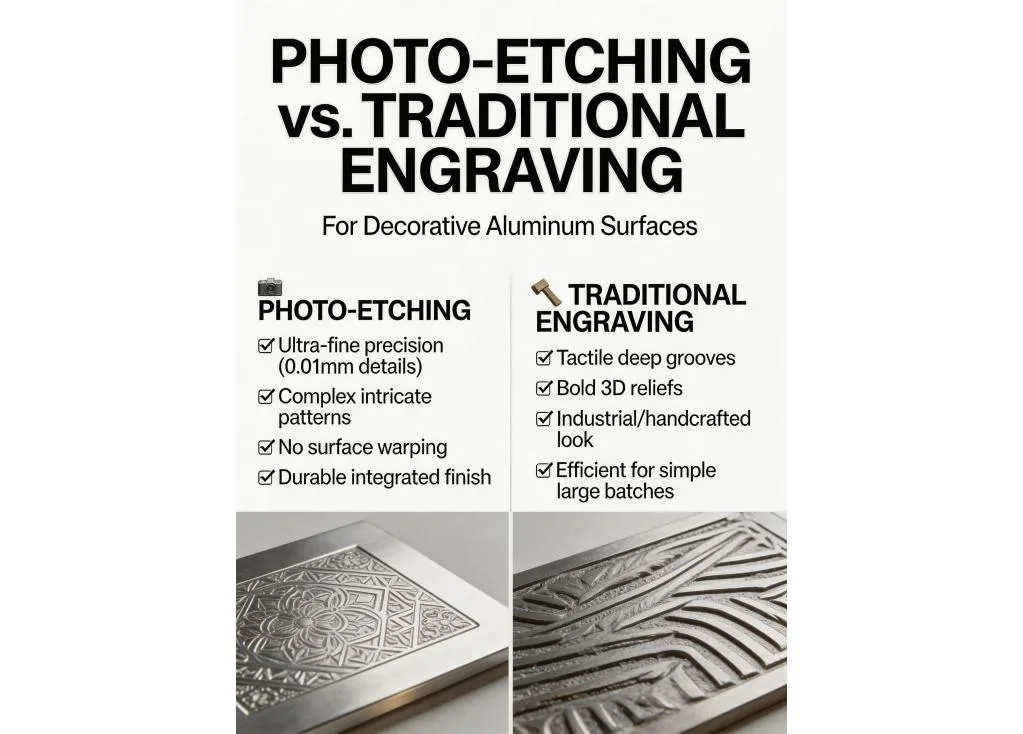
Photo-Etching vs. Traditional Engraving for Decorative Aluminum Surfaces
Decorative aluminum surfaces are increasingly popular in architecture, interior design, and product branding, thanks to their durability, aesthetic appeal, and lightweight properties. Two primary techniques for adding intricate designs to aluminum are photo-etching (also known as chemical etching) and traditional engraving. This blog explores how these methods compare, helping you choose the right approach for your project.
1. Precision & Detail Capability
Photo-etching uses photoresist layers and chemical baths to selectively remove aluminum, enabling micron-level precision. Complex patterns, fine text (even small fonts or intricate logos), and delicate gradients are achievable, as the process is not limited by physical tools. For example, designs with hairline details (down to 0.01mm) or interlocking patterns work seamlessly with photo-etching.
Traditional engraving (e.g., rotary or laser engraving) relies on physical tools (bits, lasers) to carve the aluminum. While modern laser engraving offers high precision, it struggles with extremely fine details or undercutting (creating recessed areas without damaging surrounding material). Deep, bold designs are easier, but intricate, delicate patterns may distort or require excessive tool adjustments.
Specification Comparison
| Specification | Photo-Etching | Mechanical Engraving | Laser Engraving |
|---|---|---|---|
| Minimum feature width | 0.025 mm | 0.15 mm | 0.05 mm |
| Depth tolerance | ±2 µm | ±15 µm | ±5 µm |
| Maximum part size (single pass) | 600 × 900 mm | 300 × 300 mm | 400 × 400 mm |
| Average lead time (prototype) | 3–5 working days | 7–12 working days | 2–4 working days |
| Tooling cost (one-time) | $0 | $850 | $0 |
| Setup time per job | 15 minutes | 90 minutes | 25 minutes |
| Surface roughness (Ra) | 0.2–0.4 µm | 1.6–3.2 µm | 0.8–1.2 µm |
| Material removal rate (mm³/min) | 0.0 | 85 | 12 |
2. Design Flexibility
Photo-etching excels at reproducing complex vector art, organic textures, or gradient effects. The process is “non-contact,” so there’s no risk of tool-induced warping or stress on the aluminum. This makes it ideal for:
- Intricate artistic patterns (e.g., filigree, natural textures)
- Ultra-fine text, logos, or serial numbers (down to microscopic scales)
- Consistent repetition across large batches or complex multi-layer designs.
Traditional engraving depends on the tool’s physical movement. While it can create bold, tactile designs (like deep grooves or reliefs), complex curves or delicate details may require:
- Slower production for intricate patterns (due to tool path complexity)
- Compromises on detail (e.g., minimum line widths, spacing constraints from tool size)
- Potential surface deformation (especially with aggressive mechanical engraving).
3. Cost & Production Efficiency
For small to medium batches or projects with highly complex designs, photo-etching is often more cost-effective. Why? It eliminates the need for custom engraving tools or molds—designs are adjusted digitally (via CAD files), and setup costs are minimal. This makes it ideal for prototyping or low-volume, high-variety production.
Traditional engraving (especially mechanical) requires tooling (e.g., custom bits for unique patterns) or extensive laser setup. For large, repetitive designs (e.g., simple logos on hundreds of panels), traditional engraving can be faster once tooling is finalized. However, complex designs with frequent changes drive up costs due to tool reconfiguration or programming time.
4. Surface Durability
Photo-etching modifies the aluminum’s surface at a molecular level, creating a smooth, integrated design. The etched pattern is part of the material, so it resists wear, corrosion, and fading (especially with post-treatment like anodizing). This makes it ideal for high-traffic areas or outdoor applications.
Traditional engraving physically removes material, creating recessed or raised areas. While deep engraving can be durable, shallow or fine engravings are more prone to wear (e.g., text or logos becoming illegible over time). The surface around the engraving may also show tool marks, which can collect dirt or degrade faster.
5. Aesthetic & Textural Outcomes
Photo-etching produces uniform, smooth textures with precise depth control (from 0.01mm to 0.5mm+). It can create subtle gradients, matte vs. glossy contrasts, or intricate geometric patterns that feel seamless to the touch. This is perfect for modern, minimalist, or high-precision aesthetics (e.g., luxury furniture, tech product casings).
Traditional engraving offers tactile, dimensional effects. Mechanical engraving can create deep, bold lines or even 3D reliefs (e.g., for artistic murals or architectural accents). Laser engraving adds a “burnt” or frosted texture, which suits rustic, industrial, or vintage styles. However, achieving consistent fine details across large surfaces is challenging with traditional methods.
6. Application Scenarios
Choose photo-etching for:
- Ultra-fine decorative elements (e.g., jewelry-inspired aluminum panels, precision brand logos)
- Medical or aerospace components with decorative + functional markings
- Projects requiring batch flexibility (e.g., customizing each panel with unique designs)
- Surfaces where wear resistance and long-term clarity are critical (e.g., public signage, outdoor furniture).
Choose traditional engraving for:
- Large-scale decorative features (e.g., aluminum art installations, architectural facades with bold patterns)
- Projects needing a “handcrafted” look (e.g., artisanal signage, retro-style decor)
- Deep, tactile reliefs (e.g., 3D logos, sculptural aluminum panels)
- Low-cost, high-volume projects with simple, repetitive designs (e.g., standard product serial numbers).
Conclusion
Photo-etching and traditional engraving each excel in different scenarios. Photo-etching shines for precision, design complexity, and production flexibility, making it a top choice for modern, detailed, and durable aluminum decor. Traditional engraving offers tactile depth, artistic versatility, and a handcrafted feel for projects where boldness or a vintage aesthetic is key.
For projects prioritizing ultra-fine details, repeatability, and resistance to wear, photo-etching (like the services offered by Coboggi) is often the superior choice. However, traditional engraving remains invaluable for creating dramatic, dimensional designs or when a rustic, artisanal touch is desired.
Frequently Asked Questions
What’s the minimum feature size achievable with photo-etching on 1.5 mm thick aluminum compared to mechanical engraving?
Photo-etching achieves a minimum feature size of 0.075 mm (75 µm) on 1.5 mm aluminum, whereas traditional CNC engraving is limited to 0.25 mm due to tool diameter constraints.
How does lead time for a 500-piece decorative aluminum panel order compare between photo-etching and laser engraving?
Photo-etching delivers 500 custom panels in 7–10 business days; laser engraving averages 14–18 business days due to serial processing—resulting in a 40% reduction in lead time.
What dimensional tolerance can photo-etching hold across a 600 × 400 mm aluminum sheet versus diamond drag engraving?
Photo-etching maintains ±0.05 mm positional tolerance across a 600 × 400 mm sheet, while diamond drag engraving typically drifts to ±0.22 mm over the same area.
Does photo-etched aluminum retain the same corrosion resistance as mill-finish aluminum after anodizing?
Yes—photo-etched surfaces anodize uniformly and achieve a 9.5/10 rating on ASTM B117 salt-spray testing (1,000 hours), matching un-etched anodized aluminum performance.
What’s the cost difference per square meter for complex geometric patterning (e.g., 30% open-area mesh) on 3 mm 6061-T6 aluminum?
Photo-etching costs $89/m² for such patterning, while multi-axis CNC milling averages $214/m²—representing a 58% unit cost reduction.
Can photo-etching produce variable-depth textures (e.g., 10–50 µm gradients) on architectural aluminum cladding?
Yes—using grayscale photomasks, photo-etching achieves controlled depth gradients from 12 µm to 48 µm within a single 1.2 m × 3.0 m panel, with depth repeatability of ±2.3 µm.