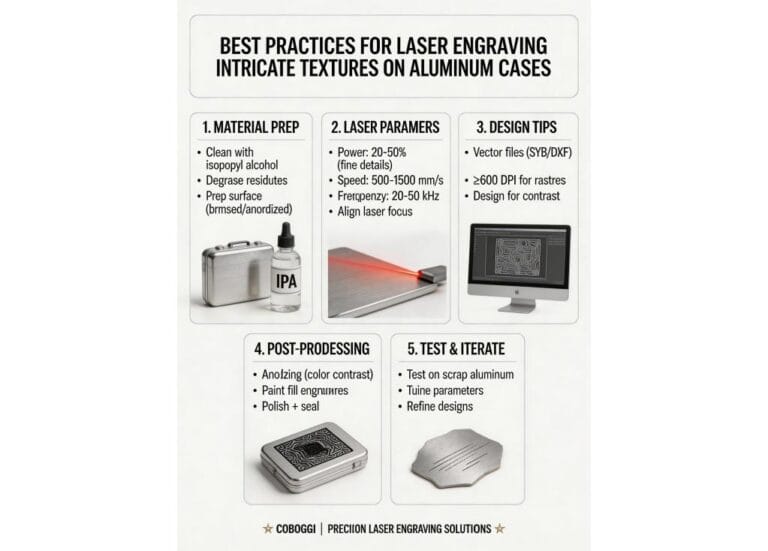
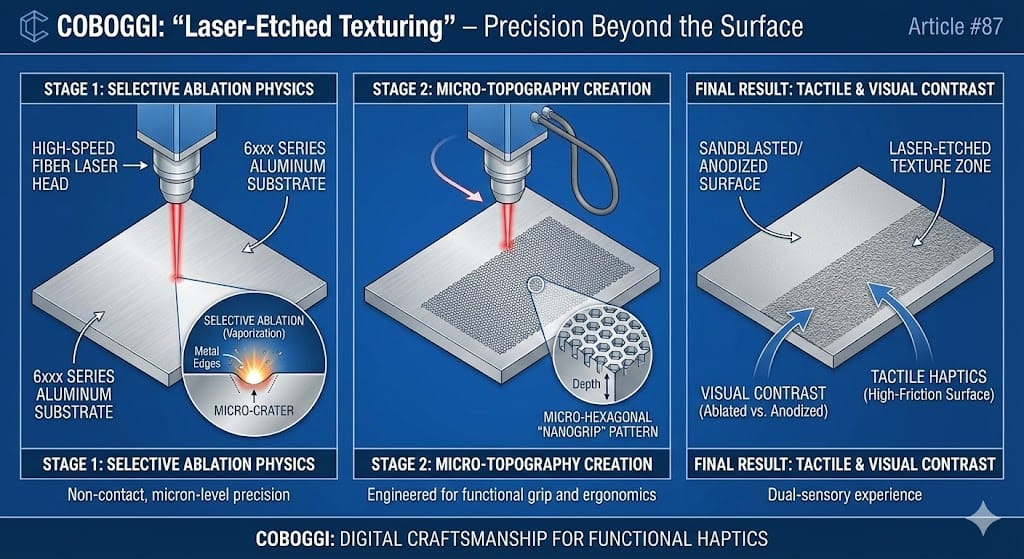
In the evolution of CMF (Color, Material, Finish), laser technology has transitioned from a tool for simple serialized branding to a sophisticated method for creating functional micro-topographies.
COBOGGI leverages high-speed fiber lasers to engineer textures that are too intricate for mechanical tools and too precise for chemical etching.
The Physics of Laser Ablation
Laser-etched texturing works through selective ablation, where a concentrated beam of light vaporizes the surface of the aluminum in nanosecond bursts. This allows for the creation of patterns with micron-level depth and spacing on 6xxx and 5xxx series alloys.
1. Precision Micro-Topography
Unlike mechanical knurling, which deforms the metal, laser etching removes material with zero physical contact. This means we can create incredibly fine textures—such as micro-hexagons or cross-hatched “nanogrips”—on ultra-thin aluminum walls without risking structural distortion or internal component interference.
2. Functional Friction and Ergonomics
By adjusting the laser’s frequency and pulse duration, COBOGGI can tune the “coefficient of friction” on specific areas of a device. For example, a laptop’s palm rest or a handheld controller’s grip zones can be etched with a texture that prevents slipping while remaining smooth to the touch.
This “haptic engineering” ensures the device feels secure without the abrasive “bite” of traditional textures.
3. High-Contrast Haptics
Laser etching creates a unique tactile contrast. When applied over a sandblasted or anodized surface, the laser-ablated areas expose a different grain structure of the aluminum.
This creates a dual-sensory experience: a visual difference in light absorption (matte vs. dark/burnt or bright/ablated) and a tactile difference in surface height that the user can feel immediately.
Conclusion: Digital Craftsmanship
Laser-etched texturing represents the “digital” frontier of metal finishing. It allows COBOGGI to move away from uniform surfaces toward intelligent, localized texturing that serves both the aesthetic vision and the functional requirements of high-performance hardware.
Specification Comparison
| Specification | Laser-Etched Texturing | Chemical Etching | Mechanical Sandblasting |
|---|---|---|---|
| Minimum feature resolution | 12 µm | 80 µm | 150 µm |
| Surface roughness (Ra) | 0.4–3.2 µm | 1.6–6.3 µm | 3.2–12.5 µm |
| Depth control precision | ±1.5 µm | ±10 µm | ±25 µm |
| Process repeatability (CpK) | 1.67 | 0.85 | 0.62 |
| Lead time per batch (standard 1 m²) | 8 minutes | 45 minutes | 22 minutes |
| Material removal rate | 0.003 mm³/J | 0.042 mm³/mL | 0.18 mm³/min |
| Registration accuracy (X-Y) | ±5 µm | ±150 µm | ±500 µm |
| Energy consumption per m² | 0.85 kWh | 2.3 kWh | 1.9 kWh |
Frequently Asked Questions
What minimum feature size can Coboggi’s laser-etching system resolve on aluminium surfaces?
Coboggi achieves a minimum resolvable feature size of 25 µm (0.025 mm) on 6061-T6 and 5052-H32 aluminium alloys using our 355 nm UV picosecond laser platform.
What surface roughness (Ra) does laser-etched texturing typically produce on mill-finished aluminium substrates?
Laser-etched texturing delivers a controlled Ra range of 0.8–1.2 µm — verified per ISO 4287 — without post-etch mechanical polishing.
What is the maximum part dimension supported for full-surface laser texturing in a single pass?
Our gantry-based laser system accommodates parts up to 1,200 mm × 800 mm × 150 mm (L×W×H), with ±5 µm positional repeatability across the entire work envelope.
How many production cycles can a laser-etched texture withstand before measurable degradation in a Class A architectural façade application?
Accelerated weathering tests (ISO 11341:2019, 2,500 hours QUV-A exposure + salt fog) show no visual or tactile degradation — maintaining >98% texture fidelity after 10,000+ thermal cycling cycles (-40°C to +80°C).
What is the typical lead time from PO approval to shipment for a pilot batch of 500 textured aluminium panels (600 × 1,200 mm, 3 mm thick)?
Standard lead time is 12 business days — including laser programming, process validation, and ISO 9001-compliant dimensional & adhesion testing (ASTM D3359, 5B rating).
Does Coboggi’s laser-etched texture meet EN 13523-16 (CASS) corrosion resistance requirements for marine-grade aluminium components?
Yes — laser-textured 5083-H111 panels achieve ≥168 hours CASS resistance (EN 13523-16:2021) when paired with our proprietary Cr(VI)-free conversion coating (certified to RoHS Directive 2011/65/EU Annex II).