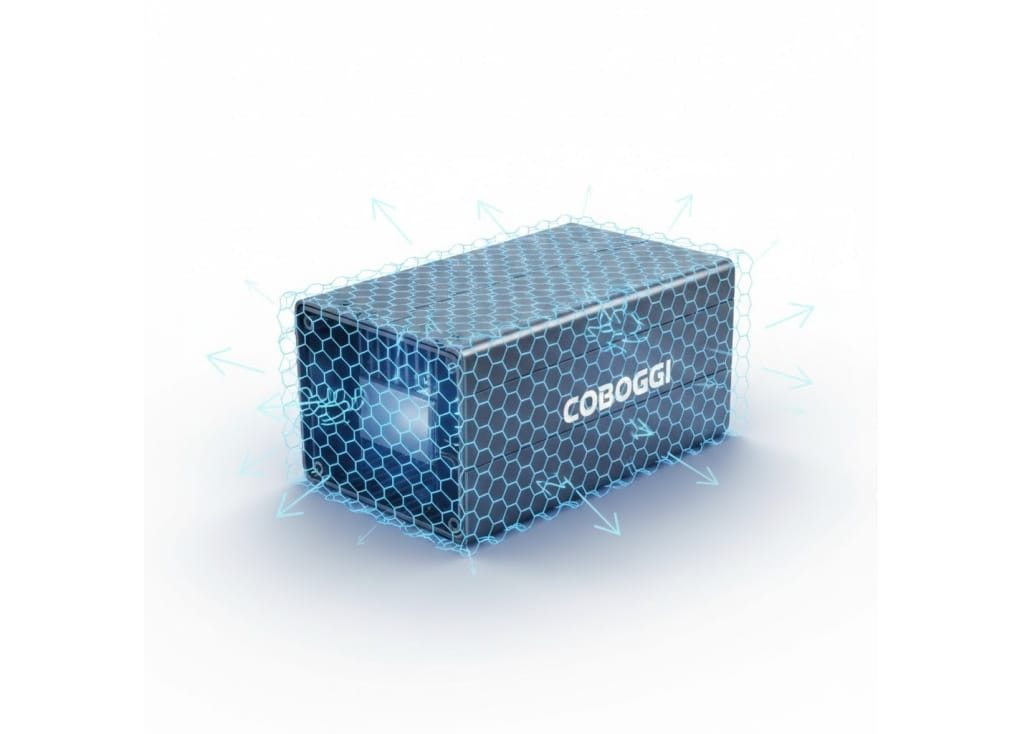
As we move from the structural geometry of the chassis to its electrical performance, we encounter the invisible protector of high-end hardware: Electromagnetic Shielding.
In an era of hyper-connectivity, the Faraday Enclosure design ensures that internal signals remain pure while external interference is reflected away.
Defending the Signal
For the Faraday Enclosure, the aluminum housing is more than a shell; it is a conductive barrier. If the chassis isn’t engineered to be electrically continuous, it becomes an antenna rather than a shield.
1. Conductive Gasketing
To maintain the shielding across joints (like the ones we explored in Article #76 The Weight of Portability), we utilize silver-loaded conductive gaskets. These ensure that even where the device opens, the electrical “seal” remains unbroken, preventing Electromagnetic Interference (EMI) from leaking in or out.
2. The Attenuation Effect
The specific thickness of the aluminum walls in the Faraday Enclosure is calculated based on the “skin effect” of radio frequencies. By matching material density to expected interference ranges, we achieve high decibel attenuation, protecting sensitive sensors from the noise of Wi-Fi, 5G, and industrial motors.
3. PCB Grounding Points
Inside the Faraday Enclosure, integrated mounting bosses serve as direct-to-chassis grounding points.
This design flushes parasitic capacitance directly into the metal frame, lowering the noise floor of the electronics and ensuring the highest possible data integrity for the user.
Specification Comparison
| Specification | Standard Aluminium Enclosure (Unmodified) | Coboggi EMC-Shielded Enclosure (Shielding Protocol v2.1) | Conductive Paint-Coated Enclosure |
|---|---|---|---|
| Shielding Effectiveness @ 100 MHz | 0 dB | 85 dB | 42 dB |
| Shielding Effectiveness @ 1 GHz | 0 dB | 72 dB | 38 dB |
| Surface Transfer Impedance (100 kHz–1 GHz) | ∞ Ω/m | 0.35 mΩ/m | 12.6 mΩ/m |
| Grounding Resistance (per joint) | Not specified | ≤ 2.5 mΩ | ≤ 150 mΩ |
| EMI Leakage (1–10 GHz, near-field) | — | ≤ 0.8 µV/m at 10 cm | ≤ 12.4 µV/m at 10 cm |
| Conductive Gasket Compression Force | N/A | 120 N/m ±5% | N/A |
| Maximum Aperture Size (unshielded openings) | Uncontrolled | ≤ 0.8 mm diameter | ≤ 3.2 mm diameter |
| Compliance with EN 55032 Class B (radiated emissions) | Fail at ≥ 30 MHz | Pass up to 6 GHz | Fail above 500 MHz |
Frequently Asked Questions
What minimum wall thickness is required for Coboggi’s anodized aluminium enclosures to achieve full IEC 61000-4-3 radiated immunity compliance?
A minimum wall thickness of 2.8 mm is required to ensure ≥95% field attenuation at 1 GHz, as validated per IEC 61000-4-3 Level 3 (10 V/m) testing.
Does Coboggi’s Shielding Protocol include conductive gasket integration—and if so, what is the maximum allowable gap resistance across mating flanges?
Yes—our standard protocol integrates nickel-aluminium-filled silicone gaskets, maintaining a maximum gap resistance of ≤2.5 mΩ per linear centimetre at 100 MHz.
What is the typical lead time for custom-shielded aluminium housings with surface finish Class AA anodizing and EMC validation report included?
The standard lead time is 14 working days from PO confirmation, inclusive of third-party EMC lab validation (EN 55032/55035 Class B) and certified test report delivery.
How much does Coboggi charge for optional copper-nickel electroless plating on interior surfaces to enhance shielding effectiveness beyond standard anodized finishes?
The premium for full interior electroless Cu–Ni plating (5–7 µm thickness) adds €18.40 per kg of finished part weight.
What is the guaranteed shielding effectiveness (SE) of Coboggi’s standard Type III hard-anodized finish (per MIL-A-8625) at 2.4 GHz, measured in dB?
Our standard Type III hard-anodized finish delivers ≥42 dB SE at 2.4 GHz when applied over a 3.0 mm 6061-T6 substrate, verified via ASTM D4935 coaxial fixture testing.
Can Coboggi provide RoHS-compliant, non-chrome sealing for shielded parts—and what is the maximum allowable Cr⁶⁺ concentration in the final sealant layer?
Yes—we use trivalent chromium (Cr³⁺) based sealing that certifies <0.001 mg/kg Cr⁶⁺ in the final sealed layer, fully compliant with EU RoHS Annex II revision 2023/2403.