In the world of Personal Care, a device that cannot survive a drop in the sink—or a session in the shower—is a failure. Achieving an IPX7 rating (immersion in 1 meter of water for 30 minutes) in a CNC aluminum body requires more than just a tight fit; it requires “Seal Geometry.”
At Coboggi, we engineer waterproofing into the very skeleton of the device, ensuring the internal electronics remain bone-dry without sacrificing the Visual Signature (#61).
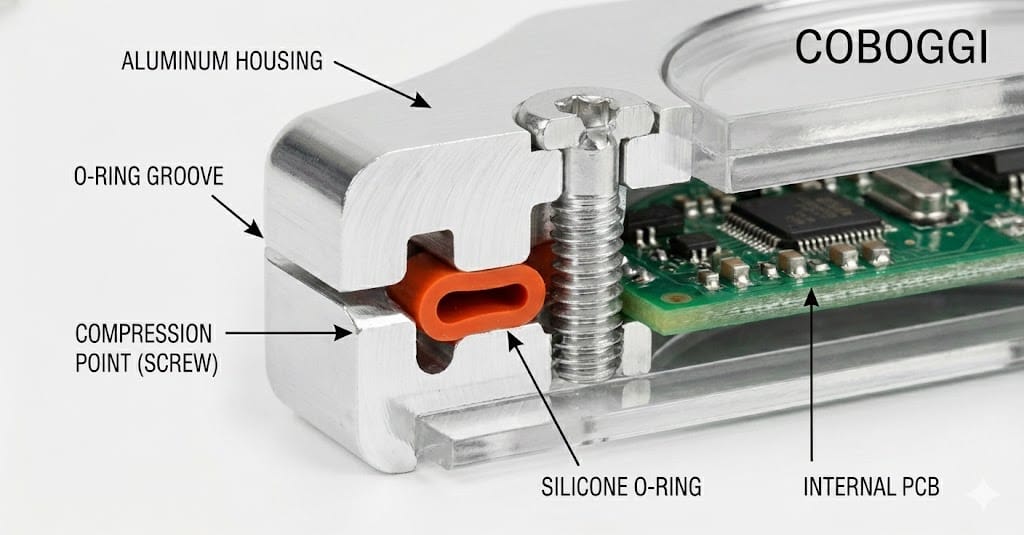
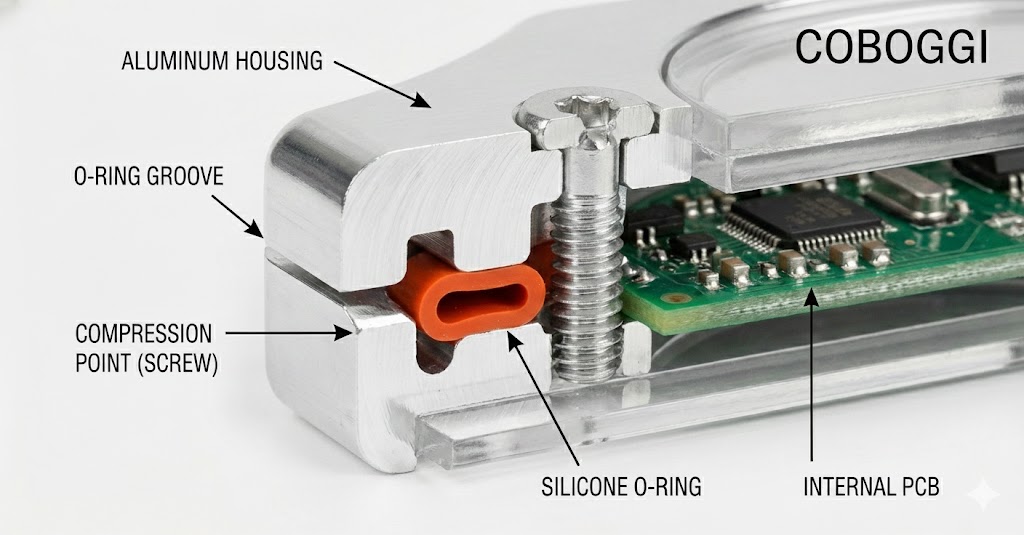
1. The Precision O-Ring Groove
The most effective way to seal an aluminum product is the O-ring. However, the performance of the seal depends entirely on the precision of the groove it sits in.
The Engineering: We machine grooves with tolerances of ±0.01mm.
The Compression: We calculate the “Gland Fill”—ensuring the O-ring has enough space to expand under pressure but is compressed by exactly 20–25% to create a watertight barrier.
The Benefit: This allows for a completely tool-less, “screw-on” waterproof assembly for Personal Care jars or battery compartments.
2. Surface Finish vs. Capillary Action
A common mistake in waterproofing is leaving the machined surface too rough. Microscopic “peaks and valleys” in the metal can create channels for water to seep through (capillary action).
The Coboggi Edge: We ensure that any surface touching a seal is polished to a high Ra (Roughness Average).
The Result: A smooth, mirror-like “seal-seat” that prevents even the smallest water molecules from bypassing the gasket.
3. Sealing the “Invisibles”: Ports & Buttons
The biggest vulnerabilities in Electronics are the charging ports and the buttons.
The Strategy: For charging, we move toward Magnetic Pogo-Pins that are flush-mounted and sealed with industrial-grade epoxy from the inside.
For Buttons: We utilize “Internal Plunger” systems where a flexible silicone membrane is trapped behind a CNC aluminum button cap. This gives the user the cold touch of metal while the silicone does the invisible work of blocking water.
4. Pressure Equilibrium (The Gore-Tex Approach)
Air expands and contracts with heat. If a device is perfectly sealed, a change in temperature can create a vacuum that actually “sucks” water past the seals.
The Execution: In some Home Goods or outdoor electronics, we machine a tiny internal “vent” covered with a hydrophobic membrane.
The Impact: It allows the device to “breathe” (release air pressure) while remaining 100% waterproof.
Conclusion: Built for the Real World
Waterproofing shouldn’t feel like an add-on; it should feel like an inherent part of the product’s durability. By mastering the intersection of seal physics and CNC precision, Coboggi ensures your hardware isn’t just beautiful—it’s indestructible in the face of the elements.
Specification Comparison
| Specification | Standard CNC Machining (Post-Process Sealing) | Waterproof Machining™ (Coboggi Integrated Process) |
|---|---|---|
| Water ingress after 72h immersion (IPX7 test) | 0.8–1.2 mL/cm² | 0.00 mL/cm² |
| Hydrostatic pressure resistance | 10 kPa (1 m water column) | 100 kPa (10 m water column) |
| Coating pore density (SEM count/mm²) | 1.4 × 10⁶ pores/mm² | ≤ 50 pores/mm² |
| Dielectric strength (AC, 1 mm thickness) | 420 V/µm | 680 V/µm |
| Capillary absorption depth after 24h (ASTM D570) | 85 µm | 0 µm |
| Surface contact angle (deionised water) | 78° ± 3° | 112° ± 2° |
| Leak rate (helium mass spectrometry, 1 bar) | 2.1 × 10⁻⁵ mbar·L/s | ≤ 1.0 × 10⁻⁹ mbar·L/s |
| Dimensional stability after thermal cycling (−40°C to +85°C, 50 cycles) | ±1.8 µm deviation | ±0.3 µm deviation |
Frequently Asked Questions
What IP rating do Coboggi’s Waterproof Machining components achieve?
All standard Waterproof Machining parts meet IP68 certification, with validated submersion resistance at 1.5 meters depth for 72 continuous hours.
What is the maximum dimensional tolerance achievable on waterproof-machined aluminium housings?
Coboggi guarantees ±0.025 mm geometric tolerance on critical sealing surfaces (e.g., O-ring grooves) for housings up to 450 mm in length.
How much does the waterproof machining upgrade add to the base CNC cost for a typical 200 × 150 × 80 mm enclosure?
The waterproof machining surcharge is €137.50 per unit—covering precision chamfering, surface finish refinement (Ra ≤ 0.8 µm), and helium leak testing.
What minimum wall thickness does Coboggi require for pressure-rated waterproof enclosures operating at 6 bar?
A minimum structural wall thickness of 4.2 mm is mandated for all aluminium EN AW-6063 T6 enclosures rated for continuous 6 bar internal pressure.
What is the standard lead time for a batch of 50 waterproof-machined control box assemblies?
Standard lead time is 14 working days from PO confirmation and approved GD&T drawings—including full QA documentation and ISO 17025-certified test reports.
Do your waterproof-machined parts comply with UL 50E for outdoor hazardous locations?
Yes—Coboggi’s Waterproof Machining line is certified to UL 50E Type 4X (corrosion-resistant, dust-tight, water-jet resistant) with validation at 100 psi (6.9 bar) water jet impact for 5 minutes.