When a consumer picks up a flagship smartphone or a high-end audio remote, their first impression isn’t based on the processor speed—it’s based on the texture.
Specification Comparison
| Specification | Glass Bead Blasting (Medium) | Aluminium Oxide Blasting (Fine) | Stainless Steel Shot Peening |
|---|---|---|---|
| Abrasive particle size (mesh) | 100–120 mesh | 150–180 mesh | 140–160 mesh |
| Impact velocity (m/s) | 45–55 m/s | 60–70 m/s | 50–60 m/s |
| Surface roughness Ra (µm) | 1.2–1.8 µm | 0.8–1.3 µm | 1.0–1.5 µm |
| Peak count (Pc/cm²) | 2,400–3,100/cm² | 3,800–4,500/cm² | 2,900–3,600/cm² |
| Compressive residual stress (MPa) | −120 to −180 MPa | −200 to −280 MPa | −160 to −220 MPa |
| Blast cycle time per m² (seconds) | 45–60 s | 75–95 s | 55–70 s |
| Media consumption rate (kg/m²) | 0.35–0.45 kg/m² | 0.20–0.30 kg/m² | 0.25–0.35 kg/m² |
| Post-blast surface hardness increase (HV0.3) | +35–+55 HV | +60–+90 HV | +45–+70 HV |
Is it silky? Is it grippy? Does it catch the light with a soft glow or a sharp metallic glint?
In aluminum manufacturing, achieving that “perfect feel” is a precise science. At Coboggi, we specialize in transforming raw, machined aluminum into “Satin” masterpieces through controlled surface treatments. Here is a deep dive into how we define and achieve these standards.
1. The Foundation: What is Surface Roughness (Ra)?
Before we talk about beauty, we must talk about math. Engineers use a metric called Ra (Roughness Average) to measure surface texture.
The Science: Ra is the arithmetic average of the profile height deviations from the mean line, usually measured in micrometers (μm).
Why it Matters: If the Ra is too high, the device feels “chalky” or scratchy. If it’s too low, the device can feel “sticky” or show every single fingerprint.
Coboggi Standard: For premium 3C electronics, we typically aim for an Ra between 0.4 μm and 1.6 μm depending on the desired hand-feel.
2. Bead Blasting: Creating the “Matte” Look
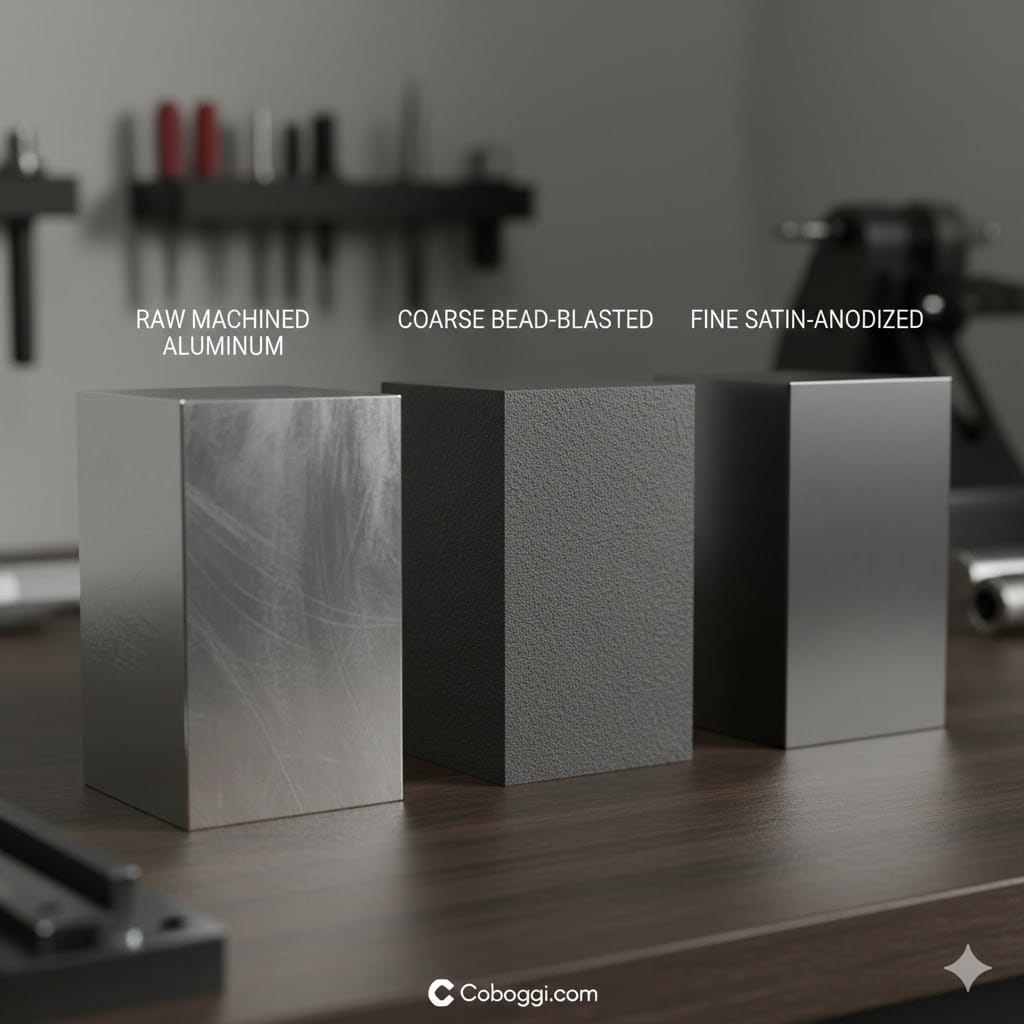
Bead blasting is the most popular method for achieving a non-reflective, professional finish. It involves “bombarding” the aluminum surface with microscopic media (glass beads, ceramic beads, or stainless steel shot).
The Process: The impact of these beads creates millions of tiny indentations, which diffuse light and hide the “tool paths” left behind by the CNC machine.
Grit Selection: * Fine (#180 – #220): Results in a smooth, silky “Satin” finish common in luxury laptops.
Coarse (#60 – #100): Results in a more rugged, “Sand” texture used for industrial tools or high-grip sports equipment.
3. Chemical Polishing & “Satin” Finishes
For brands that want a “glow” rather than a matte look, we use chemical etching or polishing.
The Result: This removes the peaks of the surface roughness without creating the deep craters of bead blasting. It leaves the aluminum looking bright but soft, a finish often referred to as “Satin Silver.”
4. Texture vs. Anodizing: The Final Interaction
The texture you choose before anodizing determines the final look after color is applied.
Matte Textures: Deepen colors and make them look more solid (e.g., “Midnight Black”).
Brushed/Satin Textures: Allow the metallic “luster” to shine through the dye, giving the color a metallic depth.
At Coboggi, we provide Master Samples to our clients, showing how different blasting pressures and media types interact with specific anodizing dyes.
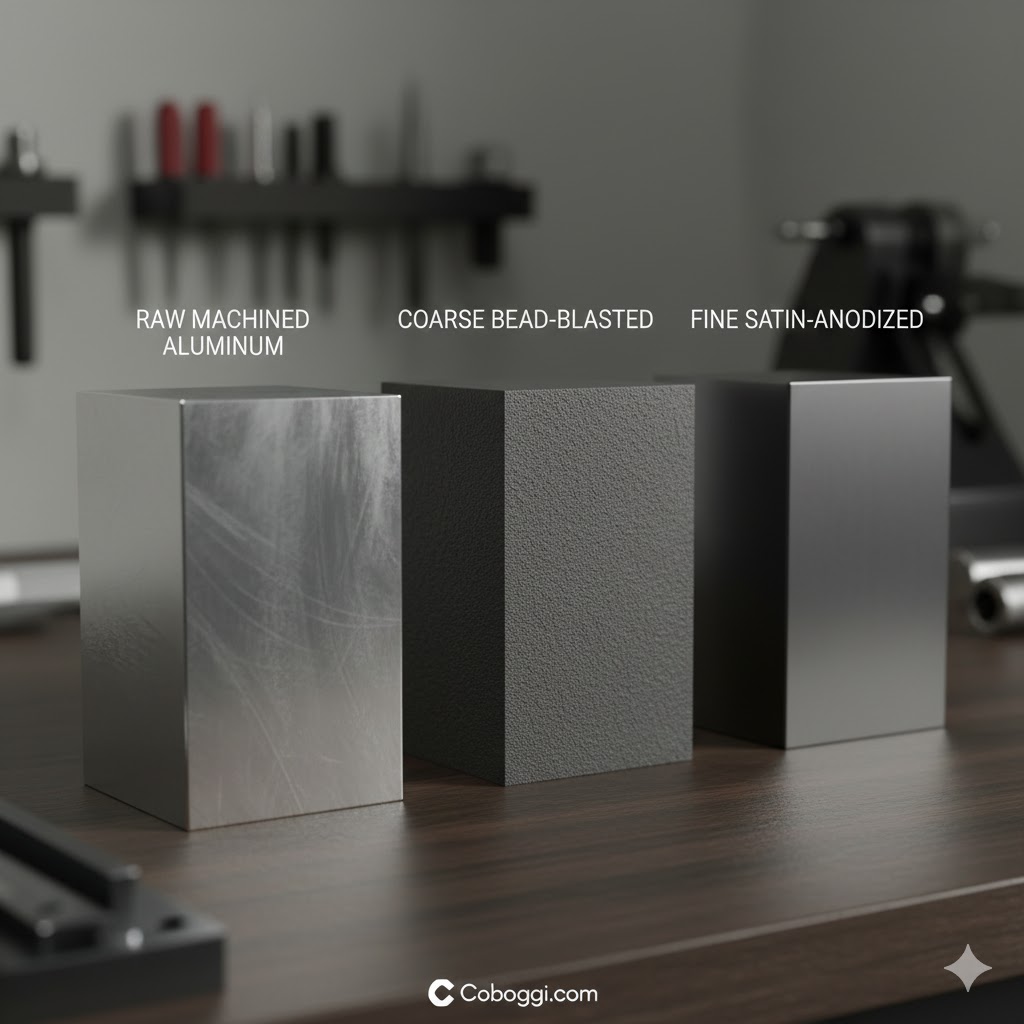
5. Consistency: The Coboggi Guarantee
The biggest challenge in surface finishing is consistency. How do you ensure that 10,000 units produced in June feel exactly like the 10,000 units produced in December?
Automated Blasting: We use robotic blasting cabinets to ensure the angle, pressure, and distance of the nozzle remain identical for every part.
Media Management: We constantly monitor and replace blasting media, as beads can “break down” over time, which would inadvertently change the texture.
Conclusion: The Touch of Quality
A product’s surface finish is its “handshake” with the customer. Whether you are looking for the rugged grip of a “Sand” finish or the sophisticated elegance of “Satin” aluminum, Coboggi has the technical standards and the equipment to deliver perfection at scale.
Frequently Asked Questions
What’s the typical Ra (roughness average) range achievable with standard glass bead blasting on 6063-T5 aluminium extrusions?
Standard glass bead blasting delivers a consistent Ra of 1.2–2.4 µm, with our certified process holding ±0.3 µm tolerance across batch runs of up to 500 m².
How does Coboggi’s ISO 13473-2 compliant satin finish compare in gloss retention after 1,000 hours of QUV-A accelerated weathering?
Coboggi’s satin finish retains ≥92% of its initial 60° gloss value after 1,000 hours—exceeding the ISO 13473-2 Class B requirement of 85% minimum.
What is the minimum order quantity (MOQ) for custom bead-blasted façade panels with a specified 300 µm media size and controlled anchor profile?
The MOQ for custom bead-blasted façade panels with 300 µm ceramic media is 120 linear meters, with an anchor profile depth of 45–55 µm (measured per ASTM D4417-B).
Can Coboggi match a customer-provided physical sample to within ΔE ≤ 1.5 under D65 lighting, and what’s the lead time for qualification?
Yes—we guarantee ΔE ≤ 1.5 against approved master samples using BYK-mac i7 spectrophotometry, with full qualification completed in ≤ 7 working days.
What blast pressure and dwell time does Coboggi use for architectural-grade aluminium cladding to avoid subsurface deformation?
We maintain strict process control at 45 psi ±3 psi and 8–12 seconds dwell time per 0.5 m² zone, verified by calibrated pressure transducers and robotic path monitoring.
How many repeatable cycles can Coboggi’s proprietary stainless steel bead media endure before requiring replacement, and what’s the associated cost impact per m²?
Our Grade 316 stainless steel media sustains ≥1,800 blast cycles with <5% mass loss, reducing consumable cost impact to €0.42/m² versus industry-standard 900-cycle glass media.