In the fast-paced world of 3C electronics and smart home technology, getting your hardware from concept to market requires more than just a good idea—it requires the right manufacturing partner with proven technical capabilities.
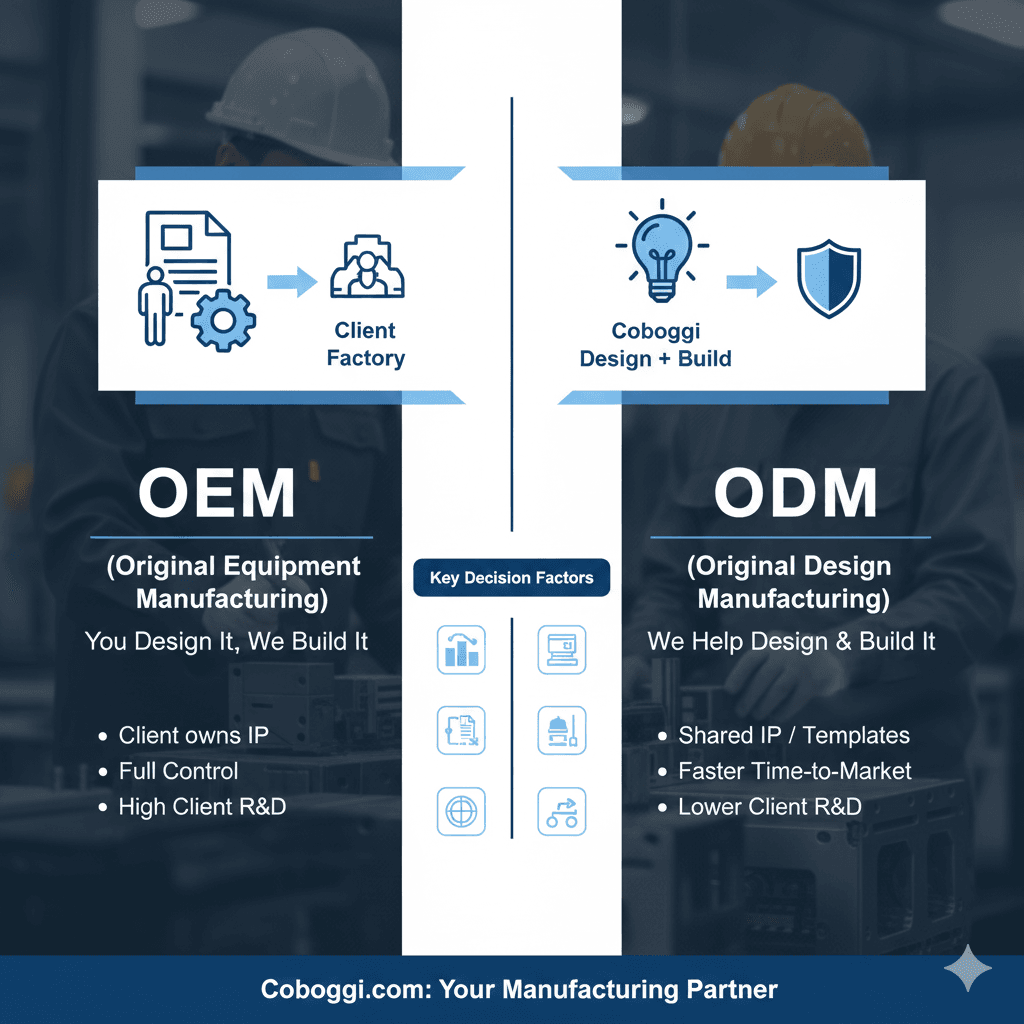
When you approach a manufacturer like Coboggi, you typically choose between two primary paths: OEM (Original Equipment Manufacturing) or ODM (Original Design Manufacturing). Understanding the difference is crucial for your budget, timeline, and intellectual property. For B2B procurement managers, this decision directly impacts unit cost, lead time, and supply chain risk.
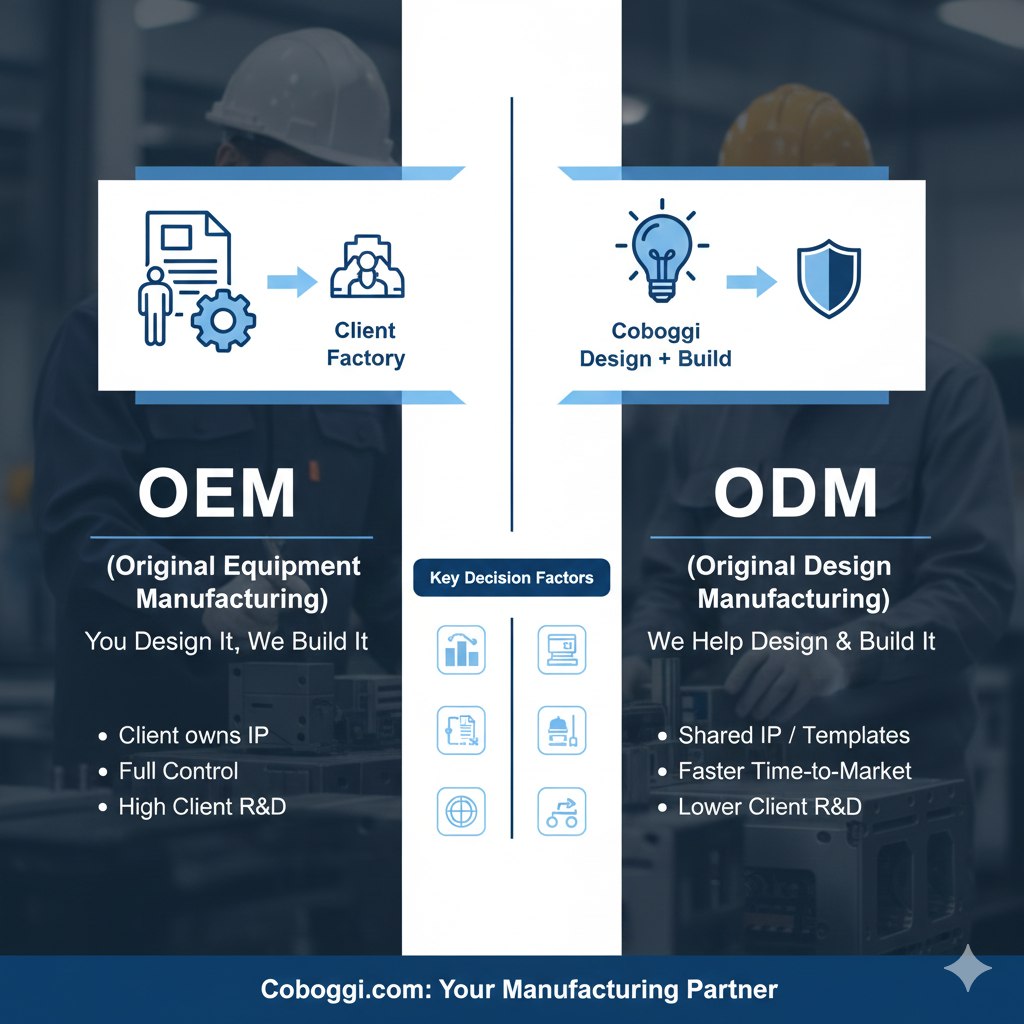
1. OEM: “You Design It, We Build It” – Precision Execution for Proprietary Designs
The OEM model is ideal for companies that have an in-house engineering team and a fully finalized CAD design with tolerances down to ±0.01mm.
How it works: You provide detailed 3D files (STEP/IGES), material specifications (e.g., Aluminum 6061-T6 or 7075-T6 with yield strength ≥ 505 MPa), and finishing requirements (e.g., hard anodizing to MIL-A-8625 Type III, 50µm thickness). Coboggi acts as your production arm, using our precision 5-axis CNC machining centers and 800-ton die-casting cells to execute your vision exactly, holding dimensional tolerances of ±0.05mm on critical features.
Best for: Established brands with specific, unique industrial designs who want total control over every millimeter of the enclosure and require NDA-protected IP.
Pro: Total control over intellectual property and brand identity; no design royalties; full ownership of tooling (molds, jigs).
Con: Requires significant upfront R&D from your side (typically 8-16 weeks for design validation); higher NRE (non-recurring engineering) costs ranging from $15,000 to $80,000 depending on complexity.
2. ODM: “We Help You Design and Build It” – Collaborative Engineering for Faster Time-to-Market
The ODM model is a more collaborative approach where the manufacturer plays a role in the design and development phase, leveraging existing platform architectures.
How it works: You come to us with a functional requirement (e.g., “I need a waterproof housing for a smart doorbell with an internal volume of 150cm³, IP67 rating, and thermal dissipation of 5W”). Coboggi’s engineering team helps design the enclosure for optimal manufacturability (DFM), chooses the right alloy (e.g., ADC12 for die-casting or 6063 for extrusion), and manages the prototyping phase with 3D-printed SLA parts in 3-5 days.
Best for: Startups or tech companies that have a great “internal” product (PCB and software) but need an expert partner to handle the mechanical “shell” and reduce BOM costs by 15-25% through design optimization.
Pro: Faster time-to-market (4-8 weeks saved vs. OEM); lower R&D costs for the client ($5,000-$20,000 for design assistance); access to proven manufacturing templates and jigs.
Con: Less granular control over the initial design phase; potential shared IP on certain design elements; tooling may be owned by manufacturer.
3. Key Decision Factors for B2B Procurement
| Feature | OEM (Original Equipment) | ODM (Original Design) |
| Design Ownership | Client owns everything (100% IP) | Often shared or based on existing templates (50-70% client IP) |
| Speed to Market | Dependent on Client’s R&D speed (12-20 weeks typical) | Faster (8-12 weeks typical, uses manufacturer’s expertise) |
| Technical Support | Execution focused (DFM review, QC) | Consultative & Innovative (design optimization, material selection) |
| Initial Cost | Higher R&D for the client ($20k-$80k NRE) | Lower R&D for the client ($5k-$20k design assistance) |
| Unit Cost (Volume 10k) | $8-$15 per unit (custom tooling amortized) | $6-$12 per unit (shared platform reduces tooling) |
| Quality Control | Client-defined specs, CMM inspection ±0.02mm | Manufacturer-defined specs, CMM inspection ±0.05mm |
4. Why Coboggi is the Ideal Partner for Both Models
Whether you are a global tech giant looking for an OEM partner with ISO 9001:2015 certified production lines, or a startup seeking ODM support to accelerate your launch, Coboggi delivers. Our 50,000 sqm facility houses 120+ CNC machines (including 5-axis DMG MORI), 18 die-casting cells (200-1,200 tons), and a dedicated finishing line for anodizing, powder coating, and PVD. We support annual volumes from 5,000 to 500,000 units, with lead times as low as 4 weeks for ODM projects. Contact our engineering team today for a free DFM analysis and cost breakdown.
Frequently Asked Questions
What’s the minimum order quantity (MOQ) for Coboggi’s ODM smart device enclosures with anodized aluminium finishes?
Our standard ODM MOQ is 5,000 units per configuration—this includes custom geometry, Class 1 or Class 2 anodizing (per ISO 7583), and ±0.05 mm dimensional tolerance on critical mounting features.
How much faster is time-to-market with Coboggi’s ODM model versus full OEM development from scratch?
ODM accelerates launch by up to 42%—reducing typical development cycles from 26 weeks (OEM) to just 15 weeks, including 3 rounds of functional prototyping and AEC-Q200-compliant thermal cycling validation.
Can Coboggi support OEM designs requiring tight surface finish specifications—and what’s the achievable Ra value?
Yes—we achieve Ra ≤ 0.2 µm on machined aluminium surfaces post-electropolishing, verified via Mitutoyo SJ-410 profilometer measurements per ISO 4287, and certified in our IATF 16949 audit reports.
What is the maximum allowable wall thickness variation across a 300 mm × 200 mm ODM enclosure to maintain EMI shielding integrity?
We hold wall thickness uniformity within ±0.12 mm across all structural zones, ensuring consistent 65 dB shielding effectiveness (measured at 1 GHz per IEEE Std 299.1-2020) without secondary plating.
Do Coboggi’s ODM enclosures meet IP67 ingress protection—and what’s the validated pressure differential during testing?
Yes—all ODM chassis undergo IP67 validation at 100 kPa pressure differential (equivalent to 1 m submersion for 30 min), with zero leakage detected using helium mass spectrometry (sensitivity: 5×10⁻⁹ mbar·L/s).
What’s the lead time for first-article approval (FAI) under Coboggi’s OEM partnership—and how many Cpk values are reported per critical dimension?
OEM FAI lead time is 12 business days from drawing release, and we report ≥3 Cpk values (minimum Cpk = 1.33) per critical dimension—covering all GD&T callouts with positional tolerances down to ±0.08 mm.