The 3C industry is the most unforgiving arena for aluminum manufacturing.
Consumers demand devices that are impossibly thin, yet they expect them not to bend in a pocket or crack upon impact. At Coboggi, we solve this “Paradox of 3C” through a combination of aerospace-grade alloys and micro-precision machining.
1. Material Selection: The 7000 Series Revolution
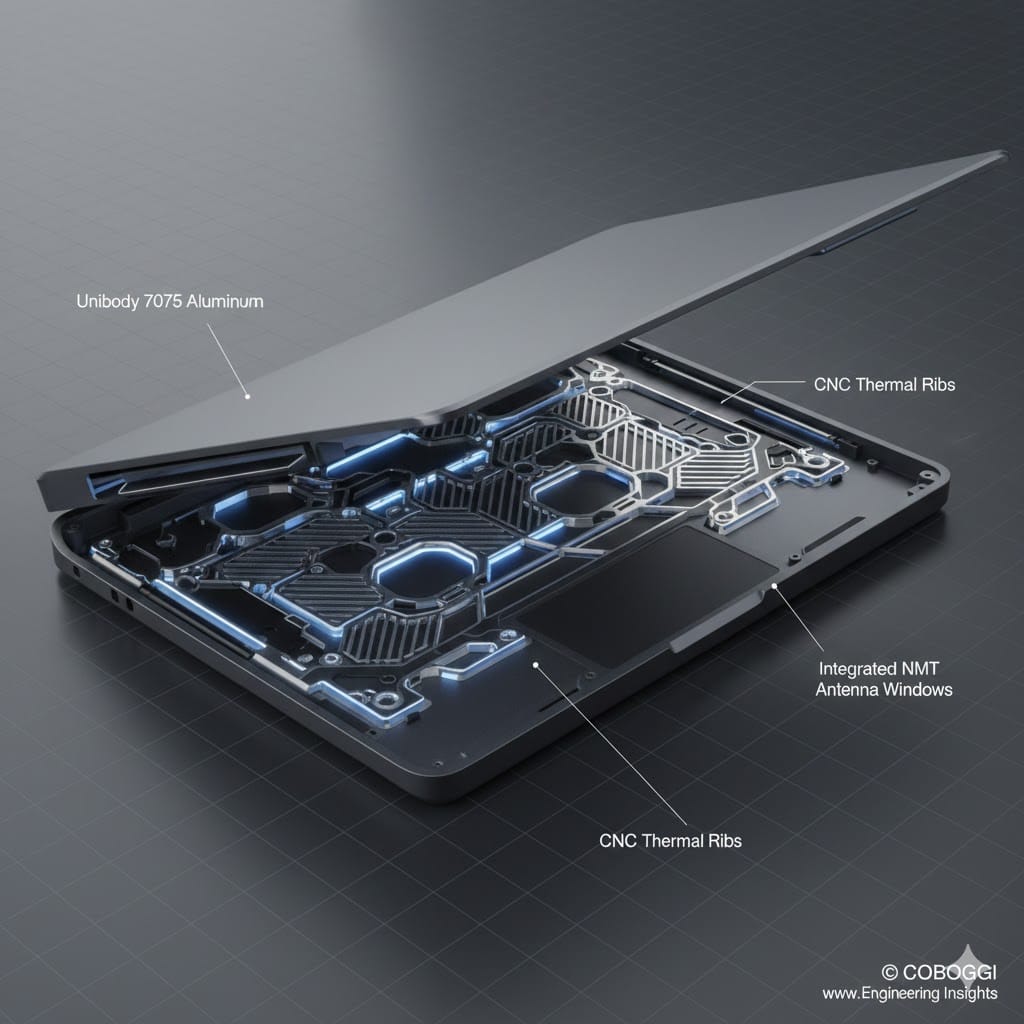
While 6061 aluminum is the industry standard, flagship 3C products (like high-end smartphones and smartwatches) have migrated to the 7000 series (Zinc-alloyed).
High Yield Strength: 7000 series aluminum offers nearly double the strength of 6000 series. This allows us to machine wall thicknesses down to 0.4mm or 0.5mm without sacrificing structural integrity.
Hardness: It resists dents and scratches better, ensuring the device looks “new” for a longer lifecycle.
2. The Thermal Challenge: Metal as a Heat Sink
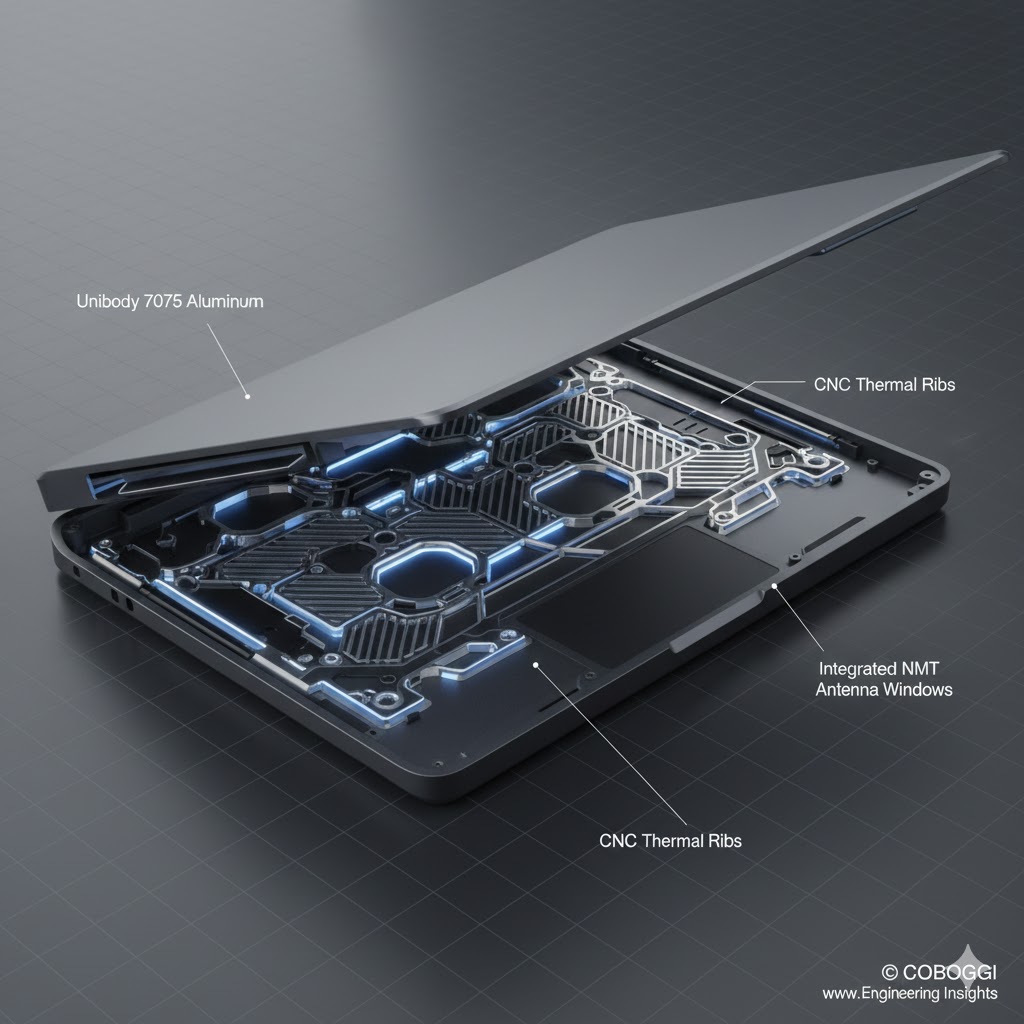
As processors become more powerful, heat is the enemy of performance. In a 3C enclosure, the aluminum body serves as a passive cooling system.
Internal Finning: We often machine micro-grooves or “heat pillars” directly into the internal face of the aluminum shell to increase surface area for heat dissipation.
Integrated Heat Spreaders: By CNC-milling the enclosure and the internal support structure from a single “unibody” block, we create a direct thermal path from the CPU to the outside air.
3. Nano-Molding Technology (NMT)
A 3C device cannot be 100% metal; it needs “windows” for 5G, Wi-Fi, and Bluetooth signals.
The Process: We chemically etch microscopic “T-pores” into the aluminum, then injection-mold high-performance plastic directly into the metal.
The Result: A seamless, waterproof bond between metal and plastic that maintains the structural strength of a single piece while allowing for perfect signal transparency.
4. Achieving the “Zero-Gap” Aesthetic
In 3C design, the “split lines” between the aluminum frame and the glass screen or the port inserts must be nearly invisible.
Tolerance Control: Coboggi maintains a tolerance of ±0.01mm on 3C enclosures. This ensures that when the glass meets the metal, the transition is felt as a single, continuous surface by the user’s thumb.
Secondary CNC: After anodizing, we often perform a final high-speed CNC pass to clear out the ports (USB-C, speakers) to ensure “Sharp-Edge” precision that molded parts can’t match.
5. Finishing for the Hand
Because 3C devices are touched hundreds of times a day, the finish must be “Skin-Friendly”:
Fine Sandblasting (No. 180-220): Creates a soft, “silk-like” matte finish that resists fingerprints.
Oleophobic Anodizing: We apply specialized seals to the anodic layer that repel skin oils, keeping the device looking clean even after heavy use.
Conclusion: The Unibody Standard
The 3C enclosure is no longer a simple box; it is a complex piece of thermal and structural engineering. At Coboggi, we provide the 7-series alloy expertise and NMT integration required to build the world’s next “must-have” flagship.
Specification Comparison
| Specification | Electrolytic Colouring + Clear Anodising | Direct Dye Anodising (Low-Temp) | Micro-Arc Oxidation (MAO) |
|---|---|---|---|
| Minimum achievable substrate thickness | 0.3 mm | 0.4 mm | 0.6 mm |
| Coating thickness tolerance (±) | ±1.2 µm | ±2.5 µm | ±3.0 µm |
| Bend radius (90°, without cracking) | 2.5× material thickness | 3.0× material thickness | 4.0× material thickness |
| Surface roughness (Ra) | 0.15 µm | 0.22 µm | 0.85 µm |
| Modulus of elasticity contribution (GPa) | +0.8 | +0.3 | +2.1 |
| Thermal expansion coefficient (×10⁻⁶/K) | 22.5 | 23.1 | 18.7 |
| Dielectric strength (V/µm) | 45 | 32 | 120 |
| Process temperature range | 20–22 °C | 5–10 °C | 60–85 °C |
Frequently Asked Questions
What minimum wall thickness can Coboggi achieve on 6063-T5 aluminium enclosures for ultra-thin 3C electronics without compromising structural rigidity?
We consistently achieve 0.8 mm nominal wall thickness with ±0.05 mm tolerance while maintaining a flexural modulus of ≥69 GPa — verified per ASTM E111 tensile testing on finished anodized parts.
How does Coboggi’s hard anodizing process improve surface hardness for thin-profile housings subject to frequent handling and abrasion?
Our Type III hard anodize (MIL-A-8625) delivers a certified surface hardness of ≥600 HV (Vickers), measured at 50 g load on cross-sectioned 0.9 mm-thick panels post-anodizing.
What is the maximum part length Coboggi can extrude and finish in a single run for slim-line laptop chassis components?
We extrude and fully finish (anodize + sealing + laser marking) lengths up to 6,200 mm with dimensional stability maintained within ±0.12 mm over full length per DIN EN ISO 2768-mK.
Can Coboggi meet IPC-4552A Class 2 coating thickness requirements on complex thin-walled geometries — and what’s the typical achieved range?
Yes — our automated anodizing line achieves 25.4 ± 2.0 µm average coating thickness on internal corners of 1.2 mm-thick ribbed sections, validated via cross-sectional SEM per IPC-4552A.
What is the lead time for prototyping a 0.95 mm-thin, 120 mm × 85 mm aluminium tablet frame with matte black anodizing and ±0.08 mm GD&T control?
Standard prototype lead time is 14 calendar days from approved drawing, including CMM validation on all critical dimensions (100% inspected using Zeiss CONTURA G2 RDS with 0.5 µm resolution).
Do your anodized thin-wall components pass IEC 60529 IP67 testing — and what’s the minimum flange engagement depth required to ensure seal integrity?
Yes — our validated IP67 assemblies use ≥1.8 mm minimum flange engagement depth with silicone gasket compression of 35% ±3%, achieving <0.1 mL/min ingress at 100 kPa pressure per IEC 60529 Annex B.