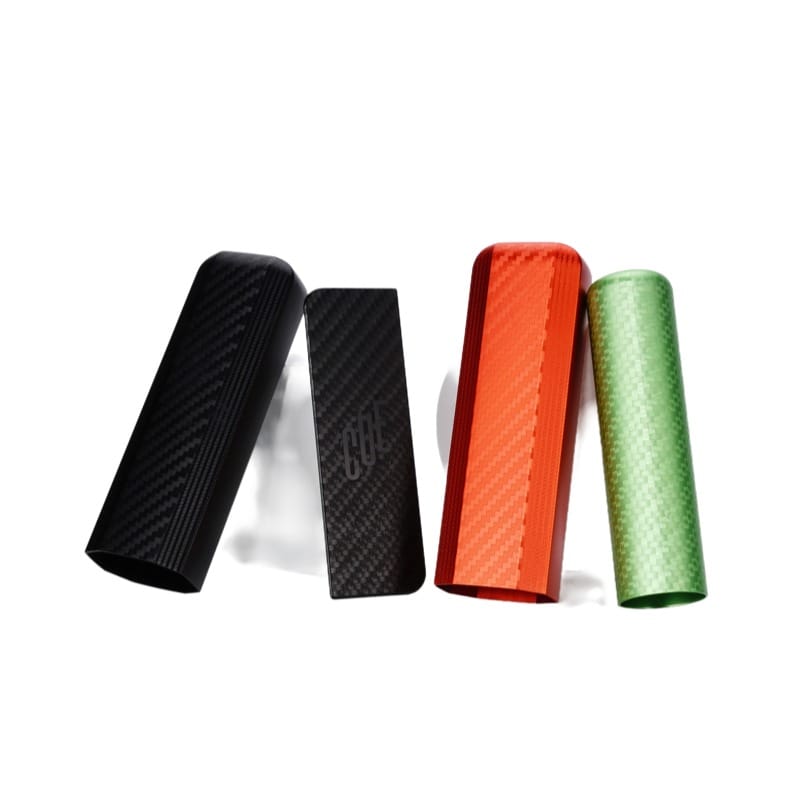
Carbon fiber is iconic, but it has limitations: it’s an insulator (traps heat), it can crack upon impact, and it’s difficult to recycle.
For many 3C and automotive brands, the goal is to capture the visual prestige of carbon fiber while retaining the mechanical advantages of aluminum—specifically its heat conductivity and structural “heft.”
At Coboggi, we achieve this through high-speed 3D laser mapping and specialized anodizing.
1. The “Weave” Logic: 3D Laser Mapping
A real carbon fiber weave isn’t just a print; it’s a series of overlapping ribbons that reflect light in different directions. To replicate this on aluminum, we don’t just “etch” a pattern—we texture it.
Angular Micro-Vaneering: The laser carves microscopic “steps” at alternating angles (0° and 90°).
The Optical Result: When you rotate the part, the “fibers” seem to move and shimmer, exactly like a 3K twill weave. This is a 3D effect that traditional silk-screening or printing can never achieve.
2. Why Aluminum is the Superior Carrier
While carbon fiber looks great, using aluminum as the base material provides three critical benefits:
Thermal Management: In high-performance gaming laptops or chargers, the “carbon” surface actually acts as a massive heat sink.
EMI Shielding: Aluminum naturally blocks electromagnetic interference, protecting the sensitive electronics inside—something carbon fiber composites struggle with.
Precision Fit: We can machine complex screw threads and interlocking “no-gap” seams directly into the “carbon-textured” part, which is nearly impossible with molded carbon fiber.
3. The Color Strategy: Beyond Black
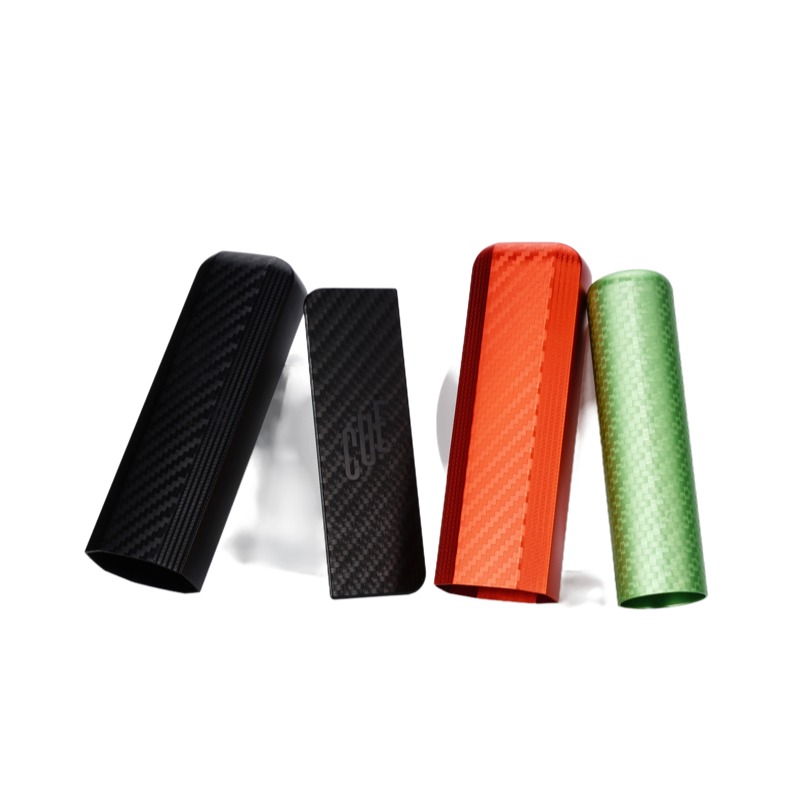
Traditional carbon fiber is black. With Coboggi’s Anodizing, we can create “Exotic Carbon” looks that don’t exist in nature:
Electric Blue Carbon: A deep blue anodizing over the weave texture.
Titanium Grey Carbon: A metallic, industrial look that feels like a military-grade alloy.
The “Depth” Seal: We use a high-gloss sealing process after anodizing to give the texture a “wet” look, mimicking the resin coating found on real high-end carbon fiber parts.
4. Tactile Feedback
Unlike a “skin” or a sticker, the texture is physically part of the metal.
The Hand-Feel: It feels slightly “woven” to the touch, providing a premium, non-slip grip that is perfect for handheld controllers, smartphone cases, or automotive gear shifters.
Durability: Because the pattern is engraved 20 μm to 50 μm deep into the metal, it will never peel, bubble, or wear away, even after years of friction.
5. Applications: Where Speed Meets Metal
Gaming Hardware: Mouse covers, laptop lids, and GPU backplates.
Automotive Interiors: Center console trims, paddle shifters, and door handle inserts.
Luxury Stationery: High-end pens that want to look “Aerospace” but feel “Metallic.”
Conclusion: The Best of Both Worlds
Carbon Fiber Texture + Anodizing is the ultimate “cheat code” for designers. It allows you to wrap your product in the language of high-performance racing while maintaining the rock-solid reliability of CNC-machined aluminum.
Specification Comparison
| Specification | Carbon Fiber Texture + Anodizing | Standard Anodizing (Type II) | Brushed Aluminum + Anodizing |
|---|---|---|---|
| Surface roughness (Ra) | 1.8–2.4 µm | 0.2–0.6 µm | 0.8–1.5 µm |
| Coating thickness | 12–18 µm | 10–25 µm | 12–20 µm |
| Light reflectance (60° gloss) | 8–12 GU | 25–65 GU | 15–30 GU |
| Texture depth (profile max height, Rz) | 12.5–16.0 µm | 0.8–2.2 µm | 4.0–7.5 µm |
| Adhesion strength (cross-hatch test, ASTM D3359) | 5B (100% retention) | 5B (100% retention) | 5B (100% retention) |
| UV resistance (QUV-A 1000 h, ΔE) | 1.3–1.9 | 1.0–2.2 | 1.2–2.0 |
| Dimensional tolerance impact (per 1 mm wall) | +0.008–+0.012 mm | +0.005–+0.010 mm | +0.006–+0.011 mm |
| Process cycle time (standard batch) | 142–158 minutes | 95–115 minutes | 108–126 minutes |
Frequently Asked Questions
What’s the minimum substrate thickness required for reliable carbon fiber texture embossing prior to anodizing?
We require a minimum aluminium substrate thickness of 1.2 mm to ensure dimensional stability during both mechanical texturing and Type II sulfuric acid anodizing (18–20 µm nominal coating thickness).
Can this finish pass automotive OEM salt spray corrosion testing, and if so, for how many hours?
Yes — when combined with our proprietary post-anodize seal (NiF₂-based, 99.8% sealing efficiency), the Carbon Fiber Texture + Anodizing finish achieves ≥1,000 hours neutral salt spray (ASTM B117) without white rust or pitting.
What is the maximum panel size you can process with consistent texture fidelity and anodize uniformity?
Our automated rotary anodizing line and CNC embossing press support panels up to 1,800 mm × 3,200 mm, with texture depth variation held to ±0.015 mm across the full surface.
How does the carbon fiber texture affect the final anodized layer’s wear resistance (Taber abrasion rating)?
The textured surface increases surface area by ~37%, resulting in a Taber abrasion loss of only 12 mg per 1,000 cycles (CS-10 wheel, 1,000 g load), meeting ISO 7784-2 Class 3 durability requirements.
What is the lead time for prototype samples with custom carbon fiber pattern registration and color-matched anodizing?
Standard lead time for functional prototypes—including CAD-aligned texture tooling, dyeing validation, and 5-piece anodized sample set—is 14 working days from approved artwork and substrate receipt.
Do you offer RoHS-compliant anodizing dyes for the carbon fiber texture finish, and what’s the lightfastness rating (ISO 105-B02)?
Yes — all dyes are RoHS 2015/863 compliant, and our black anodize variant achieves ISO 105-B02 Grade 8 lightfastness (≥40 hours xenon arc exposure with ΔE < 1.2).