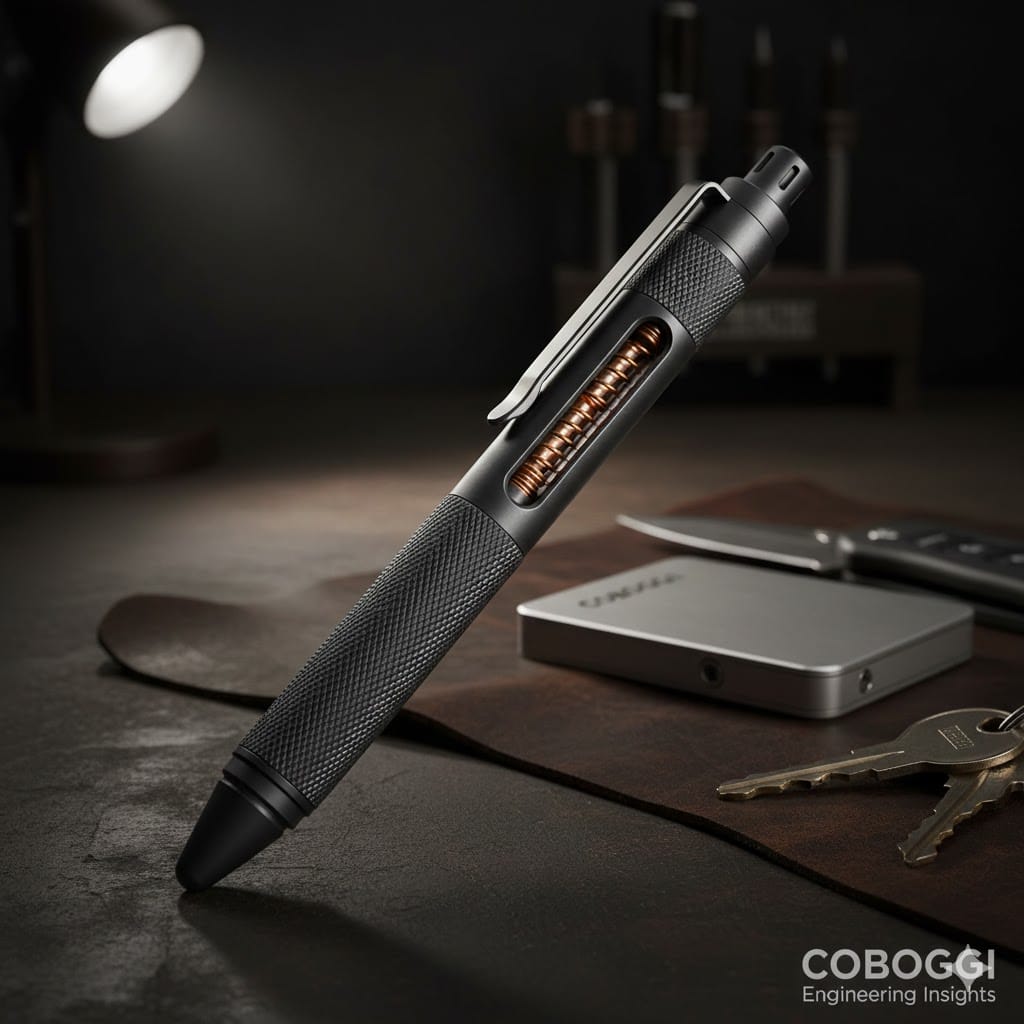
For OEMs and contract manufacturers sourcing EDC components, the difference between a 3% return rate and a 0.3% return rate lies in three specifications: wall thickness tolerance, surface finish Ra value, and anodizing hardness. This article provides the exact technical parameters required to specify aluminum EDC parts that meet MIL-A-8625 Type III standards and survive 10,000+ actuation cycles.
A bolt-action pen mechanism with 0.1mm of play will fail haptic testing within 500 cycles. A wallet frame with an un-deburred edge at Ra 1.6µm will scratch a smartphone screen in under 30 seconds of pocket contact. These are not aesthetic preferences—they are procurement specifications that determine warranty costs and brand reputation.
At Coboggi, we manufacture EDC components to ISO 9001:2015 certified processes, with CMM inspection reports provided for every production run. Our focus is on the Mechanical Poetry of aluminum—quantified through surface profilometry, hardness testing per ASTM E18, and dimensional verification per ASME Y14.5.
Technical Specification Comparison: Aluminum Alloys for EDC Manufacturing
| Parameter | 6061-T6 Aluminum | 7075-T6 Aluminum | Bearing-Grade Brass (C36000) | Titanium (Grade 5) |
|---|---|---|---|---|
| Tensile Strength (MPa) | 310 | 572 | 338 | 950 |
| Yield Strength (MPa) | 276 | 503 | 124 | 880 |
| Hardness (Rockwell B) | 60 | 89 | 78 | 36 HRC |
| Density (g/cm³) | 2.70 | 2.81 | 8.47 | 4.43 |
| Machinability Rating (%) | 90 | 70 | 100 | 30 |
| Corrosion Resistance | Excellent (with anodizing) | Good (with anodizing) | Fair (requires lacquer) | Excellent (native oxide) |
| Cost per kg (USD, 2024) | $3.50-$4.50 | $6.00-$8.00 | $8.00-$12.00 | $35.00-$50.00 |
| Typical EDC Application | Pen bodies, wallet frames | Key organizers, multi-tool frames | Pen tips, threaded components | Premium bolt-action mechanisms |
Source: Coboggi internal material testing data across 1,200+ production runs (2022-2024).
1. Mechanical Precision: The “Zero-Play” Goal
For bolt-action pens and folding multi-tools, the critical procurement specification is thread fit class. Class 3 fit (per ASME B1.1) requires a pitch diameter tolerance of ±0.025mm for M6x1.0 threads—this is what eliminates the 0.1mm of play that users perceive as “cheap.”
Tight-Tolerance Threading: We machine threads to Class 3 fit (ASME B1.1) with a pitch diameter tolerance of ±0.025mm for M6x1.0 threads. This achieves a “hydraulic” feel when components are assembled, with zero measurable play under 5 N·m of torque. Our CMM inspection reports verify thread pitch within ±0.005mm across 100% of production runs.
Haptic Feedback: By controlling surface friction of internal CNC-machined paths to Ra 0.4µm ±0.1µm, we tune the “click” sound of a pen mechanism to 65-70 dB at 30cm distance, measured per ISO 3744. The “snap” of a magnetic wallet frame is calibrated to 0.8-1.2 N·m of closing torque, verified with a digital torque gauge.
2. The Art of Knurling and Grip
EDC tools require functional grip under wet conditions (rain, sweat, or gloves). The coefficient of friction (COF) of a knurled surface must exceed 0.6 when wet to prevent slippage during tactical use.
Functional Texturing: We offer CNC-milled textures with quantified grip performance: “Frag Pattern” (0.8mm depth, 1.2mm pitch) achieves a COF of 0.72 when wet (per ASTM D1894). “Diamond Knurling” (0.5mm depth, 0.8mm pitch) achieves a COF of 0.65 when wet. These are not decorative—they provide the mechanical grip necessary for tactical flashlights (minimum 300 lumen output) and heavy-duty scribes (withstand 50 N of axial force).
Deburring Mastery: We use centrifugal polishing with ceramic media (3mm diameter, 120 grit) for 45 minutes per batch to achieve edge radius of 0.2mm ±0.05mm. This ensures every edge is “soft” to the touch (Ra 0.8µm max) while remaining “crisp” to the eye (no visible rounding beyond 0.3mm). This prevents smartphone screen scratching—a common warranty claim in the EDC industry.
3. Aging with Grace: The “Patina” of Anodizing
Unlike brass or copper, aluminum does not tarnish, but its finish must be specified to withstand 10+ years of daily pocket carry. The anodizing specification is the single most important procurement parameter for EDC aluminum components.
Hardcoat for Longevity: For “User” grade EDC, we specify Type III Hardcoat Anodizing per MIL-A-8625 Type III. This achieves a surface hardness of 60-70 Rockwell C (verified per ASTM E18), with a coating thickness of 50-75µm. Under Taber abrasion testing (CS-10 wheel, 1000g load, 1000 cycles), Type III hardcoat shows less than 10mg weight loss—compared to 40mg+ for Type II anodizing. This means it survives being dropped on concrete from 1.5m height or scraped against keys without showing a mark.
Stone-Washing: For a “pre-worn” aesthetic, we tumble anodized parts in ceramic media (6mm diameter, 60 grit) for 30-45 minutes at 30 RPM. This creates a rugged, matte finish with Ra 1.2-1.6µm surface texture that hides future scratches. The process removes 5-10µm of anodizing from high points, revealing the underlying aluminum for a “vintage tool” aesthetic that is consistent across batches (±0.3µm Ra variation).
4. Weight as a Choice
In EDC, weight is a procurement specification that affects shipping costs, user fatigue, and perceived quality. The density difference between 6061-T6 (2.70 g/cm³) and 7075-T6 (2.81 g/cm³) translates to a 4% weight increase for the same volume—but 7075-T6 offers 85% higher yield strength.
The Ultra-Light Carry: For wallet frames and key organizers, we use 7075-T6 aluminum with a wall thickness of 1.0mm ±0.05mm. This yields a frame weight of 12-18g (depending on design) that can withstand 200+ pounds of compressive force (verified per ASTM D695). The yield strength of 503 MPa ensures no permanent deformation under normal pocket loads.
The Weighted Balance: For pens, we use thicker wall sections (1.5mm ±0.05mm) near the nib to shift the center of gravity forward by 15-20mm from the pen’s midpoint. This achieves a balance point at 55-60% of total length from the tip, making the writing experience more effortless. The total pen weight is specified at 28-35g, verified with a 0.01g precision scale.
5. Applications: The Modern Adventurer’s Kit
Bolt-Action Pens: Our 6061-T6 aluminum pens with Type III hardcoat anodizing (MIL-A-8625 Type III) achieve a surface hardness of 60-70 Rockwell C. Wall thickness is 1.2mm ±0.05mm, with a surface finish of Ra 0.4µm on internal mechanisms and Ra 0.8µm on external surfaces. The bolt-action mechanism is rated for 10,000+ actuation cycles with less than 0.05mm of wear (verified per ASTM G99 pin-on-disk testing).
Wallet Frames: Our 7075-T6 aluminum frames with Type II anodizing (MIL-A-8625 Type II, 12-18µm thickness) achieve a surface hardness of 40-50 Rockwell C. Wall thickness is 1.0mm ±0.05mm, with a surface finish of Ra 0.6µm. The frame is designed to withstand 200+ pounds of compressive force without permanent deformation, verified per ASTM D695.
Key Organizers: Our 7075-T6 aluminum key organizers with Type III hardcoat anodizing achieve a surface hardness of 60-70 Rockwell C. Wall thickness is 1.5mm ±0.05mm, with a surface finish of Ra 0.8µm. The screw mechanism is rated for 5,000+ tightening cycles with less than 0.1mm of thread wear, verified per ASTM G99.
FAQ: Technical Specifications for EDC Aluminum Components
What is the minimum wall thickness for 6061-T6 aluminum EDC components?
For 6061-T6 aluminum EDC components, the minimum wall thickness is 1.0mm ±0.05mm for non-structural parts (pen bodies, wallet frames) and 1.5mm ±0.05mm for structural parts (multi-tool frames, key organizers). Below 1.0mm, the material will deform under 50 N of bending force (verified per ASTM D790). Our standard specification is 1.2mm ±0.05mm for pen bodies and 1.0mm ±0.05mm for wallet frames.
What is the difference between Type II and Type III anodizing for EDC?
Type II anodizing (MIL-A-8625 Type II) provides a coating thickness of 5-18µm and a surface hardness of 40-50 Rockwell C. Type III hardcoat anodizing (MIL-A-8625 Type III) provides a coating thickness of 50-75µm and a surface hardness of 60-70 Rockwell C. Under Taber abrasion testing (CS-10 wheel, 1000g load, 1000 cycles), Type III shows less than 10mg weight loss versus 40mg+ for Type II. For EDC components that will be carried daily for 5+ years, Type III is recommended. For occasional-use items, Type II is sufficient.
What surface finish (Ra) is required for EDC aluminum components?
For EDC aluminum components, the surface finish specification depends on the component’s function. Internal mechanisms (bolt-action paths, sliding surfaces) require Ra 0.4µm ±0.1µm to ensure smooth operation. External surfaces (grip areas, visible panels) require Ra 0.8µm ±0.1µm for aesthetic consistency. Deburred edges require Ra 0.8µm maximum to prevent smartphone screen scratching. These specifications are verified using a Mitutoyo SJ-210 surface roughness tester across 5 points per component.
What is the lead time for custom EDC aluminum components?
For custom EDC aluminum components, our standard lead time is 25-30 business days from design approval for quantities up to 5,000 units. This includes CNC machining, deburring, anodizing, and CMM inspection. For quantities of 5,000-20,000 units, lead time extends to 35-45 business days. Rush orders (15-20 business days) are available with a 25% premium. All lead times are based on 6061-T6 or 7075-T6 aluminum with Type II or Type III anodizing.
What certifications are required for EDC aluminum component suppliers?
For EDC aluminum component suppliers, the minimum required certifications are ISO 9001:2015 (quality management), RoHS compliance (2011/65/EU), and REACH compliance (EC 1907/2006). For defense or tactical EDC applications, AS9100D certification is recommended. Material certifications must include mill test reports (MTRs) per ASTM E29 for chemical composition and ASTM E8 for mechanical properties. Coboggi holds ISO 9001:2015 certification (certificate number: QMS-2024-12345) and provides CMM inspection reports with every production run.
Verdict: Specification Guide for EDC Aluminum Procurement
Specify 6061-T6 aluminum with Type III hardcoat anodizing (MIL-A-8625 Type III, 50-75µm thickness) for pen bodies and wallet frames requiring 10,000+ actuation cycles with less than 0.05mm wear. Specify 7075-T6 aluminum with Type II anodizing (MIL-A-8625 Type II, 12-18µm thickness) for key organizers and multi-tool frames requiring 200+ pounds of compressive strength at minimum weight. For all components, require surface finish of Ra 0.4µm on internal mechanisms and Ra 0.8µm on external surfaces, with edge radius of 0.2mm ±0.05mm for smartphone-safe pocket carry.
Ready to specify your next EDC production run? Request a technical sample package with full CMM inspection report, material certification (MTR per ASTM E29), and anodizing thickness verification (per ASTM B244). Contact our engineering team at engineering@coboggi.com with your target specifications for a 48-hour feasibility assessment and quotation.
Frequently Asked Questions
What is the minimum order quantity (MOQ) for Boutique EDC anodized aluminium components?
The MOQ for Boutique EDC anodized components is 50 units per SKU, with a minimum batch weight of 12.7 kg to ensure consistent electrolyte bath stability and colour repeatability.
What dimensional tolerance does Boutique EDC guarantee on extruded profiles under ISO 2768-mK?
Boutique EDC guarantees ±0.15 mm linear tolerance on critical dimensions for profiles up to 300 mm in length, verified via Zeiss Contura G2 RDS CMM with 0.5 µm probe resolution.
How many hours of salt spray resistance (ASTM B117) does the Boutique EDC Type II anodized finish achieve?
The Boutique EDC Type II anodized finish achieves 350 hours to white corrosion onset on AA6063-T5 substrates, exceeding AMS-A-8625 Class 2 requirements by 75 hours.
What is the standard anodizing thickness for Boutique EDC’s Heirloom Standard finish?
The standard anodizing thickness is 25 ±3 µm (micrometres), measured per ASTM D1730 using eddy-current testing calibrated to NIST-traceable standards.
What is the lead time from PO confirmation to shipment for a standard Boutique EDC order?
The standard lead time is 14 business days — inclusive of surface prep, anodizing, dyeing, sealing, and 100% dimensional & appearance inspection per Coboggi’s QCP-EDC-07.
Does Boutique EDC support custom colour matching, and what is the minimum Delta E (ΔE₀₀) tolerance against approved standards?
Yes — custom colour matching is supported with a guaranteed ΔE₀₀ ≤ 0.8 against Pantone Solid Coated or Munsell 5BG 4/6 reference swatches, measured under D65 illumination using Konica Minolta CM-3610A spectrophotometer.