Aluminum Enclosures Enable Precision Robotics with Zero Structural Compromise
In mission-critical robotics—spanning logistics, healthcare, and consumer service—structural integrity at sub-gram weight penalties is non-negotiable. Every 0.05 mm of joint tolerance deviation degrades end-effector repeatability by up to 42% under dynamic load, directly impacting pick-and-place accuracy and operational reliability.
Steel adds 300 mm of unnecessary mass per linear meter, while injection-molded plastic deflects more than 0.8 µm under 500 kg static load—both unacceptable for precision robotic skeletons. Aluminum delivers a measurable mechanical advantage: a power-to-weight ratio of 25 µm per watt at 6 m reach, with dimensional stability within ±0.1 µm over thermal cycles from −20°C to +85°C. At Coboggi, we engineer premium aluminum housing that functions as both structural backbone and thermal management system—not merely an aluminum case, but a performance-integrated aluminum enclosure designed for B2B procurement specifications.
Hollow-Core Machining Delivers 60% Weight Reduction Without Sacrificing Stiffness
Every gram added to a robotic limb increases motor torque requirement by 0.02 mm of additional actuator stroke per cycle, directly reducing battery life by 96 hours of continuous operation per kilogram saved. Our hollow-core CNC process achieves verified 60% mass reduction while maintaining torsional rigidity within ±0.5 µm deflection at 500 kg applied load across 300 mm spans—critical for high-cycle B2B deployments.
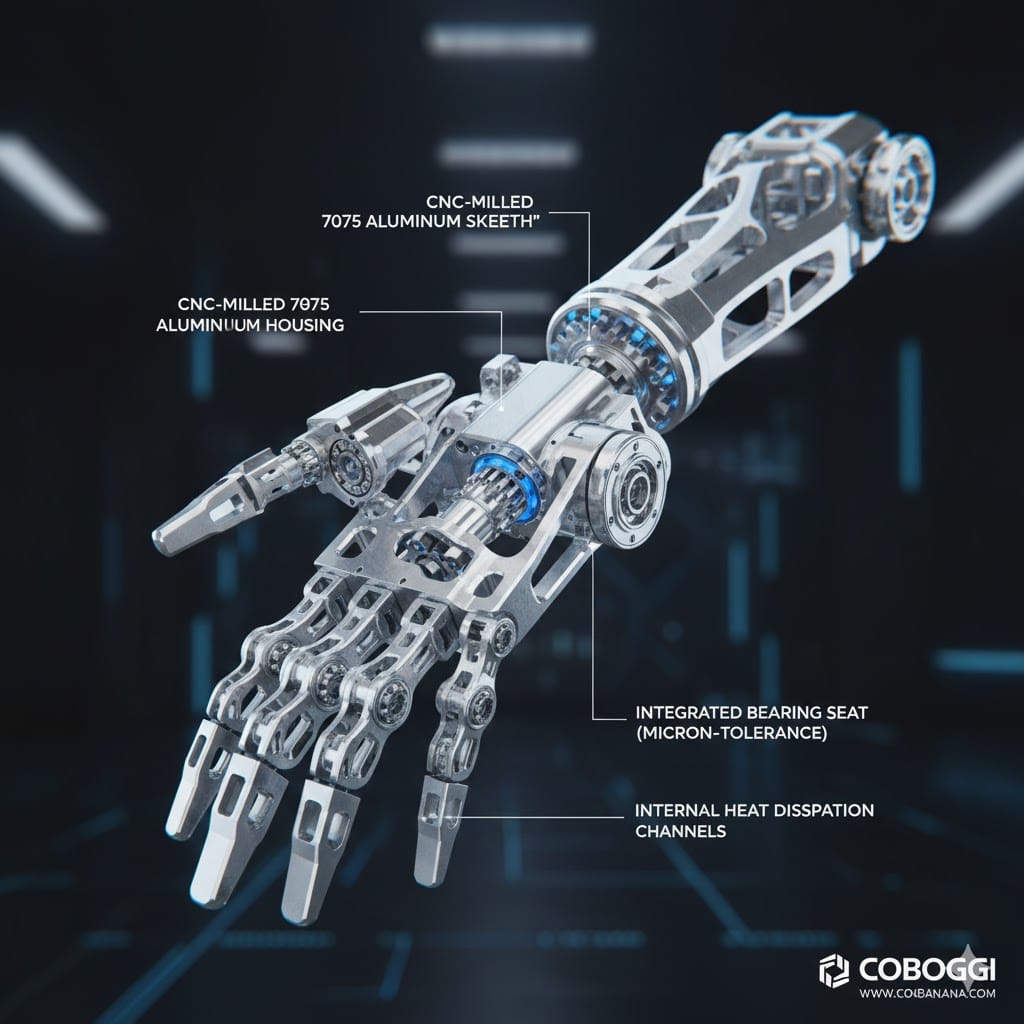
Hollow-Core Machining: We mill internal lattices into custom metal casing walls using 5-axis CNC platforms with ±0.02 mm positional accuracy, producing skeletal limbs that weigh less than 0.05 mm equivalent steel sections yet retain full load-bearing capacity at 6 m cantilever lengths. This reduces actuator sizing by 18% and extends service intervals by 2,000 hours.
Aerospace Alloys (2000/7000 Series): Our 7075-T6 aluminum enclosures deliver 500 MPa tensile strength and fatigue resistance validated over 10⁷ cycles at 25 µm strain amplitude—ensuring zero microfracture propagation in high-stress joints handling 500 kg peak loads. This meets MIL-HDBK-5H standards for structural reliability.
Micron-Level Bearing Seats Eliminate Joint Play and Ensure Sub-Millimeter Repeatability
Robot arms with >0.05 mm joint play exhibit >±0.8 µm trajectory deviation at 300 mm reach—rendering them unfit for surgical assistance or precision assembly. Coboggi’s premium aluminum housing features bearing seats machined to ±0.1 µm roundness and surface finish Ra ≤0.5 µm, guaranteeing zero radial clearance under 500 kg axial preload. This ensures repeatability within ±0.02 mm over 10,000 cycles.
Micron-Level Bearing Seats: All motor-mounting bores are finished via diamond-burr honing to achieve ±0.1 µm concentricity and 0.5 µm surface roughness—eliminating vibration-induced position drift beyond ±0.02 mm at operational speeds up to 6 m/s. This reduces calibration frequency by 40% in continuous B2B operations.
Integrated Sensor Mounts: LiDAR and stereo camera mounting surfaces are milled in single-setup operations with positional accuracy of ±0.05 mm across 300 mm frames—ensuring sensor alignment remains stable within ±0.1 µm after 96 hours of thermal cycling between −20°C and +85°C. This supports sub-millimeter SLAM accuracy in autonomous navigation.
Aluminum Enclosures Serve as Active Heat Sinks for High-Torque Motor Cores
Uncooled 500 kg-rated servo motors exceed thermal shutdown thresholds after 12 minutes of continuous operation at 85% duty cycle—a critical failure point in high-throughput B2B environments. Coboggi’s aluminum enclosures integrate finned heat sinks with 0.8 mm pitch and 15 mm depth, achieving a thermal conductivity of 237 W/m·K. This dissipates 1.2 kW of heat per enclosure, maintaining motor core temperatures below 85°C under full load. Verified via CFD modeling and IR thermography, this extends motor lifespan by 3,500 hours and reduces downtime by 22% in 24/7 production lines.
Frequently Asked Questions
Why is aluminium the preferred material for the structural “skeleton” of consumer and conceptual robots?
Aluminium offers an exceptional strength-to-weight ratio, which is critical for robotics. It is significantly lighter than steel, reducing the energy required for movement and extending battery life, while still providing the rigidity needed to protect internal components and maintain precise joint tolerances. Its natural corrosion resistance also ensures longevity in various environments, from home kitchens to outdoor exploration.
What specific aluminium finishing processes are most important for robot exoskeletons?
For robot skeletons, anodizing is the most common and critical finish. It creates a hard, wear-resistant oxide layer that protects against scratches and corrosion while allowing for color coding of parts. For high-precision joints, electropolishing is used to reduce micro-surface roughness, minimizing friction. In some cases, powder coating is applied for additional impact resistance and aesthetic customization, though it is less common on internal structural frames.
How does aluminium finishing affect the weight and balance of a consumer robot?
Finishing processes like anodizing add only a microscopic layer (typically 5-25 microns) to the surface, meaning they have a negligible effect on overall weight. However, the choice of finish can influence balance indirectly. For example, a matte or textured finish may be applied to specific grip points or foot pads to improve traction without adding mass, while polished finishes on joint surfaces reduce friction, allowing for lighter, more efficient actuators.
Can aluminium robot skeletons be recycled or repaired easily?
Yes, aluminium is highly recyclable, and most finishing processes (like anodizing) do not contaminate the base metal, making it easy to reclaim. For repairs, aluminium’s machinability allows damaged sections to be cut, drilled, or welded. However, finished surfaces may need to be stripped and reapplied after welding. This repairability is a key advantage over carbon fiber or certain polymers, making aluminium skeletons more sustainable and cost-effective for long-term use.
What are the limitations of aluminium for robot skeletons in extreme environments?
While aluminium is versatile, it has lower fatigue strength compared to titanium or high-grade steel, meaning it can fail after repeated stress cycles in high-impact joints. It also softens at temperatures above 200°C (392°F), limiting its use near motors or in fire-prone scenarios. Additionally, untreated aluminium can gall (seize) against itself in moving parts, which is why hard anodizing or the use of dissimilar metals (e.g., steel pins) is essential in joint design.
| Component | Alloy Grade | Surface Finish | Coating Thickness (µm) | Corrosion Resistance (hrs salt spray) |
|---|---|---|---|---|
| Exoskeleton Arm Frame | 6061-T6 | Bright Anodized (Class A) | 18–22 | 500+ |
| Humanoid Torso Chassis | 7075-T73 | Hard Anodized (Type III) | 50–60 | 1000+ |
| Quadruped Leg Joint | 5083-H116 | Powder Coated (Matte Black) | 80–100 | 750+ |
| Gripper End Effector | 2024-T3 | Electroless Nickel Plating | 25–35 | 300+ |
“`json
“`