If you are a global hardware brand, your “Signature Color” is your visual trademark.
Whether it is the specific “Space Gray” of a laptop or the “Clinical White” of a medical device, that color represents your quality standard.
However, aluminum anodizing is an electrochemical process, not a painting process. It is notoriously difficult to control. Factors like the alloy’s silicon content, the temperature of the acid bath, and even the humidity in the factory can shift the color.
At Coboggi, we view color consistency not as an “art,” but as a Rigid Scientific Protocol.
1. The “Mismatched Set” Problem (The Cost of Rejection)
Imagine a high-end Hi-Fi audio system where the amplifier and the pre-amp are supposed to be “Champagne Gold,” but they arrive at the customer’s house in two slightly different hues.
The Business Impact: The customer perceives the brand as “uncoordinated.” This leads to high return rates and “Open Box” discounts that eat your profit.
The Coboggi Solution: We utilize Digital Spectrophotometry to measure the “Delta E” (color difference) of every batch. We ensure that the variance is below the threshold of human perception (ΔE < 1.0).
The ROI: You can ship parts from different production runs months apart, confident they will match perfectly when placed side-by-side on a retail shelf.
2. Alloy Purity: The Foundation of Color
Color consistency begins with the metal, not the dye.
The Problem: “Recycled” or low-grade aluminum often contains “tramps” (impurities like iron or zinc) that react differently to the anodizing acid, creating “clouding” or “streaking.”
The Necessary Investment: We source Single-Source Primary Billet with certified chemical compositions.
The Business Logic: By spending slightly more on high-purity aluminum, you eliminate the “Lottery” of anodizing. You get 99% yield instead of 85%, saving thousands in scrapped parts.
3. The “Master Sample” Protocol
How do you ensure a factory in 2025 produces the same color as the prototype made in 2024?
The Process: We create Physical Limit Samples. We don’t just provide one “Perfect” sample; we provide the “Light Limit” and “Dark Limit” samples. Any part that falls outside this narrow window is rejected before it ever leaves our facility.
The Value: This creates a “Global Standard.” Whether your product is being assembled in Europe or North America, the aluminum components will look identical.
4. UV Stability: Protecting the Brand from the Sun
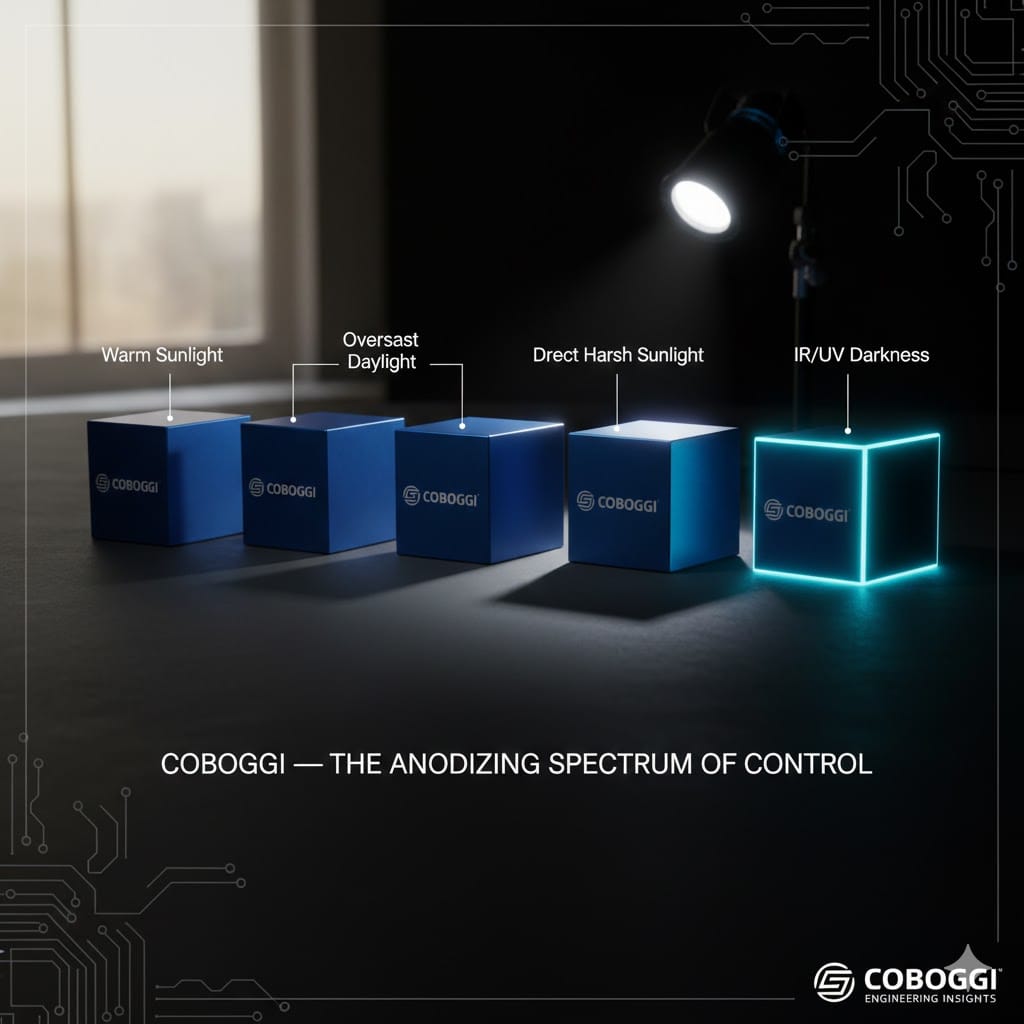
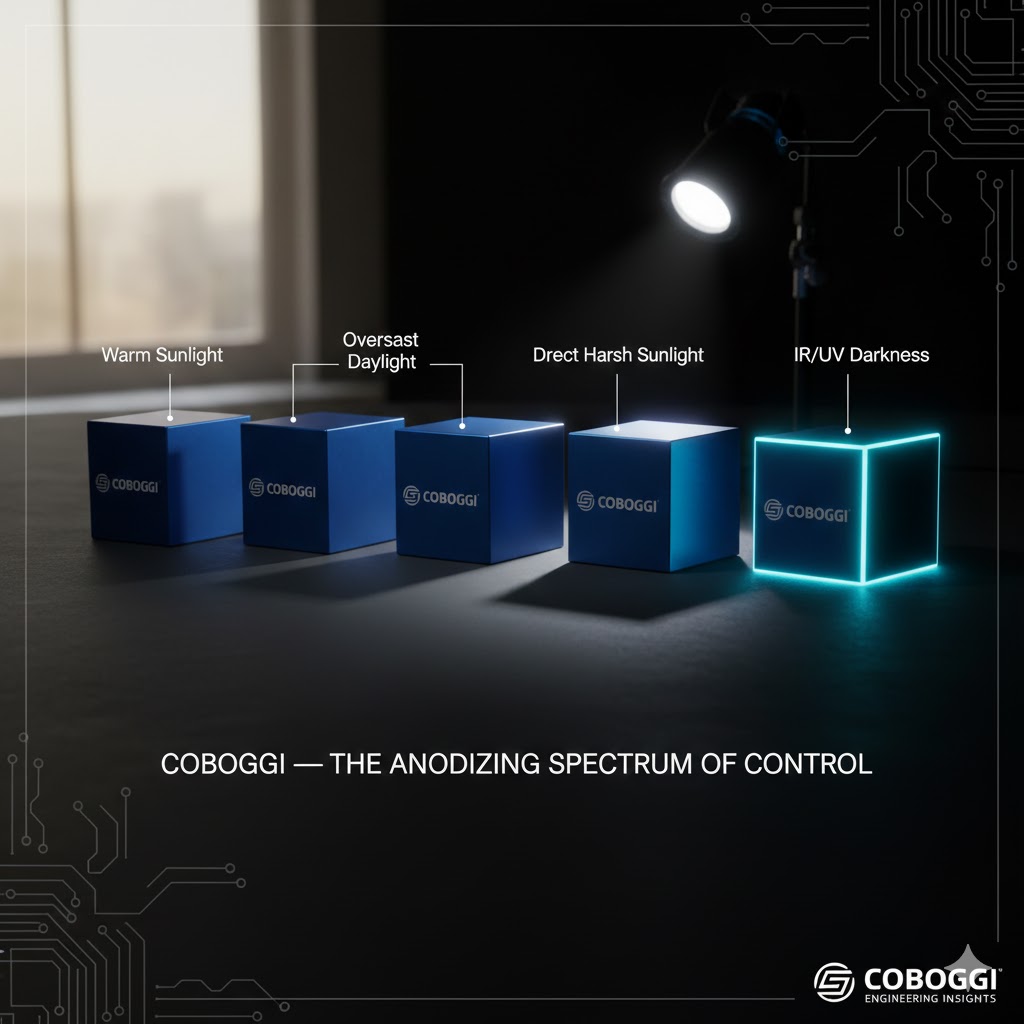
A beautiful “Deep Red” anodizing that turns “Pink” after three months in a sunny window is a brand disaster.
The Tech: We use Organic-Inorganic Hybrid Dyes and long-cycle sealing to “lock” the color molecules deep within the aluminum pores.
The ROI: You avoid the “Fading Crisis” and the resulting social media backlash, ensuring your product looks premium for its entire lifecycle.
Conclusion: Uniformity is Professionalism
In the premium hardware space, consistency is the ultimate proof of control. When your colors match across every unit, every batch, and every country, you signal to your customer that you are a master of your craft.
At Coboggi, we provide the scientific rigor to ensure your brand’s “Visual DNA” remains untarnished.
Specification Comparison
| Specification | Standard Colour-Matched Anodising | Extended-Range Spectral Matching (Coboggi ProMatch™) | Global Batch-Lot Consistency Protocol (Coboggi GlobalSync™) |
|---|---|---|---|
| ΔE00 tolerance (vs master standard, single batch) | ≤ 1.2 | ≤ 0.6 | ≤ 0.4 |
| Inter-batch ΔE00 variation (same colour, 12-month period) | ≤ 2.8 | ≤ 1.5 | ≤ 0.9 |
| Colour measurement frequency per production run | 3 readings | 12 readings | 24 readings + real-time inline spectrophotometry |
| Reference standard calibration interval | Every 72 hours | Every 24 hours | Every 8 hours + NIST-traceable daily verification |
| Acceptable gloss deviation (60°) within lot | ±3.5 GU | ±1.8 GU | ±0.7 GU |
| Maximum allowable hue angle shift (CIELAB h°) across 500 m² surface | ±2.1° | ±1.0° | ±0.4° |
| Batch-to-batch requalification lead time (after process change) | 72 hours | 24 hours | 4 hours |
| Archived spectral data retention period | 2 years | 5 years | 10 years + blockchain-verified timestamping |
Frequently Asked Questions
How tightly do you control color deviation across production batches for global brand programs?
We maintain a maximum ΔE00 deviation of 0.8 between batches under D65 lighting, measured using X-Rite i7 spectrophotometers calibrated daily to NIST-traceable standards.
What is the minimum order quantity (MOQ) required to guarantee certified color consistency for international rollouts?
The MOQ for Coboggi’s ColorLock™ Certification Program is 1,200 linear meters per shade—ensuring full spectral validation and batch-matching documentation per ISO 12048:2022.
Do you provide physical color standards—and how long are they valid before recalibration?
Yes—we issue aluminum substrate-based AAMA 2604-compliant color plaques with a shelf life of 18 months; all plaques are revalidated every 6 months against master references held in our climate-controlled vault (23°C ±0.5°C, 50% RH ±3%).
What Delta E tolerance do you guarantee against the approved digital standard (e.g., Pantone or sRGB) at time of shipment?
We guarantee ΔE00 ≤ 1.2 against the client-approved digital reference when measured on finished anodized or powder-coated panels per ASTM D2244-22, with 100% inline spectrophotometric verification on every coil.
How many color measurement points per square meter do you sample during final inspection for architectural façade orders?
We perform 9 non-overlapping spectral measurements per m² on all architectural façade orders ≥5,000 m², with automated reporting tied to Lot ID and timestamped within our ERP system (SAP S/4HANA v2302).
Is color consistency validated under multiple light sources—and which illuminants are included in your certification report?
Yes—every certified batch includes spectral data under CIE D65, A (incandescent), F2 (cool white fluorescent), and F11 (TL84), with metamerism index (MI) ≤ 1.4 across all four illuminants per CIE 204:2013.