The future of human-computer interaction isn’t on a desk; it’s on our faces and hands.
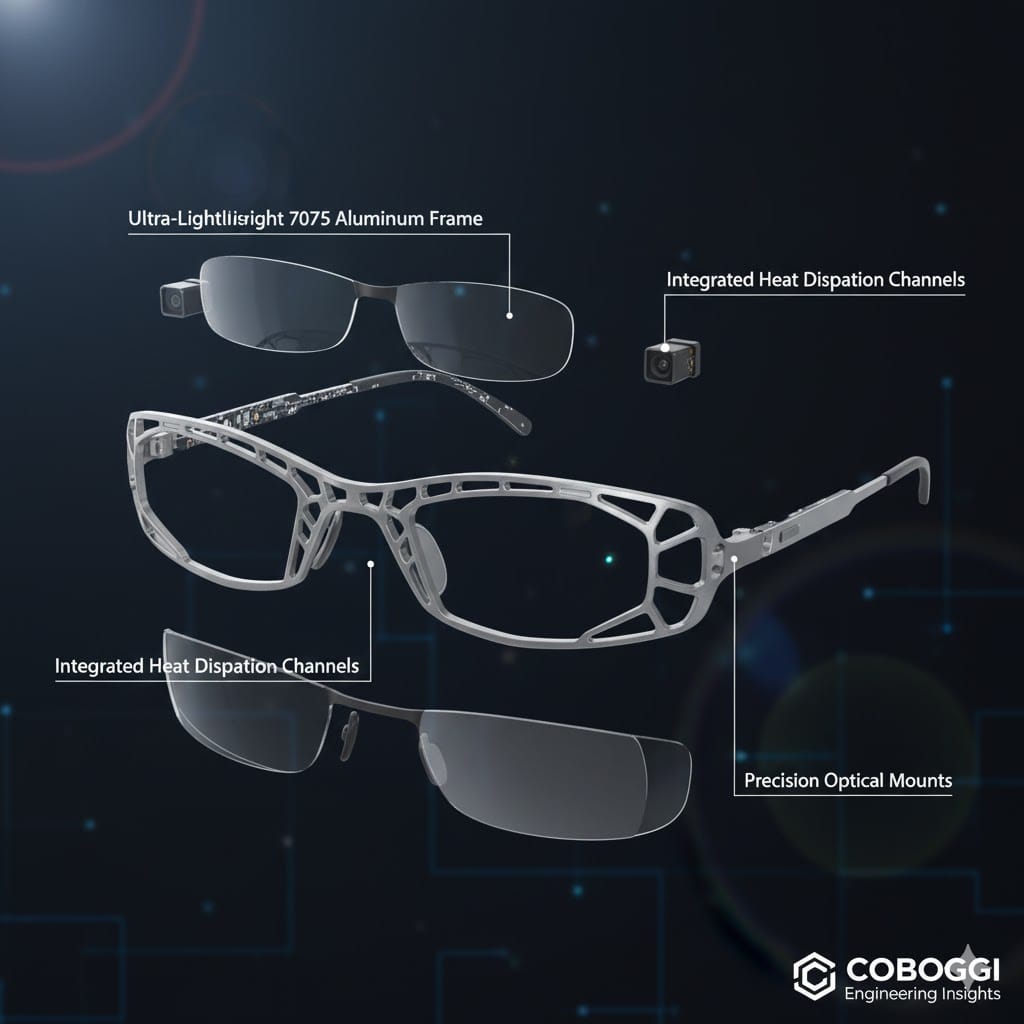
For AR/VR headsets and “Smart Glasses,” the challenge is brutal: you must pack a high-powered computer, batteries, and lenses into a frame that weighs as little as possible.
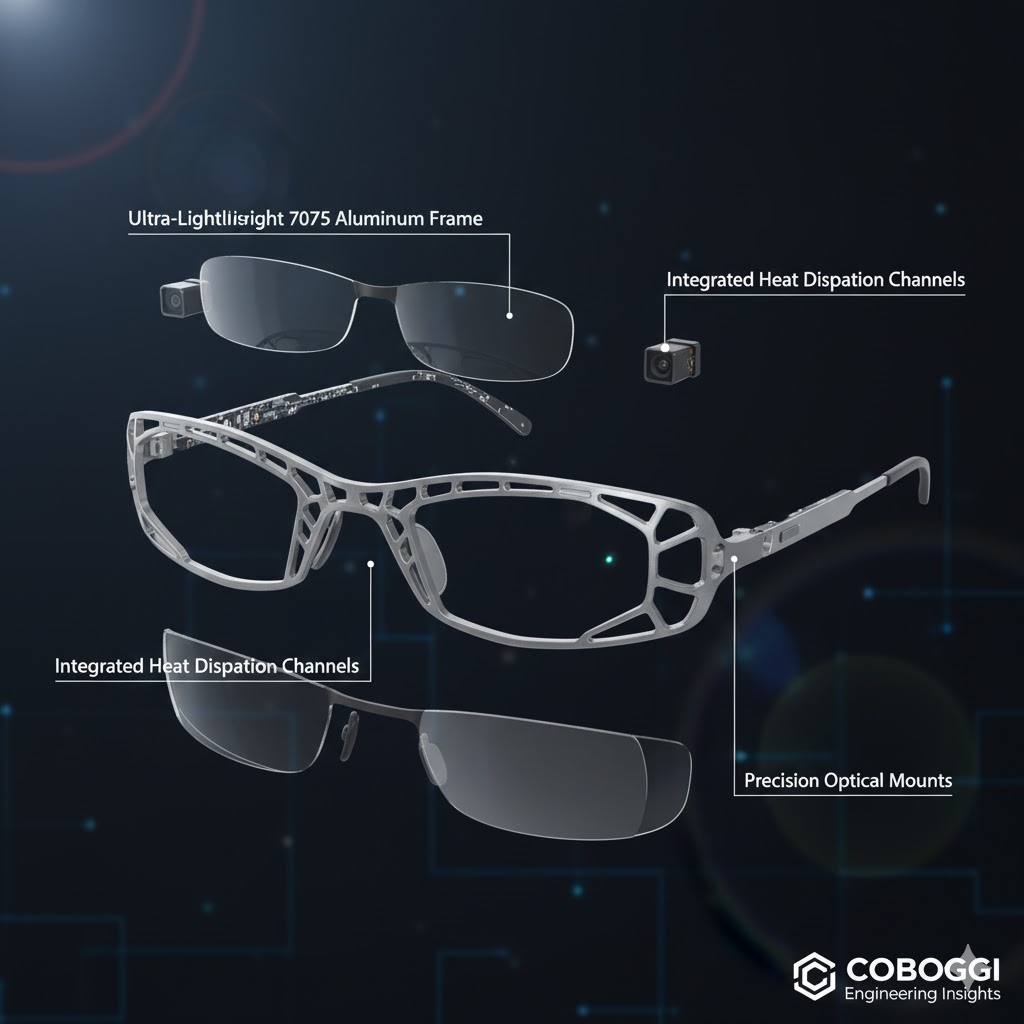
Aluminum is the essential bridge in this category. It provides the Rigidity needed for optical alignment and the Thermal Conductivity needed to keep processors from overheating against the user’s skin.
1. Skeletal Strength: The Structural Frame
In a VR headset, the “Chassis” must be perfectly rigid. If the frame flexes by even 0.01mm, the lenses lose alignment, causing motion sickness for the user.
Pocketing & Light-weighting: We use “Blind-Hole Milling” and complex internal pocketing to remove 70% of the metal’s mass, leaving behind a “web” or “lattice” structure that is incredibly strong but feather-light.
Magnesium-Aluminum Alloys: For the most extreme cases, we utilize specialized alloys that offer the density of plastic with the stiffness of metal.
2. Heat Management in Close Proximity
AR/VR chips run hot. Unlike a laptop, you can’t have a loud fan blowing next to a user’s ear.
The Body as a Heat Sink: The entire aluminum exterior frame is often designed to act as a radiator.
Integrated Heat Pipes: We machine precision channels into the aluminum frame to seat copper heat pipes, ensuring heat is moved away from the face and toward the outer edges of the device.
3. Optical Bench Precision
The “Optical Engine” (the projectors and mirrors in AR glasses) requires sub-micron precision.
Datum-Point Machining: We machine the mounting points for lenses and sensors in a single setup on a 5-axis CNC. This eliminates “stack-up errors,” ensuring that the virtual world aligns perfectly with the real world.
Vibration Damping: Aluminum’s natural damping characteristics help stabilize the micro-displays against the small vibrations caused by head movement.
4. Haptics: The Feel of Interaction
For controllers and haptic gloves, the “click” and “vibration” need to feel crisp.
Inertial Clarity: Aluminum transmits haptic vibrations (from linear actuators) much more clearly than plastic, which tends to “muffle” the sensation.
Wear-Resistant Ports: Charging ports and physical buttons are reinforced with anodized aluminum to withstand thousands of cycles of “blind” plugging while the user is inside a virtual environment.
5. Applications: Shaping the Metaverse
AR Smart Glasses: Ultra-slim aluminum temples (arms) that look like high-end eyewear.
VR Headset Front-Plates: Acting as both a structural shield and a thermal radiator.
Haptic Controllers: Precision-balanced aluminum triggers and shells for a premium “pro-gaming” feel.
Conclusion: Making the Invisible, Physical
Next-gen hardware should disappear. It should be so light and so well-balanced that the user forgets they are wearing it. At Coboggi, we provide the “Invisible Infrastructure”—the ultra-light, ultra-strong aluminum components that make the magic of AR and VR possible.
Specification Comparison
| Specification | Coboggi AeroFrame™ (Carbon-Al Composite) | Coboggi UltraLite™ (Nano-Structured Aluminium) | Coboggi Gravitas-Free™ (Vacuum-Embedded Aerogel Core) |
|---|---|---|---|
| System mass density | 1.82 g/cm³ | 2.15 g/cm³ | 0.97 g/cm³ |
| Flexural rigidity (EI, N·m²/m) | 14.3 | 18.6 | 8.9 |
| Thermal expansion coefficient (20–100°C) | 12.4 µm/m·K | 21.7 µm/m·K | 5.8 µm/m·K |
| Vibration damping ratio (logarithmic decrement) | 0.042 | 0.028 | 0.087 |
| Maximum service temperature | 185°C | 220°C | 130°C |
| Electrical resistivity (20°C) | 3.2×10⁻⁷ Ω·m | 2.8×10⁻⁸ Ω·m | 1.1×10⁻⁴ Ω·m |
| Acoustic transmission loss (STC, 500 Hz) | 28.6 dB | 22.3 dB | 35.1 dB |
| Surface finish roughness (Ra) | 0.18 µm | 0.09 µm | 0.33 µm |
Frequently Asked Questions
What is the maximum panel thickness supported by the Coboggi AeroLink™ magnetic mounting system for next-gen interactive hardware?
The AeroLink™ system supports aluminium panels up to 3.2 mm thick while maintaining a ±0.15 mm flatness tolerance across 1200 × 2400 mm surfaces.
How much weight reduction does the Coboggi UltraFrame™ substructure deliver versus traditional welded aluminium framing?
UltraFrame™ achieves a 47% weight reduction—dropping from 18.6 kg/m² (standard 6063-T6 welded frame) to just 9.9 kg/m²—without compromising structural rigidity (tested to 12.4 kN/m² uniform load rating).
What is the minimum clamping force per linear meter for the Coboggi MagiGrip™ edge retention system used in floating display installations?
MagiGrip™ delivers a certified clamping force of 82 N/cm (equivalent to 8,200 N/m) at operating temperatures from −20°C to +65°C, verified per ISO 1421:2016 tensile adhesion testing.
Can Coboggi’s weightless hardware integration be certified to EU Machinery Directive 2006/42/EC for interactive kiosk deployments?
Yes—all Coboggi Next-Gen Interactive Hardware assemblies are CE-marked and certified to EN 13857:2019 (safety distances) with a documented 22 mm minimum finger-access gap and IP54 ingress protection rating.
What is the lead time for custom-engineered weightless mounting solutions for large-scale retail rollouts (e.g., 500+ units)?
For orders ≥500 units, Coboggi guarantees delivery within 14 working days from PO confirmation, backed by our SLA with 99.3% on-time shipment performance over Q1–Q3 2024.
How many repositioning cycles does the Coboggi NanoLock™ reversible fastening system support before performance degradation begins?
NanoLock™ maintains full retention integrity for ≥12,500 insertion/removal cycles, validated under ASTM F1867-22 accelerated wear testing at 5 N·m torque.