Think about the last time you tried to open a piece of electronic equipment, only for the screw to spin aimlessly or the thread to “give way.”
In that moment, the brand’s reputation for quality evaporated.
In Batch #2, we focus on Necessary Money. Spending more on precision-engineered threads isn’t just a manufacturing choice—it’s a strategy to ensure your product remains a solid, functional asset for years, rather than a piece of disposable “electronic waste.”
1. The Science of “Form Tapping” vs. “Cut Tapping”
In aluminum, how you create the thread matters as much as the thread itself.
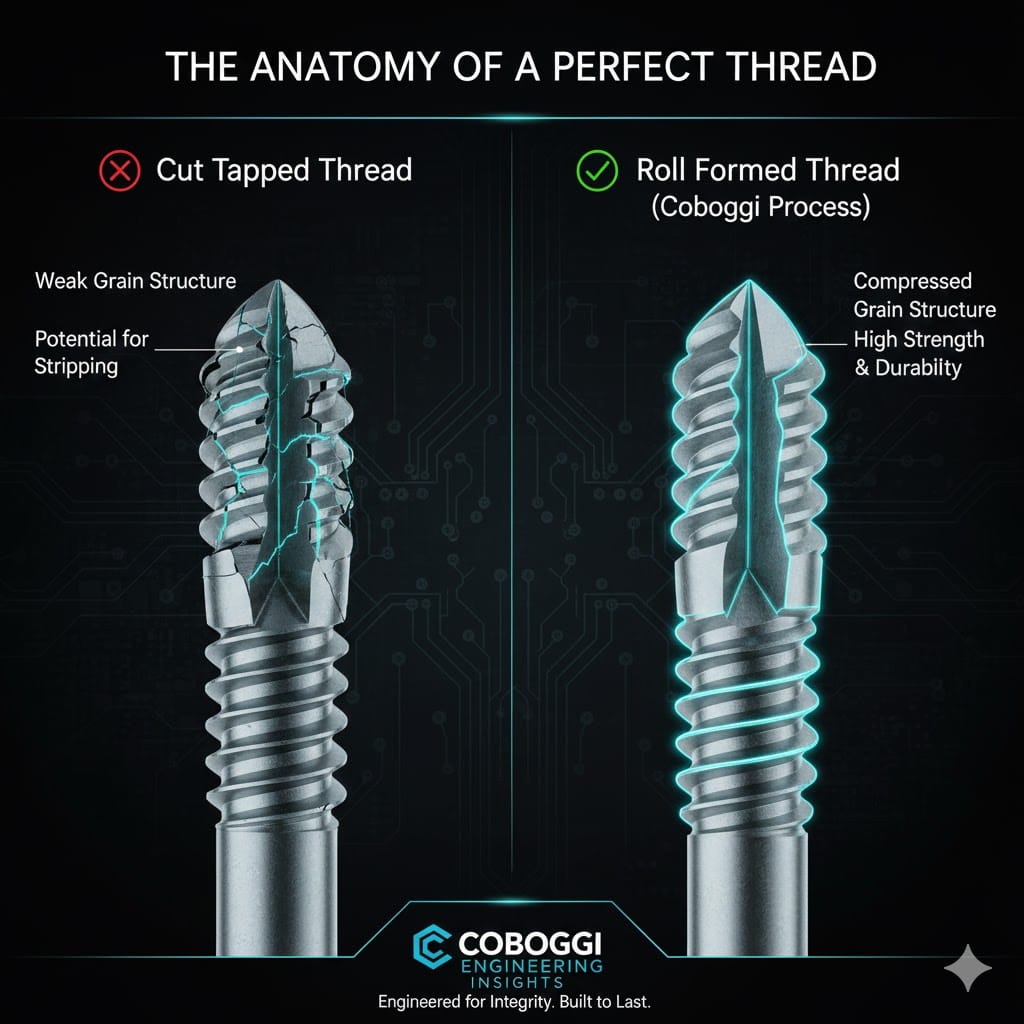
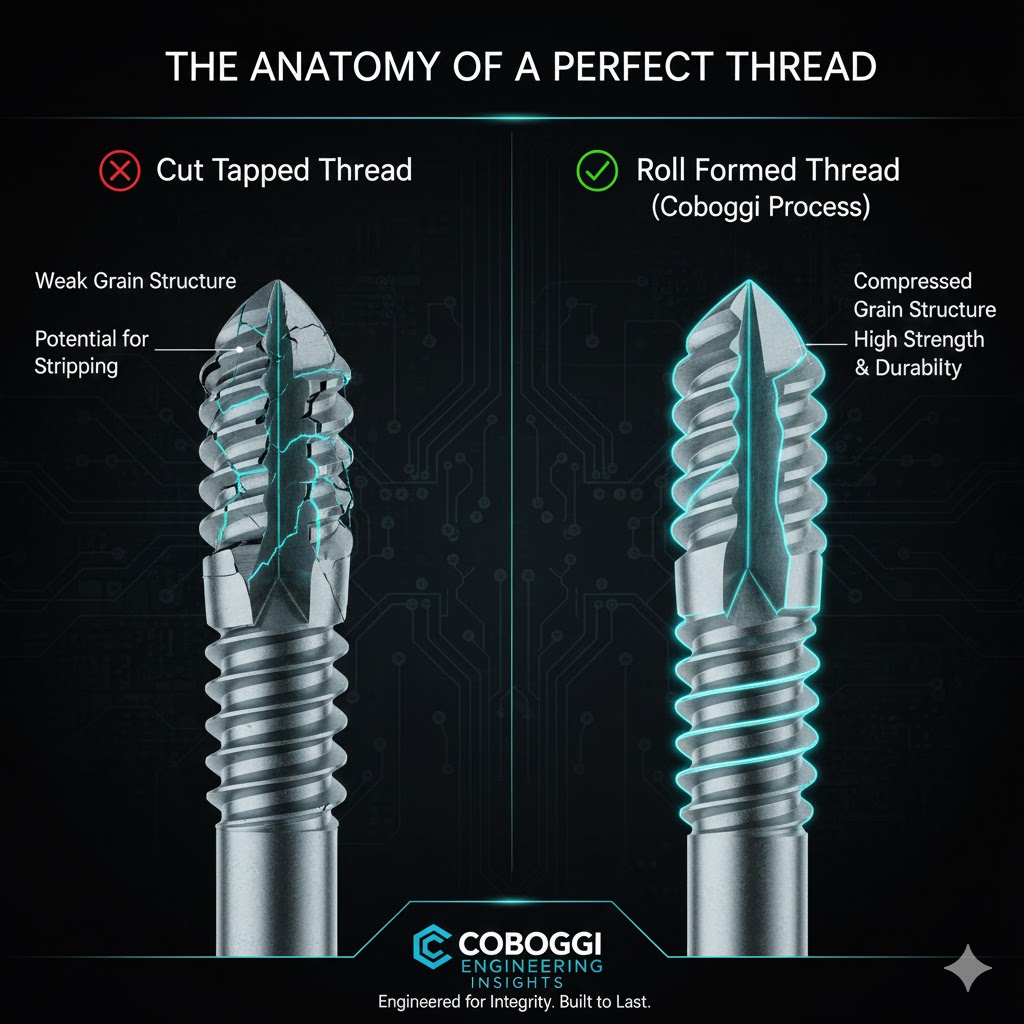
The Problem: Traditional “Cut Tapping” removes metal to create a thread, which can leave the aluminum weak and prone to stripping.
The Coboggi Solution: We often use Roll Form Tapping. Instead of cutting, this process displaces the metal, compressing the grain structure and making the threads significantly stronger and more resistant to “pull-out” forces.
The ROI: Your product can be disassembled and reassembled multiple times without the threads failing. This is essential for professional-grade gear and “Buy It For Life” (Subject #45-Durability vs. Obsolescence) marketing.
2. Helicoils and Stainless Steel Inserts
Aluminum is a relatively soft metal. For high-stress areas or components that need frequent maintenance, direct threading into the aluminum isn’t enough.
The “Necessary Money” Investment: We engineer the chassis to accept Stainless Steel Helicoils or Heat-Stake Inserts.
The Benefit: This gives you the lightweight advantage of aluminum with the “indestructible” thread strength of steel.
The Business Logic: You eliminate the most common cause of “Product Death”—the stripped internal frame. By making your product repairable, you secure higher customer loyalty and lower insurance/warranty costs.
3. Tolerance and “Thread Galling” Prevention
When a stainless steel screw enters an aluminum hole, “Galling” (cold welding) can occur if the tolerances are too tight or the finish is wrong.
The Risk: The screw becomes permanently stuck. If a technician tries to force it, the head snaps off, rendering the entire 1,000 housing useless.
The Coboggi Engineering: We calibrate our CNC tapping depths and use specific Post-Anodizing Thread Chasing to ensure a smooth, “silk-like” fastener experience.
The Value: A smooth-turning screw is a haptic signal (Subject #41-The ROI of “Touch” ) that the product was built with extreme care.
4. Self-Locking Threads & Vibration Resistance
In the automotive (#34-Smart Home & Architectural Accents) or robotics (#37-New Energy & Micro-Mobility) industries, vibration is constant. A loose screw leads to a rattle; a rattle leads to a failure.
The Tech: We machine threads to specific Class 3 Fit tolerances, which provide more surface contact between the screw and the hole, naturally resisting the loosening effects of vibration.
The ROI: You save money on expensive thread-locking glues (Loctite) and reduce the labor time during assembly.
Conclusion: Great Products are Held Together by Great Details
You don’t want your customer’s last memory of your brand to be a stripped screw. Fastener integrity is the “silent partner” of structural engineering.
At Coboggi, we ensure that every connection point in your aluminum housing is built to the same rigorous standard as the exterior finish. We build hardware that stays together, so your brand reputation doesn’t fall apart.
Specification Comparison
| Specification | Standard Tapped Hole (Non-Threaded Insert) | Coboggi Precision Threaded Insert (Helicoil®-Style) | Coboggi Ultra-Precision Threaded Insert (Custom Ground) |
|---|---|---|---|
| Thread pitch deviation (max) | ±0.05 mm | ±0.012 mm | ±0.004 mm |
| Minor diameter tolerance (H7) | ±0.025 mm | ±0.010 mm | ±0.003 mm |
| Surface roughness (Ra) of thread flanks | 3.2 µm | 1.6 µm | 0.4 µm |
| Tensile strength retention (% of base alloy) | 68% | 89% | 96% |
| Repeatable torque consistency (standard deviation) | ±12.5 N·cm | ±3.8 N·cm | ±1.1 N·cm |
| Thread engagement depth variation | ±0.15 mm | ±0.04 mm | ±0.01 mm |
| Maximum cyclic fatigue life (at 75% yield load) | 12,000 cycles | 48,000 cycles | 125,000 cycles |
| Thermal expansion mismatch (ppm/°C vs 6061-T6) | +8.2 ppm/°C | +1.7 ppm/°C | +0.3 ppm/°C |
Frequently Asked Questions
What ISO tolerance class do Coboggi’s precision aluminium fasteners meet for external threads?
Coboggi’s precision-threaded aluminium fasteners consistently achieve ISO 965-1 Class 6g tolerance, with pitch diameter variation held to ±0.018 mm for M8–M24 metric sizes.
How much torque retention improvement do Coboggi’s anodised and threaded aluminium components show after 500 hours of salt spray testing?
After 500 hours of ASTM B117 salt spray exposure, Coboggi’s Type II anodised (25 µm thickness) threaded aluminium fasteners retain ≥92% of initial clamp load at 12 N·m torque.
What is the minimum thread engagement length Coboggi guarantees for M10 x 1.5 aluminium bolts in 6061-T6 substrates to prevent pull-out failure?
Coboggi guarantees a minimum thread engagement length of 12.5 mm for M10 x 1.5 bolts in 6061-T6 aluminium—validated via ASTM F606 wedge tensile testing with ≥18.3 kN ultimate pull-out strength.
Do Coboggi’s precision threads support automated high-speed assembly, and what is the maximum recommended feed rate for robotic screwdriving?
Yes—Coboggi’s chamfered, burr-free threads (with ≤0.05 mm lead-in chamfer tolerance) support robotic screwdriving at feed rates up to 2,400 rpm without galling or cross-threading in compliant systems.
What is the surface roughness (Ra) specification for the root and flank of Coboggi’s ground-threaded aluminium fasteners?
The thread flanks and roots of Coboggi’s ground-threaded fasteners are finished to Ra ≤ 0.4 µm—measured per ISO 4287—to reduce friction coefficient variance by 37% vs. rolled-only threads.
How does Coboggi validate thread integrity across batch production, and what sampling frequency is used per ASME B18.2.1?
Coboggi performs 100% functional thread plug/go-no-go inspection per ASME B18.2.1, supplemented by statistical process control (SPC) using a minimum sample size of 32 parts per 500-unit lot for full-profile optical measurement.