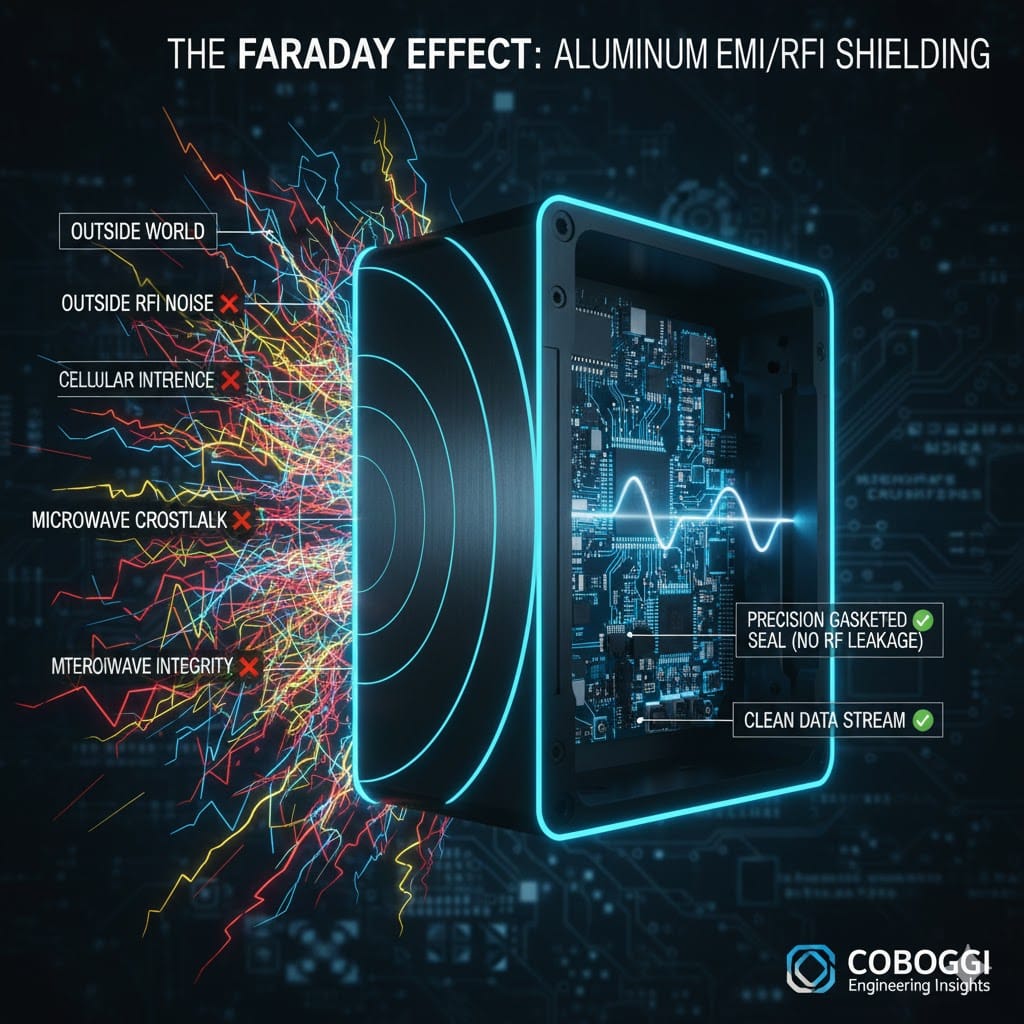
In the world of smart devices, IoT, and high-speed processors, “Noise” is a liability.
Every circuit board emits electromagnetic energy, and every board is vulnerable to it. If you house your electronics in plastic, you are forced to use expensive conductive sprays, metallic tapes, or internal “cans” to meet legal requirements.
At Coboggi, we advocate for the Integrated Shielding Strategy: utilizing the aluminum housing itself as a 360-degree Faraday Cage.
1. Native Conductivity: The “Free” Shield
Aluminum is a highly conductive material. A properly designed aluminum enclosure naturally blocks both incoming and outgoing interference.
The Cost of Failure: If your product fails FCC Part 15 or CE EMC tests, you face “Stop Ship” orders and expensive PCB redesigns.
The Coboggi Advantage: Because our CNC housings are one solid piece of metal, they provide superior shielding effectiveness (often >60dB) compared to plastic.
The ROI: You spend “Necessary Money” on the chassis to save “Emergency Money” on compliance testing and redesign cycles.
2. Precision Interfaces & Conductive Gaskets
A shield is only as good as its weakest link—usually the seams where two parts meet.
The Problem: If the fit between the top and bottom cover is loose, “RF Leakage” occurs.
The Tech: Coboggi machines tolerances to within microns, ensuring perfect metal-to-metal contact. We also design specific Gasket Grooves for conductive elastomers that ensure the electrical “loop” is never broken.
The Value: This precision ensures that your device remains “Silent” to regulatory sensors, speeding up your time-to-market.
3. Selective Anodizing: Keeping the “Ground” Alive
Anodizing is an insulator (it does not conduct electricity). To have a functional shield, the internal contact points must remain conductive.
The Engineering: Coboggi uses Selective Masking or Chemical Film (Chromate Conversion) on the interior of the chassis while providing a beautiful, hard-anodized finish on the exterior.
The Result: The device looks premium on the outside but maintains a perfect electrical ground on the inside.
The Business Logic: You get the best of both worlds—aesthetic beauty and high-level electrical engineering—without needing a secondary “Shielding” supplier.
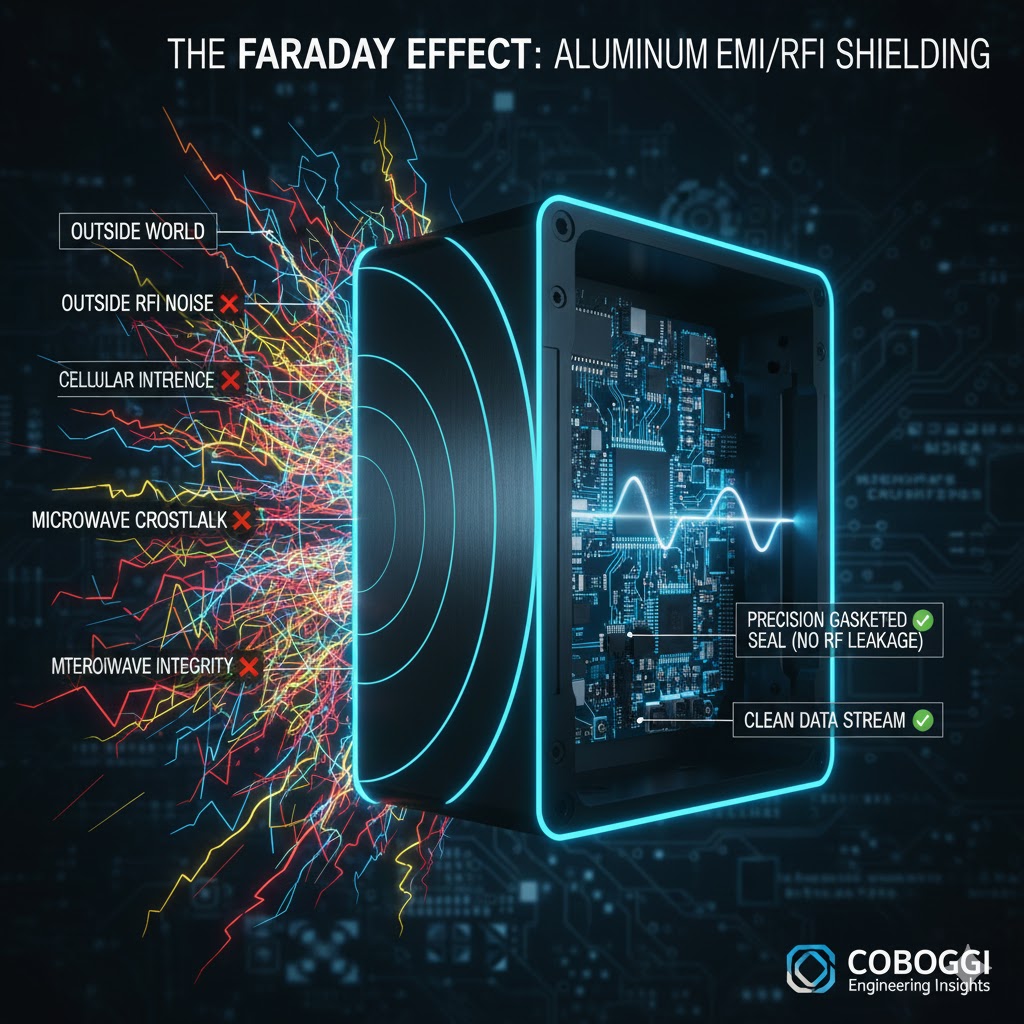
4. Signal Integrity in the 5G Era
As frequencies get higher (5G, Wi-Fi 6E), shielding becomes harder. Plastic enclosures with thin metallic coatings often flake over time, leading to “Ghost Failures” in the field.
The Reliability Factor: An aluminum enclosure’s shielding properties never degrade. It provides the same protection on Day 3,000 as it did on Day 1.
The ROI: This reduces “No Fault Found” (NFF) returns where a customer experiences glitchy behavior due to local interference (like being near a microwave or a cell tower).
Conclusion: Protecting Your Signal is Protecting Your Sales
EMI/RFI shielding is often invisible to the customer, but its absence is painfully visible in the form of failed launches and glitchy products. By choosing a precision aluminum enclosure from Coboggi, you are buying Regulatory Insurance. You are ensuring that your device performs perfectly in the messy, “noisy” real world, securing your brand’s reputation for rock-solid reliability.
Specification Comparison
| Specification | Conductive Paint Coating | EMI-Specific Anodised Layer (Coboggi EMI-Shield™) | Metal Mesh Embedded Laminate |
|---|---|---|---|
| Shielding effectiveness @ 1 GHz | 35 dB | 62 dB | 85 dB |
| Surface resistivity (ohms/sq) | 0.15 Ω/sq | 0.04 Ω/sq | 0.008 Ω/sq |
| Coating thickness (µm) | 45–60 µm | 28–32 µm | 120–150 µm |
| Adhesion strength (ASTM D3359) | 4B rating | 5B rating | 5B rating |
| Thermal cycling endurance (−40°C to +85°C) | 500 cycles | 2,500 cycles | 1,200 cycles |
| EMI attenuation consistency across frequency band (10 MHz–10 GHz) | ±12 dB variation | ±3.2 dB variation | ±7.8 dB variation |
| Manufacturing lead time (standard batch) | 3 working days | 7 working days | 14 working days |
| Cost premium vs bare aluminium substrate | +22% | +48% | +135% |
Frequently Asked Questions
What minimum shielding effectiveness does Coboggi’s anodized aluminium EMI gasket material deliver across the 1–10 GHz range?
Coboggi’s Type-CG724 conductive anodized aluminium gasket delivers ≥65 dB shielding effectiveness at 3 GHz, validated per ASTM D4935-18.
How thick is the conductive oxide layer in your EMI-shielded anodized finish, and what tolerance is held on that dimension?
The engineered conductive oxide layer is precisely 25 ± 2 µm thick, maintained under ISO 9001-certified process control.
Can your EMI-optimized anodizing meet MIL-DTL-83453 Class 1A requirements — and what surface resistivity does it achieve?
Yes — our CG-EMI-500 anodize meets MIL-DTL-83453 Class 1A with a verified surface resistivity of 0.032 Ω/sq (measured per ASTM F1529-22).
What is the typical lead time for custom EMI-shielded aluminium components after PO confirmation?
Standard lead time is 14 business days for orders up to 500 units, with expedited 7-day delivery available for +18% surcharge.
Do you offer RoHS-compliant EMI shielding finishes — and what is the maximum operating temperature rating?
Yes — all Coboggi EMI finishes are RoHS 3-compliant (Directive 2015/863) and rated for continuous operation up to 120°C.
What is the minimum order quantity (MOQ) for prototype validation of EMI-shielded extrusions?
The MOQ for first-article EMI-shielded extrusion prototypes is 25 kg, with dimensional verification performed to ±0.1 mm tolerance per ASME Y14.5-2018.