Every successful hardware startup eventually hits a wall.
In traditional shops, scaling usually results in a “Quality Tax”—as volume goes up, the attention to detail goes down.
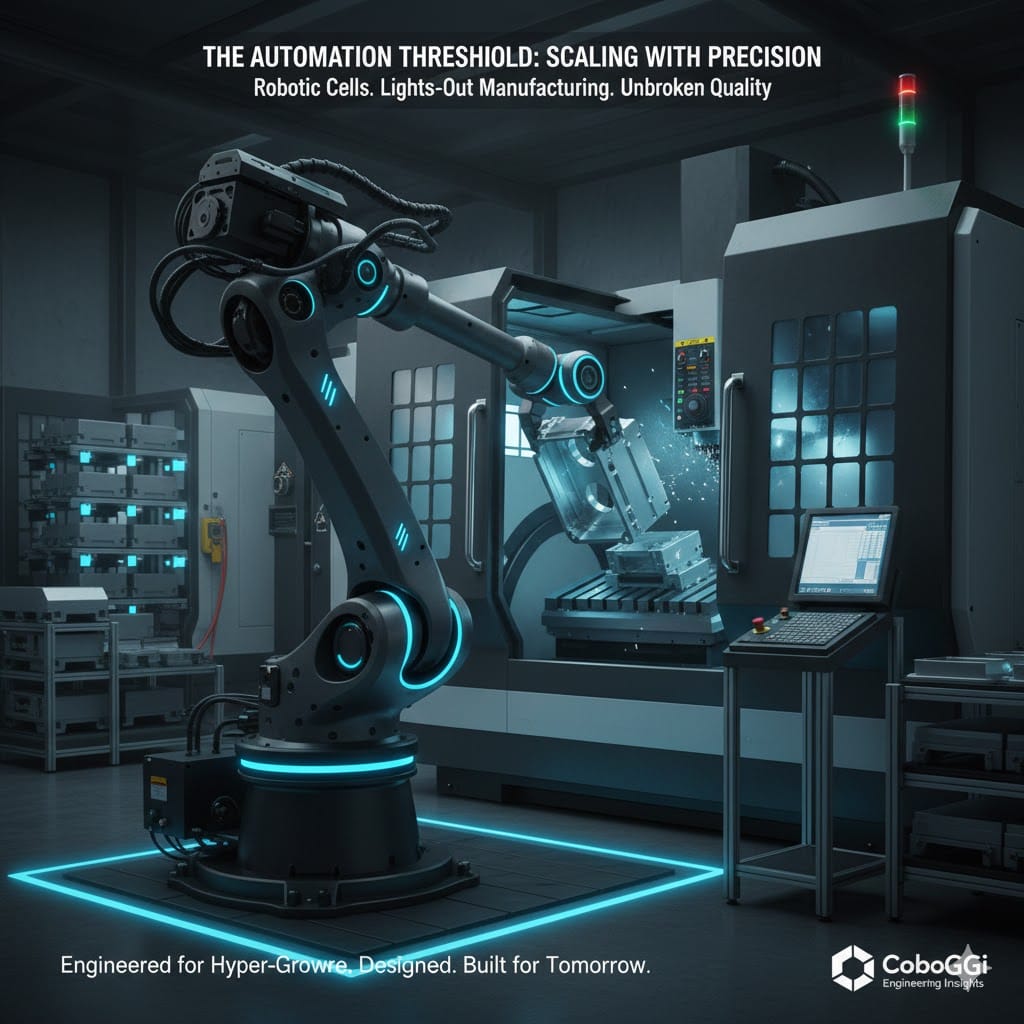
At Coboggi, we bypass this through The Automation Threshold: a data-driven transition to robotic integration that ensures unit #50,000 is identical to unit #1.
1. What is the “Automation Threshold”?
It is the mathematical point where manual labor becomes a liability rather than an asset.
The Manual Era: Great for prototyping, but prone to human fatigue and “shift-change” variance.
The Robotic Era: Coboggi utilizes Robotic Arm Tending for our CNC machines. Robots don’t get tired, and they don’t have “bad days.”
The ROI: By automating the loading and unloading process, we increase “Spindle Up-Time” by up to 40%, allowing us to meet aggressive deadlines without rushing the machining process.
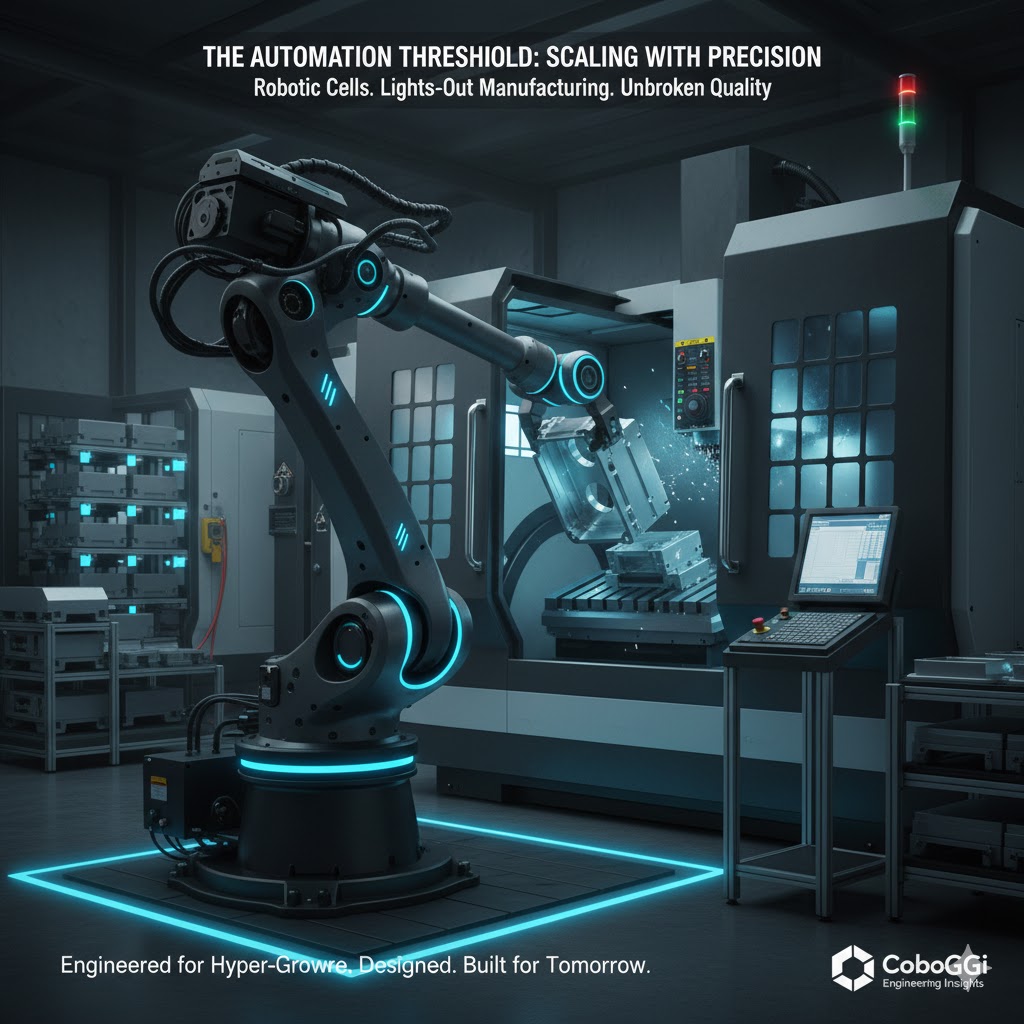
2. Lights-Out Manufacturing: The 24/7 Advantage
“Lights-out” manufacturing refers to production that continues even when the factory lights are off and the staff has gone home.
The Tech: Our advanced CNC cells are equipped with automated pallet changers and tool-breakage sensors. If a tool wears down, the machine detects it, swaps in a fresh tool, and keeps running.
The Business Logic: This maximizes the return on expensive machinery, allowing us to offer more competitive pricing for high-volume orders without cutting corners on material or finish.
3. Maintaining the “Coboggi Standard” at Scale
The biggest fear for a premium brand is that mass production will look “cheap.”
In-Process Probing: Our automated lines use infrared probes to measure parts during the cycle. If a dimension drifts by even 5 microns, the system auto-corrects.
Consistency: Automation ensures that the Haptic Density (#46) and the Diamond-Cut Bevels (#49) remain razor-sharp across every single unit.
The Result: You can scale your marketing and sales globally, knowing that your supply chain is an unbreakable engine of consistency.
4. Reducing the “Cost per Unit” (CPU)
Scaling isn’t just about making more; it’s about making them more efficiently.
Labor Efficiency: Automation reduces the “human touch points” per part, which drastically lowers the cost of production at high volumes.
Quality Control ROI: Because robots are highly repeatable, “Scrap Rates” drop significantly. You stop paying for wasted material and start paying for finished, shippable goods.
Conclusion: Ready for the Big Leagues
Scaling is where many hardware brands fail. They choose partners who can’t bridge the gap between “Craftsmanship” and “Volume.”
At Coboggi, we’ve integrated both. We provide the soul of a master machinist with the power of a robotic workforce.
We don’t just help you grow; we ensure you grow with your reputation intact.
Specification Comparison
| Specification | Manual Batch Processing | Semi-Automated Line (3-Station) | Full In-Line Automation (12-Station) |
|---|---|---|---|
| Parts per hour (PPH) capacity | 8–12 | 45–60 | 180–220 |
| Process time per part (min) | 142–168 | 58–72 | 22–28 |
| Operator-to-machine ratio | 1.0 : 0.8 | 1.0 : 2.4 | 1.0 : 8.6 |
| Coating thickness variation (±µm) | ±4.2 | ±1.8 | ±0.7 |
| Reject rate (% of finished parts) | 3.8% | 1.4% | 0.35% |
| Chemical consumption per m² (litres) | 1.92 | 1.35 | 0.87 |
| Energy use per kg of aluminium (kWh) | 2.41 | 1.76 | 1.23 |
| Time to ramp from order to first shipment (days) | 14.5 | 7.2 | 3.1 |
Frequently Asked Questions
What’s the minimum annual volume where Coboggi’s automated anodising line becomes cost-competitive versus manual processing?
Automation delivers ROI starting at 1.2 million part units per year — below this threshold, our semi-automated hybrid line (with ±0.5 µm thickness control) offers better TCO.
How tight a dimensional tolerance can your robotic racking system maintain across 10,000+ parts per shift?
Our servo-guided racking maintains ±0.15 mm positional repeatability on part hooks, verified via in-line CMM sampling every 200 parts.
Does your automated pretreatment line handle complex extrusions with internal cavities ≥3 mm in diameter?
Yes — our multi-stage spray manifold achieves full coverage in cavities down to 2.8 mm diameter, validated using dye-penetration testing on ISO 9227 salt-spray panels.
What is the maximum part weight our automated anodising hoist system supports without compromising oxide layer uniformity?
Our dual-motor hoist handles up to 42 kg per rack while maintaining ±0.3 µm anodic film thickness variation across the full load (per ASTM B580).
How much floor space does your turnkey automated finishing cell require for throughput of 800 m²/day?
The compact cell occupies just 142 m² — including chemical tanks, rinses, ovens, and robotic transfer — 37% less footprint than legacy linear systems.
What uptime guarantee do you provide for the integrated PLC-controlled automation suite over a 12-month contract period?
We guarantee ≥98.2% scheduled uptime, backed by real-time SCADA monitoring and 4-hour onsite response SLA for critical faults.