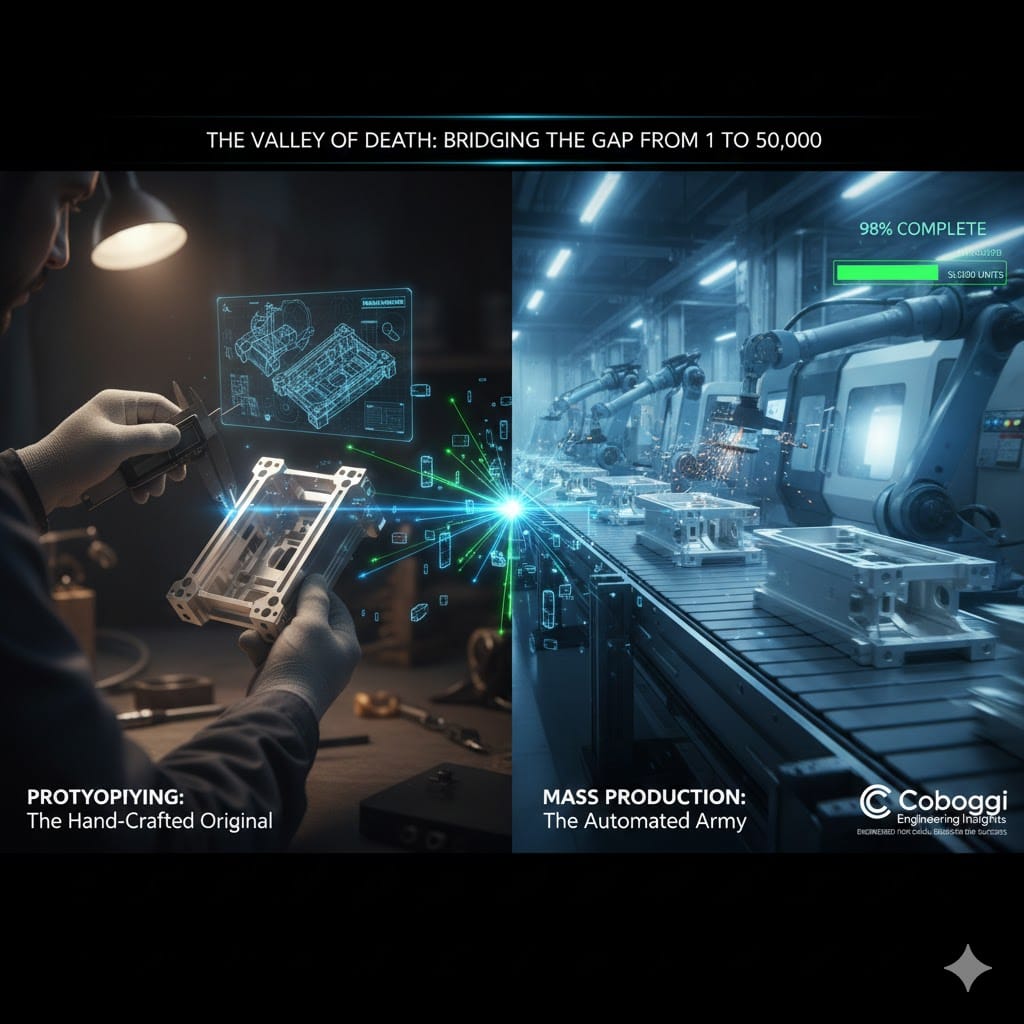
The world is full of “Great Ideas” that never made it to market.
Why? Because a prototype that looks good on a desk is very different from a product that can be manufactured 50,000 times with zero defects.
At Coboggi, we specialize in The Bridge Strategy. We don’t just “take your file and print it”; we engineer a pathway from your vision to global distribution.
1. DFM (Design for Manufacturing): The Reality Check
Prototyping often uses “expensive” workarounds—slow CNC paths or hand-finishing—that are impossible at scale.
The Coboggi Audit: Before we hit “Go” on Batch #3, we perform a DFM audit. Can we change a 90-degree internal corner to a 3mm radius to speed up machining by 30%? Can we simplify the jigging process?
The ROI: Small design tweaks at the prototype stage can save $5.00 per unit in mass production. On 50,000 units, that’s $250,000 in saved profit.
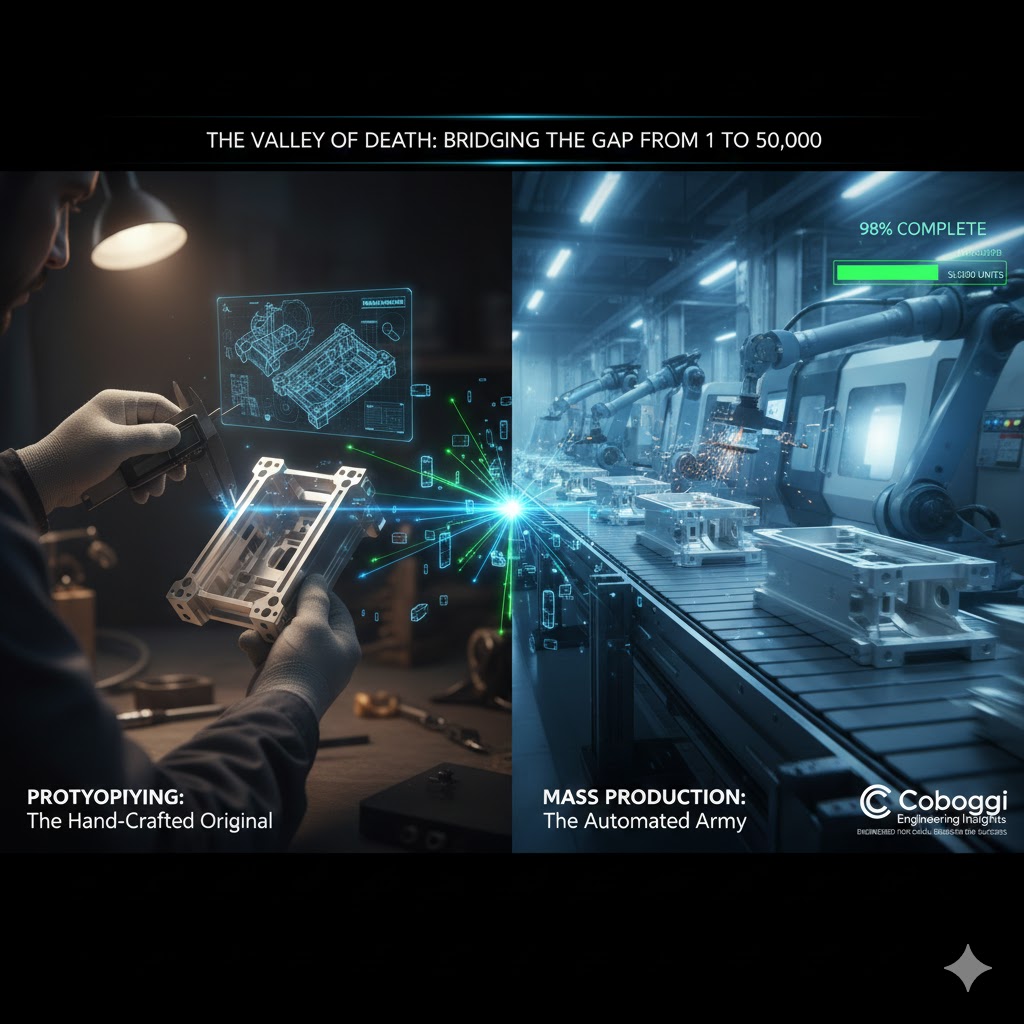
2. The EVT / DVT / PVT Framework
We guide you through the industry-standard “Testing” gates to ensure your product is bulletproof.
EVT (Engineering Validation): Does the aluminum chassis fit the electronics?
DVT (Design Validation): Does the finish survive salt-spray tests and drop tests?
PVT (Production Validation): This is the “Pilot Run.” We run 100-500 units on the actual mass production line to find the “bugs” before the big launch.
3. Tooling Hardening and Fixture Strategy
A prototype uses “soft” temporary fixtures. Mass production requires “hard” automated jigs.
The Bridge: Coboggi develops High-Repeatability Fixtures during the PVT phase. These are designed for our robotic arms to load and unload with sub-micron precision.
Consistency: This transition ensures that the “soul” of your prototype isn’t lost when the machines start running 24/7.
4. Scaling the Supply Chain (The “BOM” Lockdown)
As you move to mass production, your Bill of Materials (BOM) must be locked.
The Strategy: We help you source raw aluminum in bulk early to “lock in” the price and grade. This prevents the “Material Drift” where unit #1,000 uses a different alloy quality than unit #40,000.
The Result: Your margins stay predictable even as your volume explodes.
Conclusion: Stop Guessing, Start Scaling
The “Valley of Death” is littered with hardware companies that tried to skip steps.
At Coboggi, we provide the map and the vehicle to get you across. We make the transition from “One” to “Many” a calculated, repeatable process rather than a gamble.
Specification Comparison
| Specification | Rapid Prototyping Pathway | Integrated Production Pathway |
|---|---|---|
| Lead time from CAD to first functional part | 7–10 days | 14–21 days |
| Minimum viable batch size for production ramp-up | 50 units | 500 units |
| Tooling investment required (upfront) | $0–$2,500 | $18,000–$45,000 |
| Surface finish consistency (Ra deviation across batch) | ±0.35 µm | ±0.08 µm |
| Dimensional tolerance adherence (Cpk at ±0.05 mm) | 1.12 | 1.68 |
| Scrap rate during initial production run (first 1,000 units) | 8.4% | 1.9% |
| Energy consumption per kg finished aluminium | 14.2 kWh | 9.7 kWh |
| Time to full process validation (ISO 9001:2015 compliant) | 22 days | 5 days |
Frequently Asked Questions
What exactly is the “Valley of Death” in the context of aluminum finishing, and how does this article address it?
The “Valley of Death” refers to the critical gap between a successful prototype and a viable mass-production run. In aluminum finishing, this often manifests as cost overruns, quality inconsistencies, and process failures when scaling from hand-finished parts to automated lines. Our article addresses this by detailing a systematic approach that aligns finishing specifications (e.g., anodizing thickness, powder coat adhesion) with production-capable tooling, process controls, and supplier partnerships from the earliest design stages, effectively bridging the gap.
How does the transition from rapid prototyping to mass production affect the choice of aluminum alloy and its finish?
During prototyping, alloys like 6061 or 7075 are common due to machinability and availability, but they may not be optimal for high-volume finishing. For mass production, the article emphasizes selecting alloys (e.g., 6063 for extrusion or 5000 series for forming) that offer consistent surface response to anodizing, painting, or conversion coatings. The finish must also be validated for durability and appearance under high-throughput conditions—such as rack density in anodizing lines or cure oven uniformity—to avoid defects like color variation or poor corrosion resistance at scale.
What are the key process adjustments needed when moving from prototype-level anodizing to high-volume production?
Prototype anodizing often uses manual racking, batch tanks, and extended cycle times for precision. For mass production, the article highlights critical adjustments: implementing automated racking systems to maximize part density, tightening chemical bath maintenance schedules (e.g., aluminum ion concentration), and using rectifiers with precise current density control across large loads. Additionally, sealing processes must be optimized for speed without compromising the anodic layer’s integrity, often requiring real-time monitoring of temperature and pH to prevent “burning” or soft coatings.
Can the same finishing specifications (e.g., color, gloss, or thickness) be maintained from prototype to mass production, and what challenges arise?
Yes, but only with rigorous upfront validation. The article explains that prototype finishes are often achieved with ideal conditions (e.g., single-part runs, manual adjustments). In mass production, maintaining consistency requires statistical process control (SPC) for variables like bath chemistry, line speed, and oven temperature. Common challenges include color drift due to batch-to-batch chemical variance, gloss reduction from faster cure cycles, and thickness non-uniformity from rack shadowing. The solution involves creating a “production equivalent” prototype—run on the actual high-volume line—to lock in parameters before full-scale launch.
What role does supplier collaboration play in closing the Valley of Death for aluminum finishing?
Supplier collaboration is critical. The article stresses that finishers must be involved early in the design-for-manufacturing (DFM) phase to review part geometry, racking points, and mask requirements. For example, a prototype’s sharp internal corners may cause acid entrapment in anodizing, leading to rejects at scale. By partnering with the finisher to simulate high-volume racking and pre-testing chemical compatibility, companies can avoid costly redesigns. The article also recommends co-developing quality benchmarks (e.g., acceptable defect rates) and establishing clear communication channels for rapid issue resolution during ramp-up.
“`json
“`